
Grand Rounds content is drafted and edited with AI assistance. A page names a CTO or specialist reviewer only when that review actually took place. This page explains sourcing, review and corrections, and how we attribute network experience and our relationship with Dinarys.
The publishing standard is to disclose material AI assistance; name an actual reviewer with their scope and version; attribute CTO experience to its source profile; and identify material corrections. This standard does not mean every existing page has CTO or specialist review, or that a cited CTO wrote or checked the surrounding analysis.
Last updated: 29 October 2026.
How this content is produced
Grand Rounds content is drafted and edited with AI assistance. Source checking compares material claims with the relevant originals, retaining the source date, context and unresolved limits. The content draws on the experience of CTOs in our network; a profile citation identifies that experience rather than making the CTO an author of the surrounding analysis. Figures taken from a profile are attributed to that profile, not independently measured here.
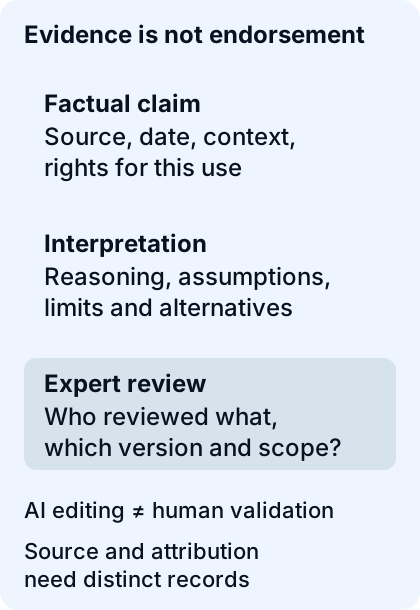
The production workflow calls for an editor who did not write the text to review the complete draft and relevant evidence. That editor may be an AI reviewer rather than a human; named human or specialist review requires its own record. A review counts only when it actually occurs and is bound to the version reviewed. Editorial review and specialist domain review are recorded separately.
Expert attribution and AI use
- Name an author or contributor only for documented, authorized participation.
- State the scope of expert input: a quotation, interview, comments on a passage or review of a particular version.
- Keep AI-generated interpretation distinct from an expert's words and personal experience.
- Label constructed scenarios as illustrative editorial examples.
- Attribute profile facts to the named CTO, project or organization and responsibility, with figures described as the profile states them.
Sourcing rules
| Evidence type | What it supports |
|---|---|
| A CTO profile on this site | The network expert's described contribution in its role and context; figures remain attributed source statements |
| A project-experience entry | The contribution, period where supplied and result described by the named source |
| A session account | Participation and what was reported or discussed within that account's scope |
| Editorial analysis or illustration | Reasoning about a decision, explicitly distinguished from an observed result |
Link material factual claims to identifiable original sources. Keep event dates separate from access dates, program scale separate from personal impact, and citation provenance separate from answer accuracy. Use approved material within its authorized scope; public accessibility alone grants no general reuse permission.
Health, finance, legal and security topics
Use relevant primary authorities for consequential factual claims, including regulators, standards and official documentation. Where evidence is unavailable, narrow or remove the claim. A named clinical, compliance, legal, financial or security review appears only when it occurred, with its actual scope and version. These articles frame technology decisions; case-specific advice and acceptance remain with qualified responsible parties.
Boundaries and commercial relationship
Grand Rounds is an initiative of Dinarys, and a conversation may lead to cooperation with Dinarys.
Weigh our content and curator recommendations with that relationship in mind, and ask about any supplier, implementation or commercial arrangement before commissioning work.
What each page shows
The standard for new pages is to disclose material AI assistance, actual review status, the last-updated date and material corrections. Check each page for what it actually states; this policy does not certify that every existing page meets the standard. Publication requires the applicable editorial and source checks. About Grand Rounds explains the initiative; the session route concerns founder sessions rather than article production.
Updates and corrections
A material change should identify the page and what changed: a factual correction, a revised interpretation or a newly available source. A source-access date describes the check, rather than the underlying project or event.
To raise a concern, contact the curator and name the page, the exact claim and a supporting public source. Keep confidential records out.