
A customer is willing to try a paid AI pilot of your expert service, and your team can build. The open question is who will carry the workflow from a convincing demo to a controlled release, and then hand technical control back to you.
Short answer. Compare candidates using four checks—editorial selection advice, not a validated ranking:
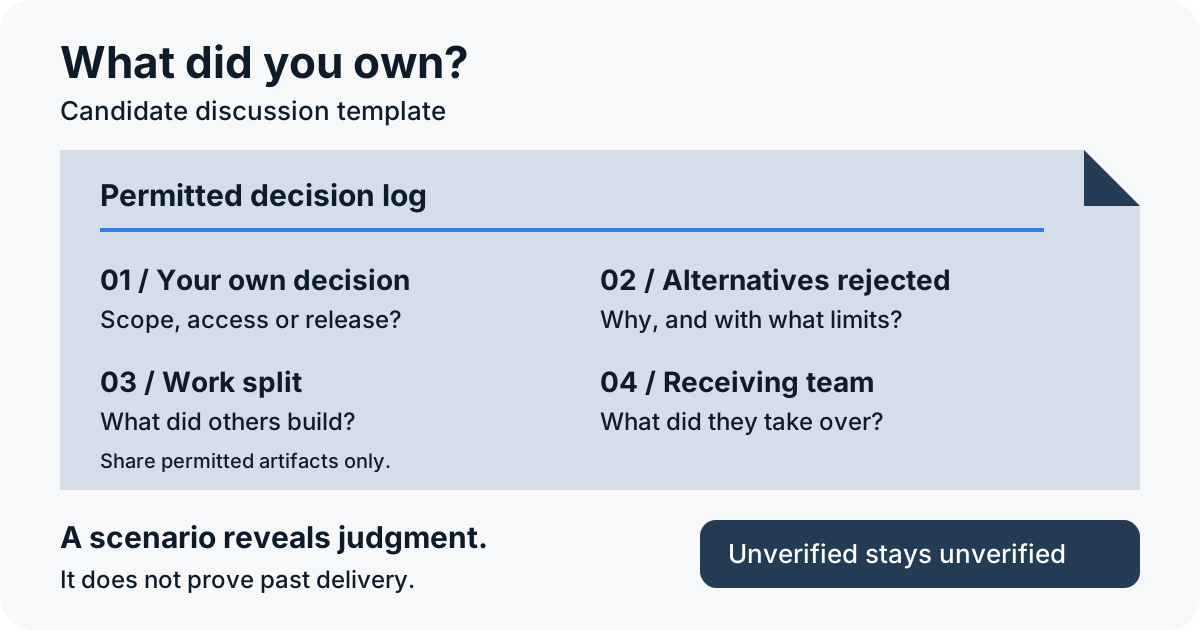
- Personal contribution. A permitted example of a decision they owned on a comparable workflow, the alternative they rejected, and what the receiving team took over. If confidentiality prevents sharing, use a synthetic walkthrough as scenario evidence only; it cannot establish past delivery, so keep that uncertainty explicit while examining the other checks.
- Your pilot, walked through. Your representative job, from authorized sources to expert review, release and a safe stop.
- A scope with owners. One named owner each for product decisions, engineering and domain review. The CTO leads technical decisions and release criteria; your team or a selected supplier builds.
- A handover you can test. Your team runs the pilot independently after handover; continuing is a separate decision.
Technical leadership can make the pilot testable and operable. Whether customers pay is a separate finding you record from their feedback.
Establish which gap you are hiring to fill
Use a specialist for a narrow review, configuration help when a ready product covers the task and an implementation supplier when the design is settled. A CTO mandate fits a cross-team decision spanning source rights, evaluation, technical release and ongoing ownership.
Verify personal contribution, not proximity to an AI project
Ask for a permitted decision record or reference from a comparable workflow. Identify the candidate’s personal contribution, alternatives, receiving team and remaining uncertainty. Keep technical execution, customer demand and current availability as separate evidence questions.
| Question | Evidence worth examining | Confirm separately |
|---|---|---|
| What did you personally decide? | A specific component, scope, access, or release decision; alternatives considered and consequences | That every achievement of the former employer was the candidate's contribution |
| What did you build, and what did others build? | Clear separation of design, coding, engineering management, and domain review | That the adviser will supply those other roles in your pilot |
| How did you judge outputs? | Representative tasks, expert acceptance, evidence trace, rejection/escalation behavior | That a benchmark from another domain is your acceptance standard |
| What failed in real use? | An explainable failure, corrective action, and remaining limitation | That your sources, rights, or tenant boundaries are already solved |
| What did the receiving team take over? | Configuration/code ownership, runbook, support route, known gaps, and a handover exercise | That the person has ongoing capacity or is currently available |
Two further warnings: a promise that customers will pay, and a request for production credentials before scope is agreed.
Relevant CTO experience and the next evidence question
For example, Carlos Blanco's profile describes an AI-powered interviewer built with voice, analytics and payments. Ask what he personally decided on the payments path, what others built and what the receiving team took over. This is a profile-sourced lead for further questions, not proof of your workflow's fit. Participation and availability require confirmation through the curator.
Walk through your pilot before agreeing to it
Give the candidate one representative job and ask them to walk it from authorized source to release. At each boundary, ask for their decision, the responsible owner and an artifact you could inspect:
| Boundary | A more specific answer | An answer that leaves evidence missing |
|---|---|---|
| Sources | Names the rights owner and excludes disputed material | “We will ingest what you have” |
| Review | Names the domain reviewer, rejection and escalation routes | “Accuracy gets tuned later” |
| Release | Shows a stop route and who can authorize it | No stop or recovery owner |
| Cost | Counts failed attempts and human review | Model usage only |
| Handover | Your team runs an agreed task independently | An adviser-operated demonstration only |
These are discussion prompts, not a validated scale. For counting full cost per accepted output, see Productizing Expertise With AI.
An invented example: counting the cost of an accepted output
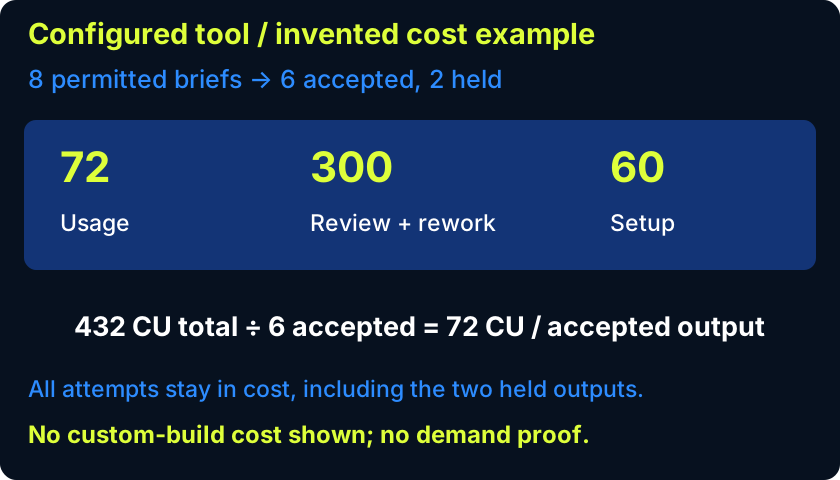
Invented example: a consultancy wants one expert-reviewed proposal outline for one engagement type. The source collection’s reuse rights need an authorized decision. Exclude the disputed collection pending that decision and have the practice reviewer assess the cleared corpus. The customer’s preference for reviewed output sets the offer; compare all preparation and rework across the eight attempted outputs.
In fictional cost units (CU), a configured tool produces 6 accepted outputs from 8 permitted briefs. All attempts, review/rework and setup total 432 CU, or 72 CU per accepted output. The two held outputs remain in cost. This is neither a quote nor custom-build cost or demand evidence.
Agree the scope across product decisions, engineering, and domain review
The scope of a first pilot follows five things: workflow count, settled source rights, domain-review capacity, implementation capacity and the person receiving control at handover. Price, timing and team shape depend on those factors and are agreed with whoever you appoint; this page cannot quote them.
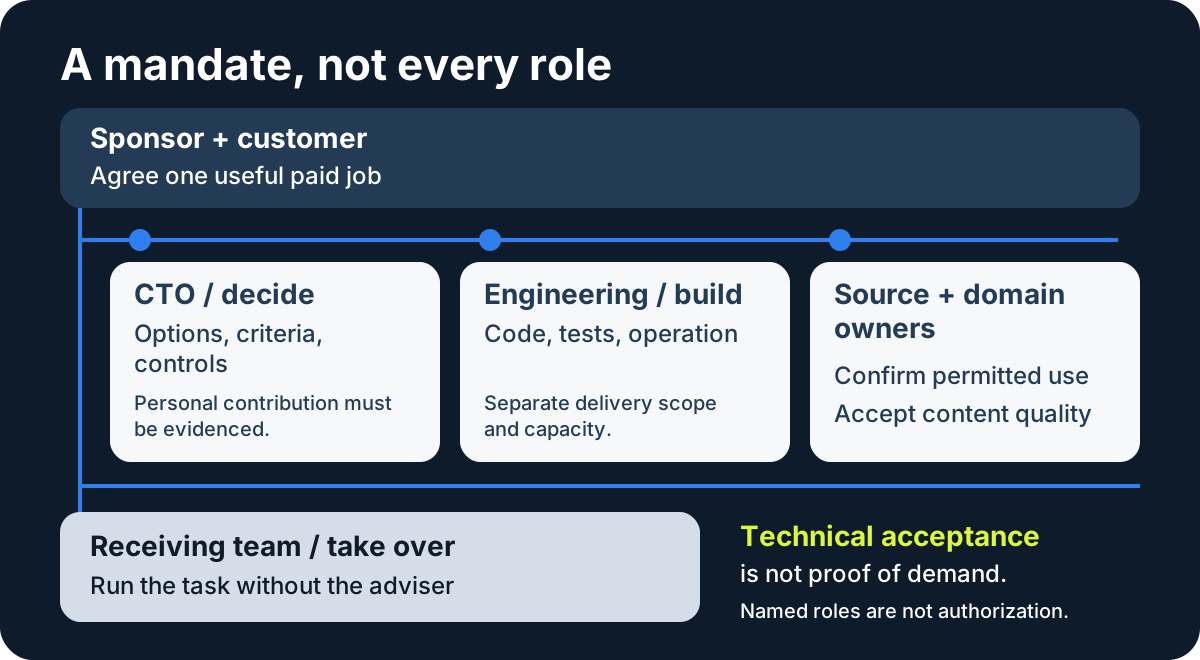
Replace proposed role labels with accepting people. The founder owns the customer job, the CTO the agreed technical decisions, engineering the build, the source owner permitted use and the domain reviewer content acceptance. Name the recipient for handover.
| Workstream | Accountable decision or acceptance | Execution and evidence | Boundary to make explicit |
|---|---|---|---|
| Customer job and offer | Founder/commercial owner agrees the outcome, buyer, and value test | Product/practice lead records customer feedback and purchase objections | CTO does not guarantee sales or substitute for the customer's purchase decision |
| Product and technical decisions | CTO leads build/buy choice, workflow boundaries, evaluation design, and technical release criteria | Decision record, same-job component comparison, data flow, and risk/dependency log | Scope is one pilot workflow, not a universal AI platform |
| Engineering | Client engineering lead or selected supplier accepts implementation responsibility | Code/configuration, access controls, tests, deployment and rollback instructions | Team capacity, contract, support, and change scope are agreed separately |
| Knowledge and domain review | Authorized source owner confirms permitted use; domain reviewer accepts content quality | Corpus/version register, reference tasks, source checks, rejection and escalation records | Technical leadership does not create data rights or replace specialist judgment |
| Pilot acceptance | Sponsor and relevant reviewers accept their stated parts | Results on agreed tasks, cost record, limitations, and customer-use feedback | Technical acceptance and willingness to pay are distinct findings |
| Handover | Receiving technical and process owners accept control | Runbook, access/ownership inventory, open issues, and receiving-team walkthrough | The team can run the task without the adviser; continuing with the adviser is a separate decision |
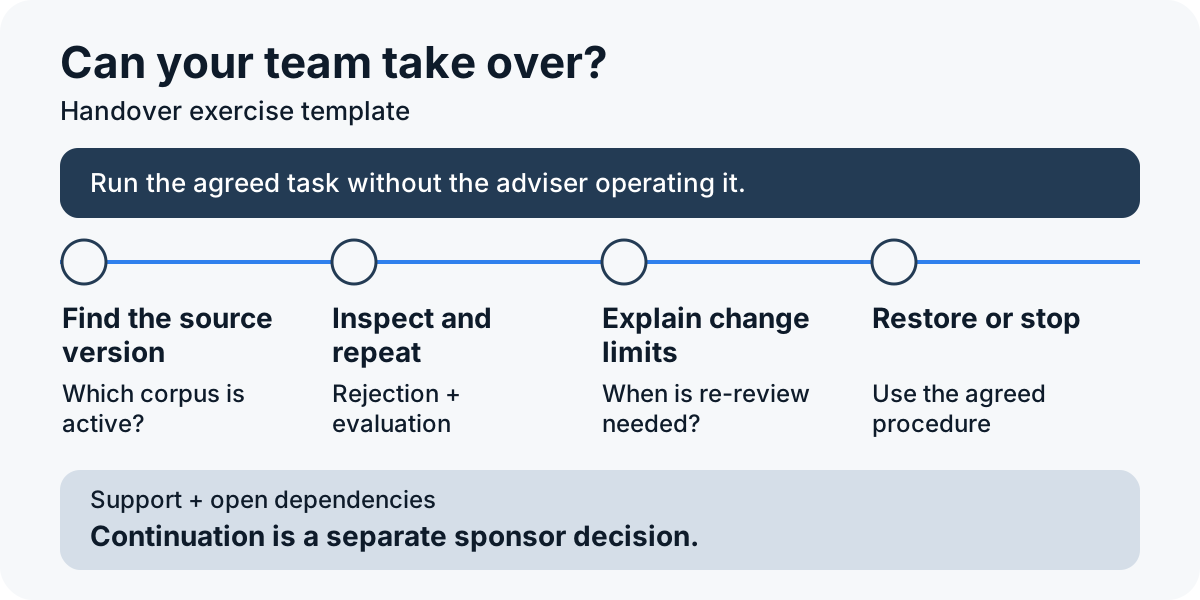
Make handover an acceptance exercise
Have the receiving team operate an agreed task independently: locate source versions, inspect a rejection, repeat evaluation, use the stop/recovery route and explain re-review triggers. Transfer the decision log, configuration, instructions, open issues and permitted access.
Agree a pilot without a sales promise
Take the scope table into the first discussion: contribution evidence, your representative task and a named owner for each part. Bring a nonconfidential outline to the Grand Rounds curator, who listens and can identify relevant CTO experience. Agree the pilot acceptance record. If delivery routes remain unclear, start with Productizing Expertise With AI; for operational failures, see your AI demo works but the paid pilot does not.
Boundaries
Technical leadership does not create data rights, replace a domain reviewer or promise demand. For legal, clinical or financial content, a qualified specialist owns the acceptance decision.
Grand Rounds is an initiative of Dinarys, and a conversation may lead to cooperation with Dinarys.