
Bring in a CTO when the decision blocking your scientific-product milestone crosses the boundaries your current owners can cover: for example, preserving scientific assumptions while changing the software handoff. If your scientist, software lead or a narrow specialist can already settle it, use them. Otherwise define a bounded contribution and name the person who takes over the result. Scientific validity still belongs to the qualified scientific owner.
The Grand Rounds curator takes you from the first conversation to setting up how you work with a CTO, and supports you afterwards. Availability, scope and terms require their own agreement. Bring the milestone and the receiving person's actual task.
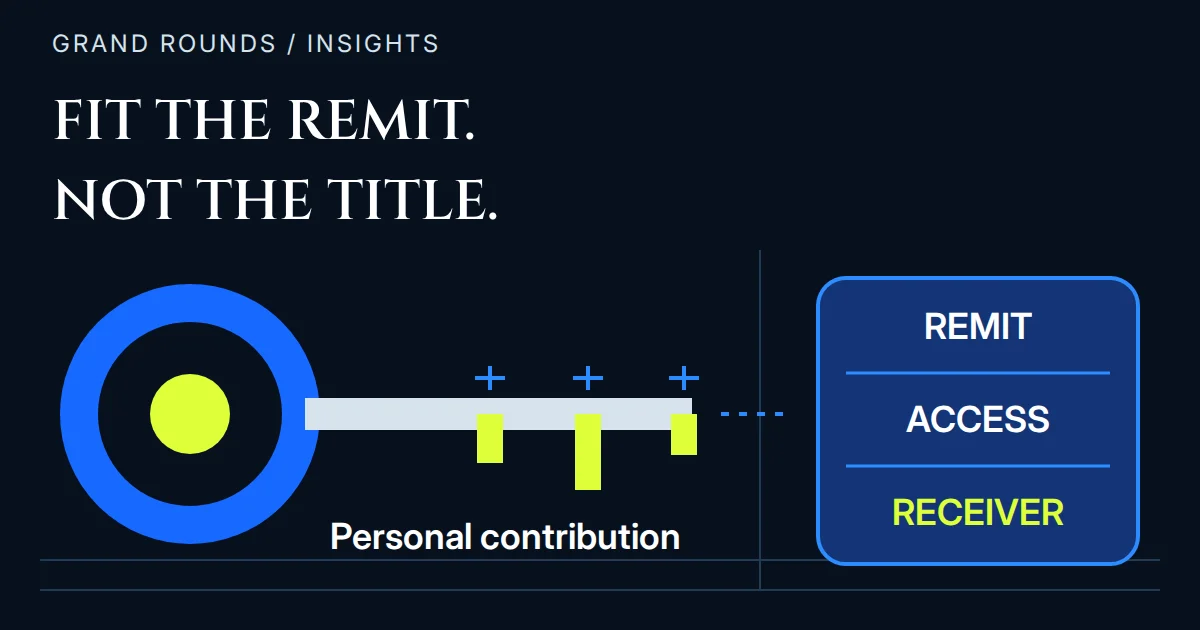
Select for the unknown, not the entire future product
Limit the scope to the next scientific, execution or buyer decision. State what the existing scientist, software lead and vendor already cover and who can accept the remaining contribution. If you cannot yet name the unknown, start with why a scientific prototype cannot be reproduced by the next person or which uncertainty comes first.
| Leading unknown | Contribution to look for | Receiver who can judge it |
|---|---|---|
| Whether the evidence supports the scientific claim | Relevant domain judgment and evaluation design. | Scientific owner or appropriate domain reviewer. |
| Whether another person can perform the agreed calculation | Data/software judgment about inputs, transformations, configuration and handoff. | Software/data lead and intended receiving user, with scientific review of claim limits. |
| Whether a buyer values the output against the present alternative | Customer-task, comparator and buying-process investigation. | Product sponsor and actual customer user/economic buyer. |
The worked example below is computational. For an assay, lab protocol or regulatory evidence package, write the access and handover note with your lab or regulatory owner; a software-minded CTO does not replace that review.
Look for permitted evidence of personal work
Ask for a specific personal decision and permitted corroboration. Distinguish scientific judgment, software/product work and buyer discovery; compare the evidence to the receiving person’s actual task.
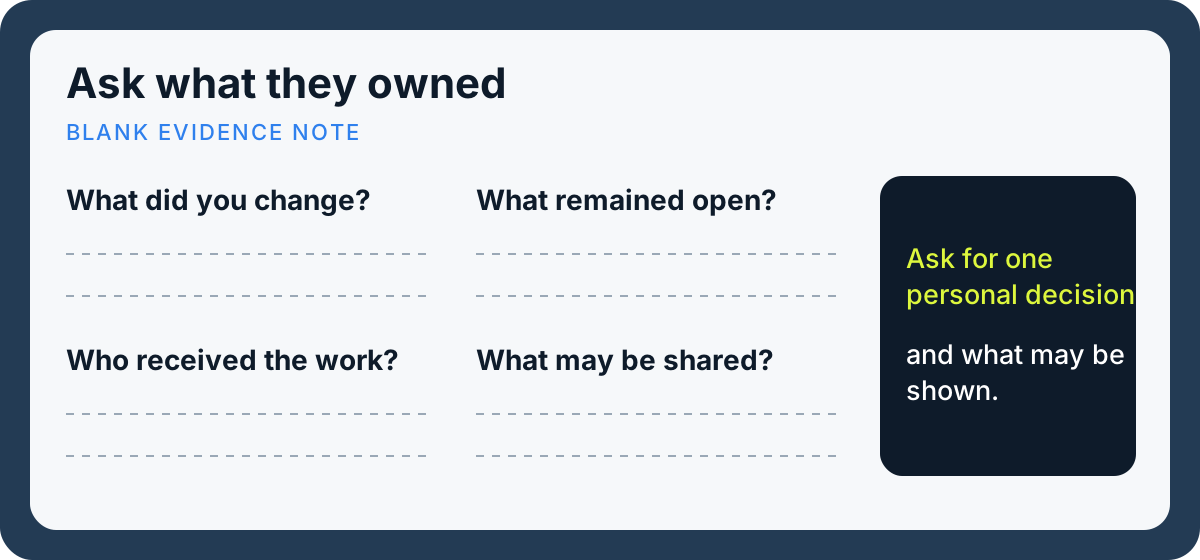
Five questions that separate a fitted scope from a default production proposal:
- Which unknown does your proposal resolve, and how will we see it resolved?
- What is the smallest result that lets the receiving person perform the agreed run?
- What would you leave to our scientist, our software lead or a specialist?
- What access do you need, and what could you do with a synthetic example?
- Which part of your proposal would we drop if the first result answers the question?
Red flags — editorial judgment, not a validated test: a production program proposed before the unknown is named; unrestricted access requested without explaining why a synthetic example is insufficient; a past title offered instead of a personal decision; no identified recipient for a handoff. Counterexample: a one-off assessment can be useful without a past operational handover, if its present recipient and purpose are clear.
Relevant scientific-product experience
As stated in Elad Katz’s profile, his work includes developing NaviPlate/NaviCells organoid products. That is scientific-product context to examine, not proof that the software rerun or wet-lab assay in your milestone is reproducible. Ask for the comparable personal contribution and the evidence its receiver used.
As stated in Arno Schaepe’s profile, he took Definiens’ image-analysis technology from early prototype to core product, with continuing responsibility for stability and scaling. This is scientific-software product experience; a particular computational rerun still needs its own evidence.
Ask for the candidate’s personal decision, permitted corroboration and the receiving owner for your milestone. Fit is discussed through the curator.
Invented illustration: receiving a computational handoff
Invented, unperformed illustration of your own check; it is not a Grand Rounds process. A company handing a numerical-analysis prototype to a partner analyst agrees one task: what the analyst needs to perform one specified calculation. Before sharing restricted code or data, it could give candidates a synthetic table of arbitrary two-dimensional points and ask for a toy summary calculation to see how they approach the handoff. Three scopes could then be compared:
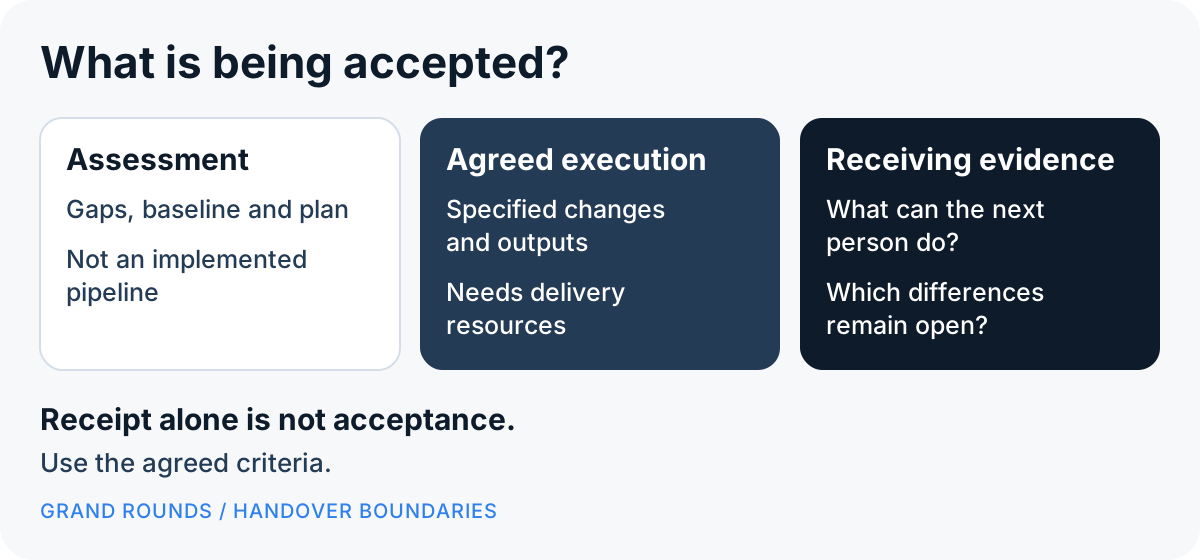
- An assessment of the current run, hidden dependencies, receiving person's needs and handoff plan.
- Bounded implementation by the company's own team under that plan.
- A broader production program, justified by the partner's operating requirements.
Handling the synthetic table shows reasoning, not whether the candidate would find hidden dependencies in real code. It says nothing about the company's science and does not replace permitted evidence of personal work.
Agree access and responsibilities before the work
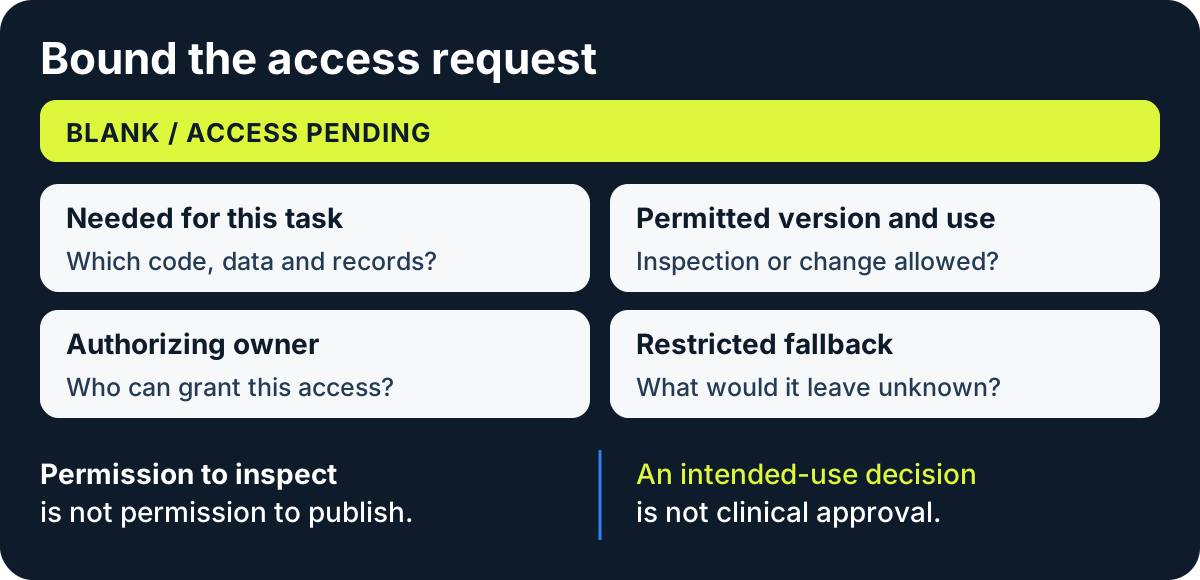
Agree task-specific data/code access, confidentiality, IP responsibilities and reviewer authority before sharing material. A synthetic example can test the proposed approach while restricted inputs remain protected.
Write the milestone, rerun and receipt note
| Field | What to write for your milestone |
|---|---|
| Milestone/remit | One blocked decision and the specific contribution |
| Permitted access | Data/code/configuration versions and authorizing owner |
| Receiving task | Who performs which run or uses which result |
| Evidence/receipt | Inspectable output, comparison and receiver disposition |
| Retained approvals | Scientific, IP, clinical, security and commercial owners |
Example row — invented, unperformed. Scope: assess what a partner analyst needs to rerun one specified calculation. Access: synthetic table only, until the data owner approves versions of the code and inputs. Receiving task: the analyst performs the run from the written handoff. Evidence: compare the analyst's output with the company's own run and list differences. The scientific owner retains claim review; IP and security owners retain real-data approvals. Record receipt separately from scientific or commercial acceptance.
What shapes the scope you ask for
Whatever route you take, the scope depends on:
- Which unknown the milestone must resolve: scientific, repeatable execution or buyer value.
- Whether the first need is an assessment, a design reviewed by your own owners, or checks on implementation by your team or a supplier you choose. The build stays with them.
- Which code, data, configuration and conversations the owners will share for this task.
- Who receives the result and who judges its scientific, technical or commercial meaning.
Your next step: match scope, access and who takes over the result
Write the milestone, list decisions already covered internally and name the access owner and receiving person. Use those facts to challenge a default production proposal before you talk with the curator.
Boundaries
A CTO conversation explores a contribution; the scientific claim stays with your scientist, and clinical, regulatory, IP and security decisions stay with the qualified owners. Permission to inspect material is separate from permission to publish it. Implementation stays with your team or a supplier you choose.
Grand Rounds is an initiative of Dinarys, and a conversation may lead to cooperation with Dinarys.