
Recurring service work identifies a job worth investigating, not a proven product market. Treat willingness to pay as supported only when the buyer takes a concrete step toward buying the stated offer; interest in a sample or in AI is not that step. Even a purchase does not establish repeat demand or viable delivery economics.
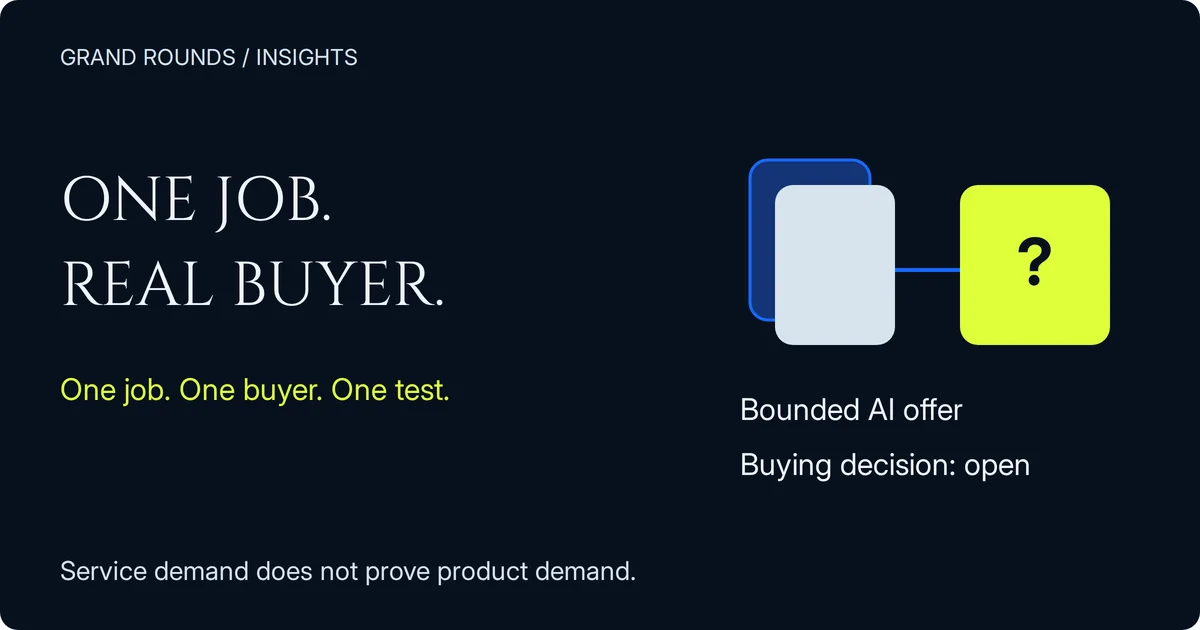
Your experts keep doing similar work for paying clients. They gather documents, apply the firm's method and prepare a reviewed result. A founder sees the repetition and asks: could customers buy this as an AI product instead of commissioning another engagement?
Possibly—but customers buying the service is evidence for the job, not proof that they will buy an AI product. They may be paying for expert interpretation, accountability or a conversation that the proposed interface removes.
For a consultancy, expert-service firm or product company packaging domain knowledge, the first decision is not which model to use. It is which bounded customer job deserves a demand test, using material you are actually allowed to use. Start with a map of the job, rules and data—not a platform roadmap.
Separate a new product from a more efficient service
An internal AI assistant can help experts research or prepare work while the customer continues buying the existing service. That is an operating-capacity decision. A customer-facing product is a different commercial proposition: a defined buyer acquires a bounded result or capability under stated quality, review and support limits.
The interface need not be fully self-service. A reviewed digital product or productized service may be closer to what the customer values. Be explicit about what is still performed by people instead of calling it automated.
| Question | Internal service improvement | External productization |
|---|---|---|
| Who uses the workflow? | Your expert team | A customer or a defined customer-facing delivery process |
| What does the customer buy? | The existing expert service | A distinct bounded offer that still needs validation |
| What must be learned? | Whether whole-work effort and quality improve | Whether the buyer wants this offer, can buy it and needs it again |
Do not turn an internal research efficiency result into evidence of external willingness to pay. If capacity is the only problem, an approved internal tool may be enough. There is no requirement to launch a software business.
Choose one job customers already commission
Look at actual paid work, not a list of tasks an AI model can perform. Select a candidate whose purpose, inputs and output can be described clearly enough for a customer to recognize it.
Ask the service owner:
- What event makes a client request the work?
- Who uses the result, who checks it and who authorizes spending?
- Which part recurs, and which part depends on genuinely bespoke judgment?
- What does the customer do after receiving it?
- What do they use instead, including doing nothing or retaining the service?
“Turn our knowledge into a chatbot” does not answer those questions. “Help a training manager identify which course materials need review after a product update” names a job you could investigate. It is not a demand claim.
Prefer a candidate for which you can inspect permitted work examples, find an accountable domain reviewer and speak to a relevant buyer through your normal authorized process. Selecting it only nominates the next test. It does not certify a market.
Map the customer job, rules and data
Use a one-page working record. Mark assumptions and unknowns rather than filling gaps with optimistic estimates.
| Map field | What to capture |
|---|---|
| Trigger and customer job | The event, task and decision the output supports |
| Buyer, user and reviewer | Distinct people/roles; purchase authority still to confirm |
| Bounded output | What is delivered and what remains outside the promise |
| Existing alternative | Current service, customer effort or existing product |
| Expert rules | Required checks, exceptions and decisions that must remain explicit |
| Candidate AI work | Retrieval, comparison or drafting to test—not assumed capability |
| Sources and knowledge | Origin, version, permitted purpose/audience and unresolved restrictions |
| Quality boundary | What the reviewer must verify; when to withhold or escalate |
| Whole-work effort | Preparation, review, correction, delivery and support—not just generation |
| Demand test | The buyer action and objection you need to observe next |
Knowledge ownership is not permission for every input
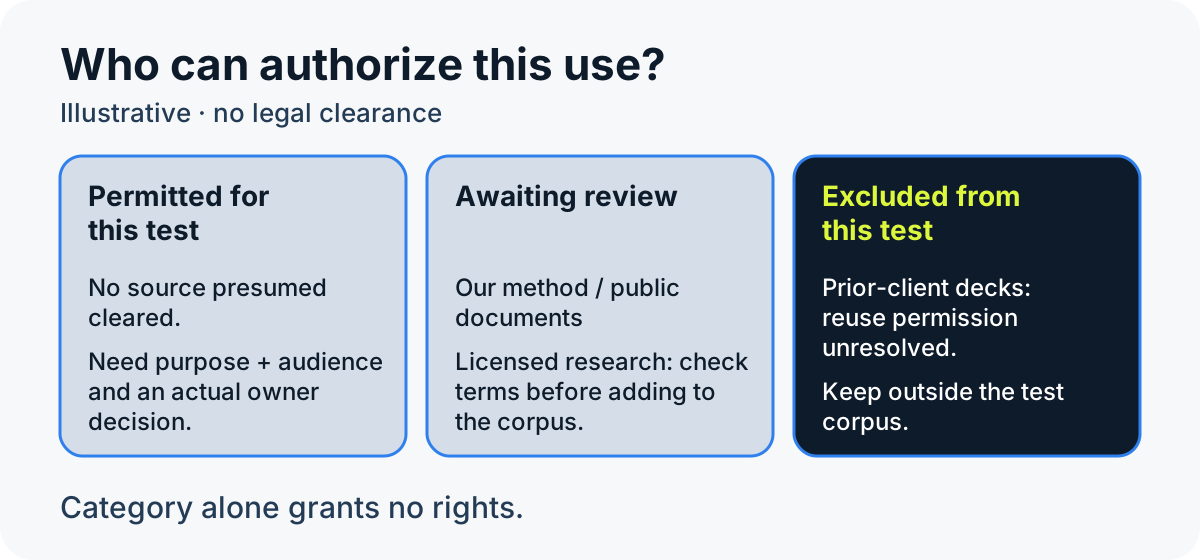
Your method, licensed research, public documents and prior-client material can have different permitted uses. Possessing a file or having used it in one engagement does not establish that it may become input to another customer's product.
Record who can authorize each intended use. Keep unresolved material outside the test corpus until that owner resolves it, and ask qualified legal or contractual reviewers when necessary. Also distinguish permission to process a source from permission to show it to a customer. Technical leadership does not grant either right.
If the selected job cannot be performed usefully without excluded material, narrow the promise or postpone that test. Do not disguise the gap with a generated answer.
Test the proposed offer, not enthusiasm for AI
Use existing customer conversations to understand the last time the buyer commissioned the job: what triggered it, how they handled it, what mattered and what made approval difficult. Avoid making “Would you use our AI?” the decisive question.
Strategyzer's guidance on testing value propositions distinguishes what customers say from what they do. Interviews can reveal the job and objections; a concrete action toward using or buying the stated offer provides different evidence. Neither a positive interview nor a prototype walkthrough is a sale.
For your next authorized customer discussion, show a representative output made with permitted inputs. State honestly how it was produced, what review it includes and what it excludes. Ask:
- Would this output support the actual task—or is the essential value missing?
- Which expert interaction or assurance would you still require?
- Who would authorize buying this bounded offer, through what process?
- What would you need to see before making that decision?
Record the answer and the concrete next action separately. Agreeing to inspect a sample shows willingness to inspect a sample. Requesting terms indicates a purchase process to explore. A purchase is stronger evidence of that particular offer, but repeat use and broader demand still remain to be tested. An unanswered invitation is unknown, not an automatic rejection.
Invented example: a training-update brief
Invented, unperformed example—not a client case. A specialist training firm already sells course-maintenance work. It considers a product that gives training managers a reviewed change-impact brief after a vendor releases new product documentation.
The candidate map names the training manager as user, a learning lead as the buyer to confirm, and the firm's subject specialist as reviewer. Inputs are the customer's authorized course outline and vendor documentation whose proposed use must be checked. Prior-client decks with unresolved reuse permission are excluded.
The proposed output identifies sections needing review, links each suggested change to supporting evidence and flags uncertainty. It does not promise a complete updated course or automatic publication. The proposed demand test is a transparent sample walkthrough followed by a discussion of a bounded purchase—not a claim that such a discussion or purchase has happened.
If the customer values an expert workshop more than the brief, the next offer might remain a service. If the brief matters but source use remains unresolved, the test narrows or waits. If buyers want the output but review and support effort remain high, whole-work cost still needs investigation. Each is a useful finding, not a reason to invent a product-success story.
Choose the workflow before choosing the build
Keep the current service and existing vertical products as alternatives. A technical leader's experience can inform a bounded job and its checking work; it cannot establish whether your clients will buy the offer. No savings figure or paid-product outcome transfers to your business. The commercial owner owns the offer and demand test, the domain expert owns subject-matter acceptance, and the client team or chosen supplier implements under a separate scope.
Next action: choose one job customers already pay to have done, map its rules and allowed data, and define one honest test of the proposed offer with a real buyer. Do not call AI-product willingness to pay established until you have evidence for that offer.
Once that candidate is clear, Productizing Expertise With AI covers delivery routes, and Choosing a CTO for Your First Paid AI Product Pilot covers the pilot-leading contribution. If a cross-system technical decision needs outside judgment, bring the map to the Grand Rounds curator, who listens to the problem and can identify CTOs in the network who have dealt with something similar. The immediate task remains choosing and testing the customer job—not buying a platform or booking an assumed expert.
Boundaries
Grand Rounds is an initiative of Dinarys, and a conversation may lead to cooperation with Dinarys.