
The AI draft arrives quickly. The expert still has to find the source passages, reconcile document versions, and check every important number. If that describes your financial document workflow, faster drafting has not yet demonstrated more casework capacity.
The missing link is a reviewable evidence path: the applicable source and locator, the number's context, permitted access, and the reviewer's decision. Without it, the expert has to rebuild the analysis. Scaling draft production can simply move the queue into verification.
For a financial services operation, specialist practice, or FinTech/RegTech product, the business task is not simply to generate an answer. It is to move a permitted document pack through intake, analysis, and accountable review without losing the evidence behind the result.
Before choosing a new model or a larger retrieval system, map one recurring case. Identify where experts spend time, which errors force them to reopen the documents, and what they must be able to verify before signing off.
Start with the case, not the chatbot
Choose a repeatable document task: for example, preparing an evidence-backed summary of specified financial disclosures for a qualified reviewer. Define the case start, required output, permitted sources, and the human approval that ends the task. Keep investment, lending, legal, and other consequential decisions outside this drafting example.
Name the process owner and the domain or risk reviewer who defines acceptable content. Security and data owners establish permitted use and access; technical leadership assesses the implementation.
The current workaround may be sensible: analysts use keyword search, cross-check spreadsheets, or keep AI in a sandbox because a generated answer does not shorten verification. Preserve that process as the baseline. A new system needs to justify its total burden, not merely produce a more fluent first draft.
Map intake → analysis → review, including the errors
Use this map as a working artifact for one case type. Record actual evidence and unknowns rather than assuming every possible error is already happening.
| Stage and responsible role | Evidence to retain | Error or unknown to investigate |
|---|---|---|
| Intake — case/process owner | Case ID, task, document inventory, versions, permitted uses, missing items, authorized users. | Incomplete pack, wrong entity or period, duplicate or superseded source, unclear rights. |
| Analysis — analyst with technical support | Extracted passages and table locations, retrieval trace, claim-to-source links, calculations and assumptions. | Misread row/column, wrong unit or sign, unsupported inference, missing qualifier, wrong version. |
| Review — domain/risk reviewer | Claim-level checks, corrections, unresolved questions, no-answer/escalation reason, acceptance decision. | Citation does not support the claim; a material exception is missing; a number cannot be reproduced. |
| Handover — process owner with data/security owners | Approved output version, release authority, evidence location, access/retention conditions, subsequent changes. | Draft mistaken for approval, outdated result reused, revoked source still exposed through a saved answer. |
A citation is a route to a check—not proof of truth
“The answer has citations” is too weak an acceptance condition. A cited document may be the wrong version, or its passage may discuss a related subject without supporting the claim.
For each material statement, the reviewer needs to establish:
- Factual support: does the exact passage support this statement, including its qualifications and exceptions? Which parts are source facts, calculations, or analyst interpretation?
- Numeric support: do entity, period, currency, unit, sign, and denominator match? Can the calculation be reproduced from the cited inputs?
- Table support: are the right row, column, header, and footnote preserved? A cell without its “in thousands” label is not a complete number.
- Version support: is this the source applicable to this task? How were amendments, restatements, superseded policies, and duplicate files resolved? Retain both the selected version and the reason for excluding conflicting versions.
- Access support: may this user and system use the underlying material for this purpose? Does the evidence remain available to the authorized reviewer?
A high-quality extraction can help with the first steps, but it does not approve the interpretation. If the required evidence is missing or contradictory, the output should identify that limit instead of completing the answer by inference.
Current and applicable are different checks. The latest upload may concern a different period; a historical case may need the policy effective at that time. Record document identity, version, effective date where relevant, case period, and who determined applicability. A successful index refresh establishes neither the right comparison nor which policy governs the case. Keep superseded material distinguishable from the selected source rather than allowing either to appear under an ambiguous filename.
Check permissions and changes across the evidence path
Ask the technical, data, and security owners how authorization is applied before material enters retrieval and model context, and how it carries through saved results, exports, logs, and support access. Login alone is not evidence that every document boundary is correct.
Revocation needs its own question: what happens after a source permission changes? For a concrete example, Microsoft's Azure AI Search documentation (page dated August 8, 2026) marks token-based query enforcement as a preview feature. It says permission changes in the source reach search results only after the permission metadata is synchronized to the index. That is a specific implementation dependency, not a product recommendation or a guarantee about your system.
Have the responsible owners agree controlled checks for an unauthorized role, another tenant where relevant, and a changed or revoked source. Use synthetic or explicitly permitted data in an authorized environment. Do not test by exposing live confidential documents. The owners also need to decide how previously generated outputs, caches, and retained evidence are handled; a retrieval check alone does not settle those obligations.
The wrong version can have a real citation
The following documents, values, and behaviors are wholly invented. They illustrate an evidence problem, not a customer case or a financial recommendation.
A reviewer asks: “Summarize the reported revenue change and confirm that all debt conditions were met.” The data owner identifies revised report v2 as the applicable source for this task.
| Synthetic evidence | What it establishes—and does not |
|---|---|
| Superseded report v1, page 12: FY2025 revenue €12.4 million. | A number in an older version, not the applicable figure for this task. |
| Applicable report v2, page 14: revenue table, EUR thousands; FY2025 12,040, FY2024 10,000. | Reported values equivalent to €12.04 million and €10.00 million, subject to the table's scope and notes. |
| Report v2 refers to a separate debt-conditions schedule, absent from the permitted case pack. | The available evidence does not establish whether all conditions were met. |
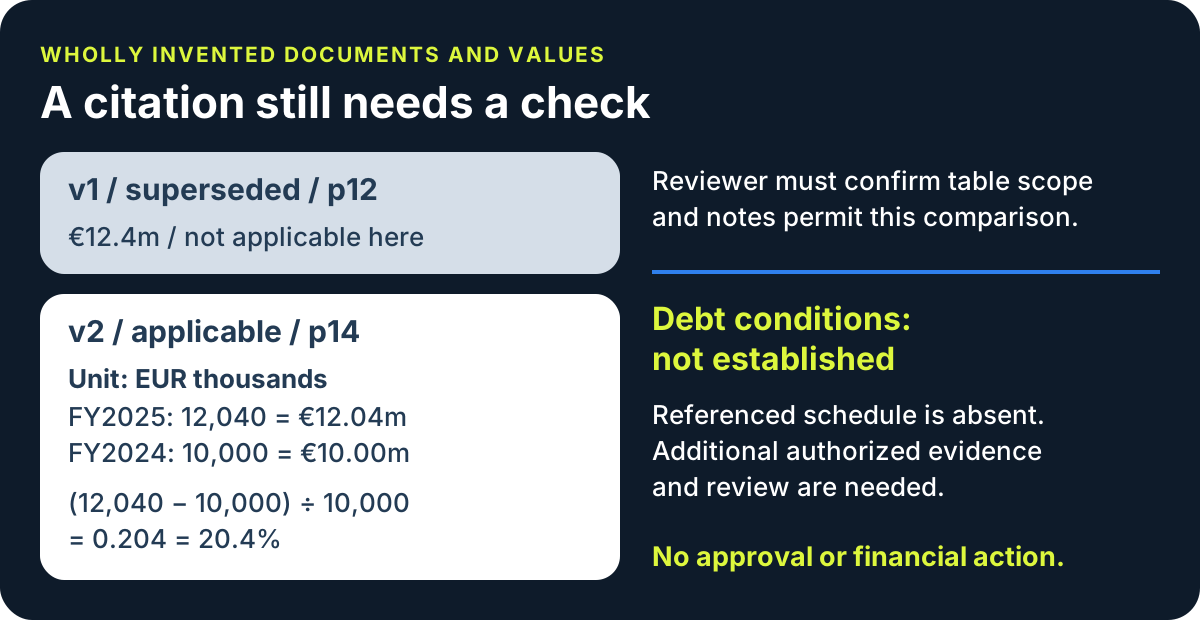
An invented draft says, “Revenue rose to €12.4 million and all debt conditions were met,” with a citation to v1. The citation exists. It does not make that figure applicable to this task, and it does not support the debt-conditions statement.
A reviewable draft would separate the two tasks:
The applicable v2 revenue table reports €12.04 million for FY2025 and €10.00 million for FY2024. Those inputs give a 20.4% increase: (12,040 − 10,000) ÷ 10,000 = 0.204 = 20.4%. The domain reviewer must confirm that the table scope and notes permit this comparison. The permitted case pack does not establish whether all debt conditions were met; that part requires additional authorized evidence and review.
Missing debt evidence is a no-answer, not evidence of either compliance or failure. This illustration provides no financial clearance or authority for external action.
Measure net review time, not drafting speed
Compare the current process and the assisted process on comparable permitted cases, with the same task boundary and review standard. Separate routine, difficult, incomplete, and no-answer cases; do not hide the latter by removing them from the denominator.
Record active human effort by role, including preparation, verification, correction, escalation, and final approval. Record machine waiting and end-to-end elapsed time separately. Avoid double-counting the same correction session as both review and rework.
Extend the illustration with an invented effort ledger for one routine case completed to the same review standard in each process. These minutes are assumptions, not observations from the documents above, measured results, or savings estimates.
| Active human work | Manual process | AI-assisted process |
|---|---|---|
| Intake and preparation | 10 minutes | 14 minutes |
| Analysis and draft preparation | 35 minutes | 8 minutes |
| Source and number verification | 25 minutes | 42 minutes |
| Corrections and final sign-off | 10 minutes | 20 minutes |
| Total human effort | 80 minutes | 84 minutes |
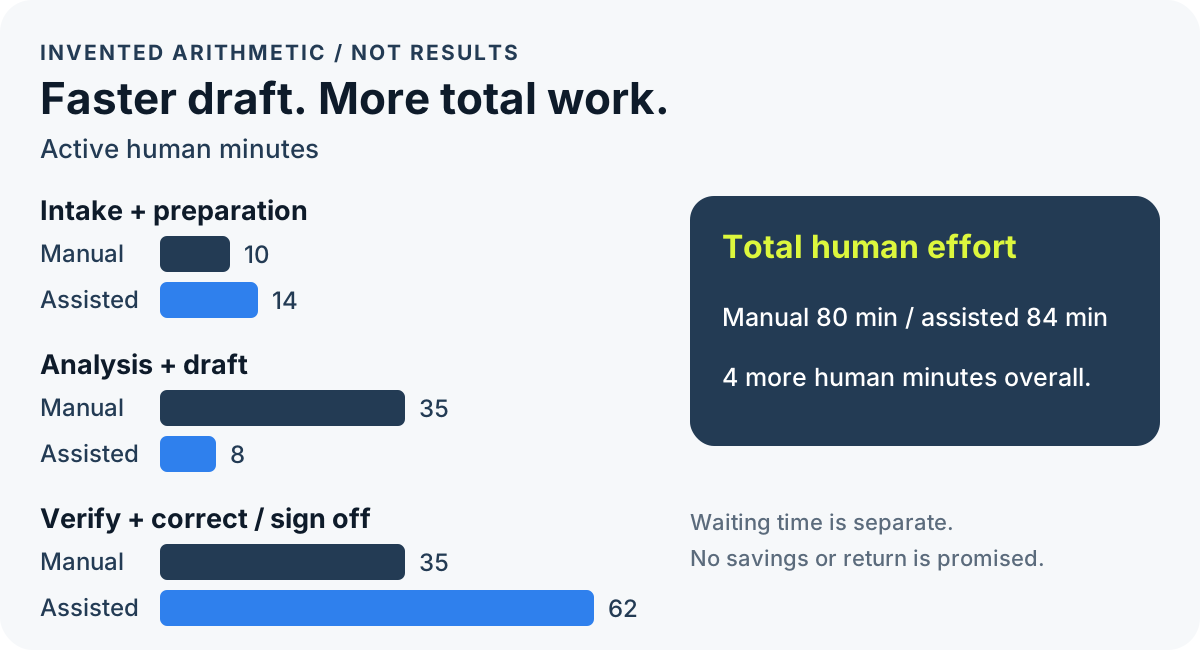
Here, analysis and drafting use 27 fewer human minutes, but verification plus correction/sign-off rises from 35 to 62 minutes. Net human time saved is 80 − 84 = −4 minutes: the assisted process uses four more minutes overall. A faster draft has not created capacity in this illustration.
Change one assumption and the result reverses: with verification at 32 minutes instead of 42, the assisted total is 14 + 8 + 32 + 20 = 74 minutes, saving 80 − 74 = 6 minutes. Both versions are invented. They show why drafting speed alone proves neither a capacity gain nor a loss. Measure the full task on your own cases—and check whether effort falls for the expert role that actually limits throughput.
For a cost comparison, apply agreed role-specific cost assumptions to those minutes and add service charges, including failed attempts and retries. Do not convert a hypothetical time difference into a promised financial return. Also compare error severity, unresolved cases, review backlog, and accepted-case counts. Quicker completion with worse evidence is not equivalent work.
No-answer and escalated cases still consume effort. Report their time and disposition separately. A cheap refusal is not a completed analysis; an unsupported confident answer is not a successful case merely because it reached the end of a pipeline.
Keep one casework evidence record
For each sample case, use this reusable record alongside the intake–analysis–review map:
- Task and authority: case ID, requested output, exclusions, sponsor, domain/risk reviewer, data/security approval owners.
- Sources and applicability: document IDs, versions and dates; selected source and reason; superseded or conflicting versions; applicable policy and effective date where relevant; exact fragments/table cells, headers and notes; permitted use, role/tenant, known missing material.
- Claims: proposed statement; supporting source; factual or numeric check; calculation/assumptions; unsupported or conflicting elements.
- Execution: alternative/configuration and attempt ID, relevant application/model/retrieval versions, approved trace location, output version, and observed access/update findings. Distinguish a proposed check from a performed one; keep attempts separate. Do not put secrets or unrestricted copies of case documents in the record.
- Review and effort: accepted/corrected/rejected/no-answer/escalated status; reason and reviewer; preparation, analysis, verification, rework, service cost, and elapsed time.
- Disposition: what remains manual, what needs clarification or a bounded technical check, stop conditions, responsible owner, and next evidence.
Use the record to distinguish the repair before choosing an architecture:
| If the record shows… | Compare next | What that option does not settle |
|---|---|---|
| Documents are hard to locate, but the current process preserves support. | Existing search, manual reading, and explicit rules. | Missing sources and substantive interpretation. |
| Cells lose their headers, units, or notes. | Extraction that retains source locations and table context. | Whether the extracted inputs support the conclusion. |
| Relevant permitted passages are repeatedly missed. | Retrieval-grounded drafting against the existing search baseline. | Source applicability, access correctness, or claim support by itself. |
| Review requests or exceptions lose their place. | A fixed workflow with recorded steps and responses. | The substantive review or authority to act. |
| A demonstrated gap remains between existing systems. | A bounded custom integration. | Its own maintenance burden or evidence of capacity gain. |
These are different jobs, not a ladder toward more autonomy. Keeping the manual process, improving intake, or restricting an unsupported output may be the useful outcome. For a fuller approach comparison, the companion guide is Designing Financial AI Casework With Evidence and Expert Sign-Off.
Take one recurring case back to the queue
Pick a case type with a real queue, a process owner, and examples you are permitted to use. Complete the map and evidence record, then compare total review and rework against the existing process. Find the specific point where evidence is lost or expert effort increases before choosing a technical remedy.
If the permitted dataset is not yet available, keep that boundary explicit. Revisit the bounded check when access is approved or the review burden changes—not just because another model has been released.
To talk through the evidence gaps, inquire through the Grand Rounds curator, who can tell you whether a Grand Rounds session fits. Grand Rounds supports technical decisions; implementation by your team or a selected provider is separate. Domain, risk, security, and data owners retain approval. This article is not legal or investment advice and does not prescribe automated financial decisions.
Boundaries
Grand Rounds is an initiative of Dinarys, and a conversation may lead to cooperation with Dinarys.