
Short answer. Choose the financial workflow first. Then ask each candidate, whether an individual or a firm, to name one person and one decision that person owned in a comparable workflow. Public career work often matches a neighbouring workflow rather than yours, so record each match as matched, adjacent or not shown, and name who accepts the result. Credit policy, compliance and regulatory interpretation stay with their owners in your firm. A part-time CTO supplies technical decisions, not clearance.
The worked example below applies that test to public pages read on 18 November 2026. In it, no single source proves an SME underwriting mandate or a compliance approval. Nobody was contacted, nobody is ranked, and every provider statement is that provider's own.
Our interest. Grand Rounds is an initiative of Dinarys, and a conversation may lead to cooperation with Dinarys. Grand Rounds is one route among those compared here, so it gets the same test as the others.
Which financial workflow needs leadership?
"Fintech" is too broad to compare on. Name one of these: payments (moving money, reconciling timeouts), investment machine learning, lending preparation (documents to reviewer-ready evidence), regulated evidence (answers traceable to source documents) or enterprise delivery (vendor selection and building a team). For the lending workflow itself, Grand Rounds has a separate page, Fintech CTO Consulting for Lending Workflows. This page compares who could lead, not how to run that workflow.
Write one matrix row per workflow, with six inputs: the specific workflow; the named person's own contribution; data and transaction controls; the qualified reviewer; the first milestone; and availability, scope and terms. Table 1 fills the first two inputs from the four Grand Rounds career-case pages and marks what each page does not show.
Table 1. Workflow-to-provider evidence matrix, Grand Rounds career cases (public pages, read 18 November 2026)
| Workflow | Named contribution on the page | Not shown | State; who accepts |
|---|---|---|---|
| Payments | None of the four pages describes a payments workflow | Payment flow, reconciliation, transaction controls | Not shown. Your payments owner accepts; no candidate yet |
| Investment ML | Berkan Sesen: senior quantitative portfolio manager and fund co-manager; screening engine over 10,000+ stocks; analysts vetted picks | Lending, payments, current availability | Matched to investment ML only. Your investment lead accepts |
| Lending preparation | Jerome MacGillivray: co-founder of a crypto-backed lender; the page says its Data Team assessed collateral tokens | Who personally did that assessment; SME underwriting; hands-on loan-system build | Adjacent. Your credit or risk owner accepts |
| Regulated evidence | Marton Csernai: AI engineer; retrieval pipeline for regulated documents with 100% citation provenance | A named financial deployment; lending-platform delivery | Adjacent. Your compliance owner accepts use of outputs |
| Enterprise delivery | Neil Taggart: employee #5 who built a wealth firm's technology function and ran platform selection | Payments, lending, ML; any regulator's view | Matched to supplier selection in wealth management. Your CEO or board accepts |
The labels matched, adjacent and not shown are Grand Rounds' own editorial reading of what each public page shows. They are not a ranking, a rating or an endorsement.
A row fails when any of these is true:
- the contribution is a job title with no decision described;
- the evidence belongs to the provider, not the person who would do the work;
- a number is quoted without its original scope;
- "compliance" is a department, not a named reviewer;
- availability and terms are unknown but treated as agreed.
The diagram shows one row filled in for an invented lending-preparation founder.
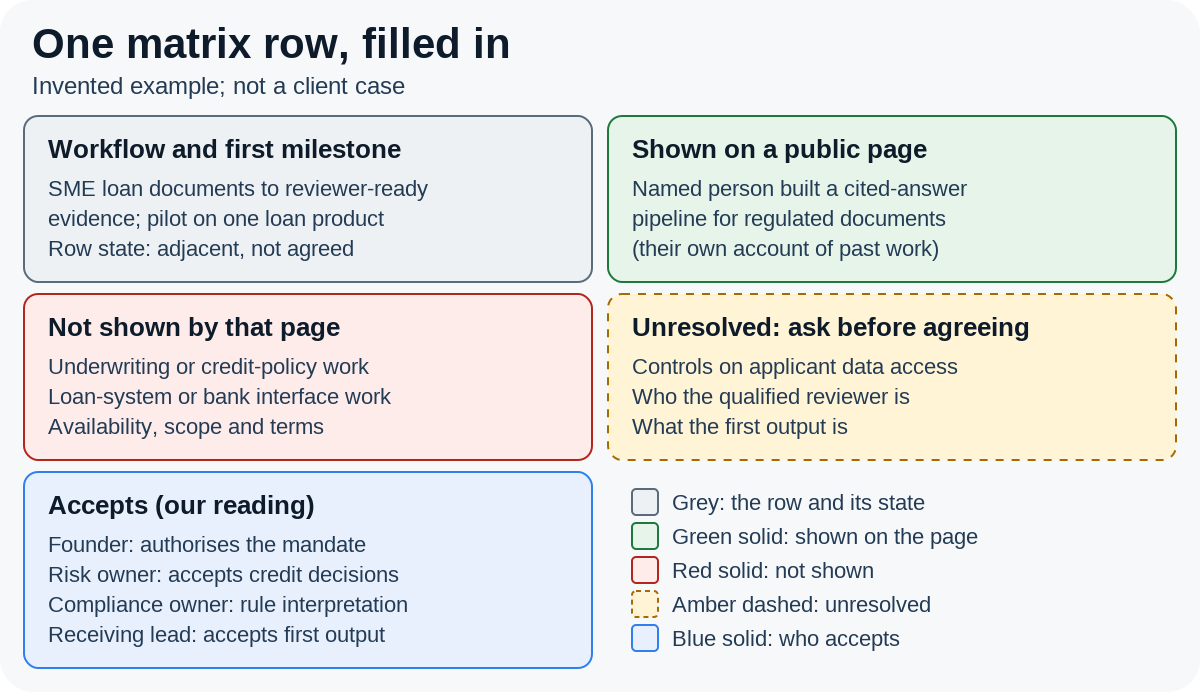
What did the proposed person own?
Start with the case that matches your row, then read what it leaves out. All four pages are public accounts of work before Grand Rounds. Each says it is not a Grand Rounds engagement and not a promise of the same result for another company.
Investment ML: Berkan Sesen. Using natural language processing to build thematic equity funds describes Sesen's work at J.P. Morgan Asset Management from 2017 to 2021. ThemeBot, the team's thematic engine, screened more than 10,000 stocks. The funds' methodology, which ranks companies by combining a textual relevance score with a revenue exposure score, was filed as a US patent application in 2020 with Sesen as a named inventor, and analysts validated selections before any stock entered a portfolio. The page reports that the machine-learning thematic funds reached more than $2bn in combined assets under management. That figure belongs to the funds, not to one person. This is career evidence for a model-ranked, human-vetted workflow, and says nothing about payments, lending or availability.
Regulated evidence: Marton Csernai. Regulated document analysis where every AI answer cites its source records an AI engineer building a hybrid retrieval-augmented generation pipeline, with Temporal for durable workflow orchestration, delivering "100% citation provenance" for regulated document analysis. The page does not name the regulations or a financial deployment, and the Grand Rounds fintech page describes the experience shown for Csernai as FinTech and KYC-integration experience, "not lending-platform delivery". It speaks to a "show where each answer came from" requirement, not to credit logic or a compliance approval.
Enterprise delivery: Neil Taggart. Setting up the technology function of a growing multi-family office says Taggart joined FigTree as its fifth employee and built its technology function, including security and data governance, and ran the selection and deployment of a wealth-advisor platform combining d1g1t, FutureVault and Bloomberg, with vendor negotiations. Taggart's site, as the page reports, says that by March 2022 FigTree used d1g1t and FutureVault day to day, including for compliance management and oversight. That is a supplier decision; the page does not say who accepted the compliance side.
Lending-adjacent: Jerome MacGillivray. Launching crypto-backed loans and deciding which tokens to accept covers MacGillivray as co-founder of MoneyToken in 2018 and 2019. The page says the company's Data Team assessed tokens before accepting them as collateral, looking at liquidity, trading-wallet behavior, AML risk and usage. BNB was accepted from 22 March 2019 after that review, with one wallet cluster flagged for extra KYC and AML checks. The page credits the assessment to the team, so MacGillivray's personal part in it is a question to ask. A crypto-collateral lender is not an SME underwriter.
What the three other providers' pages say
Table 2 sets three other providers' own pages beside Grand Rounds on the same footing. "Not stated" means the page did not say.
Table 2. Provider pages as read on 18 November 2026
| Provider | What the page offers | Fintech workflow named | Price and terms on the page |
|---|---|---|---|
| CTO on Demand | Audit with written report, quick wins and 90-day roadmap; fractional retainer; interim cover. Case: Vault Platform | Not stated; Vault is described as ethics and compliance software | Audit from £4,000, fixed scope, one month, excluding VAT. Fractional 2 to 4 days a month; rate not printed. Stop at end of any phase, no notice period |
| TechCXO | Advice on vetting a fractional CTO; a technical due diligence service with investor dashboard and key findings | Not stated | Fee not stated |
| Turczynski | Architecture review, vendor selection with weighted scorecard and three-year cost view, team assessment | Not stated; financial services appears in a list of regulated sectors that carry a premium | From £1,000 a day, VAT additional; from £3,000 a month, three-month minimum (VAT for that tier not stated). UK and EU clients only. The page also says "No retainer commitment beyond the first month", so confirm which applies |
| Grand Rounds | Profiles and cases above; lending page says a lending-specific contribution is verified first | Four cases, none an SME underwriting delivery | No price; terms confirmed per enquiry. Availability not stated on the profiles page |
The one fintech-adjacent case among them is the Vault Platform account that CTO on Demand published itself and links from its services page. It describes a VP Technology role at an ethics and compliance software company from 2022 to 2024: the engineering team grew from 7 engineers to 16 including contractors, and Diligent acquired the company in 2025. Some detail is withheld under an NDA, per the page. Finance, fintech and the FCA are not stated, so it is evidence for enterprise delivery in compliance software, not for a financial workflow. TechCXO's vetting article is general method, shown with a May 2026 date, and its investor and transaction services page names no individuals. Turczynski's page, last updated 30 April 2026, names past clients that it does not describe as financial firms.
What remains with risk, compliance and the current team?
The Grand Rounds lending page is explicit: credit decisions stay with risk owners, credit policy, model validation, regulatory interpretation and legal advice remain with competent responsible parties, and technical advisory "establishes neither a default-rate result nor compliance". Implementation sits with your team or a separately selected supplier. Use that as the default split in every row. The administrator and receiving-lead roles are our suggestion, not the page's:
- Credit and risk owner: approves credit decisions and policy.
- Independent validator: model validation.
- Compliance owner or counsel: regulatory interpretation and legal questions.
- Authorized administrator: grants data access under your own rules; keep credentials out of early conversations.
- Current team or chosen supplier: implementation.
- Receiving lead: accepts the first output, in writing.
If your firm is regulated by the FCA, read its outsourcing and operational resilience page (it shows an update of 14 July 2026). It says firms are responsible for their regulatory obligations on outsourcing and third-party arrangements and "cannot delegate any part of this responsibility to a third party", and describes outsourcing as a service provider performing a process, service or activity on a firm's behalf. The page does not say whether a part-time CTO mandate counts as outsourcing, and whether it applies to you is for your compliance owner or adviser. None of the pages read here says that any person or firm named in this article is authorized or approved by the FCA, and this article does not say so either. Ask each candidate what status applies to them and what you must check yourself.
For data and transaction controls, ask which controls the person has worked inside, such as access rules, audit trails or reconciliation, and which of them your own systems already enforce. The Grand Rounds Technology Assessment & Architecture Review page asks that first enquiries leave out credentials and confidential source files.
Can we verify the fit and mandate before committing?
Verify the person, not the brand. A CTO on Demand or TechCXO page describes a firm; a Grand Rounds profile describes a person's career. Either can be a start, and neither is a mandate. Ask each candidate:
- Which decision in a comparable workflow did you personally take, and who disagreed?
- What artifact exists, such as a decision record, vendor scorecard or review memo, and can you share a redacted version?
- Which data and transaction controls did you work inside, and who reviewed them?
- Who was the qualified reviewer, and what did they accept?
- What would you deliver at the end of the first period, and what would you still not know?
- What are the days, coverage, term, notice and price unit, in writing?
TechCXO's vetting article, a provider's viewpoint rather than a fintech standard, suggests similar probes: ask for a time the candidate "owned the full technology function", and note that a VP of Engineering title is not the same as owning a technology organization. It also suggests three references, ideally founders or CEOs, and a discovery or assessment period of two to six weeks. Prices on the pages use different units: a fixed audit, a day rate and a monthly retainer. They cannot be compared until scope and coverage are the same.
If the open question is the state of your current systems rather than who leads, an assessment may come before a mandate. The Technology Assessment page describes a written decision memo, as a proposed output of a separately agreed assessment, separating what was inspected, asserted and unknown. It says the memo is advice, separate from authority to implement, and that it is not automatically part of a curator call. It states no price.
Name the choice, the open condition and the owner
Close the matrix when you can write three sentences for each row. An invented founder with an investment-ML row might write: the choice is to take forward the person whose page describes a model-ranked screen vetted by analysts; the unresolved condition is availability, mandate scope and who validates the model; the accountable next action is for the head of investment to hold a first conversation and name the validator. If any sentence reads "we will see", the row is unfinished.
Next step
First fill in the matrix with your current team, using the six inputs and your own workflow. If a decision or expertise gap remains, bring the decision, the deadline and the evidence you have to the curator through Talk to the person shaping the room. The page presents the call as a way to see whether your company could be selected for the next event and which path fits; it states no price and does not promise selection. You can also browse Meet the CTOs, which states no availability. Any engagement is separately scoped and confirmed before it starts.
Limits of this page
- Provider facts come from each provider's own pages as read on 18 November 2026. We obtained no quotes, tested no offer and contacted nobody.
- The four Grand Rounds cases are career accounts, not engagements, independent verification or a promise of availability or the same result.
- Table 1's state labels are our reading. The invented row and founder are illustrations, not findings.
- The FCA page is cited for its stated principle only; this is not legal or regulatory advice.