
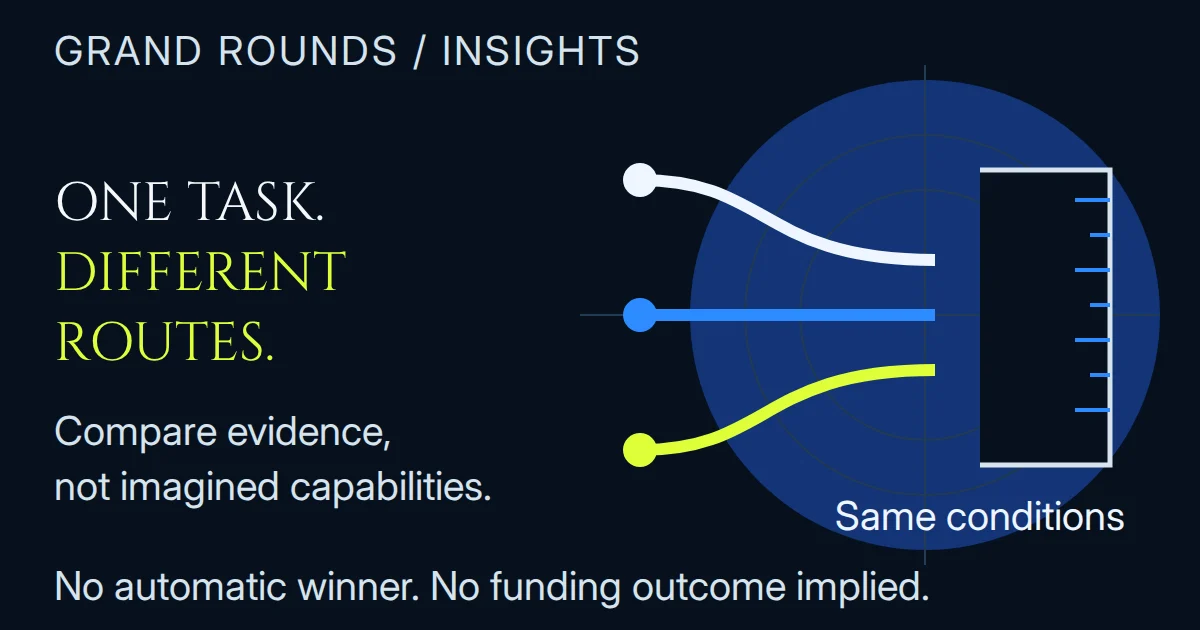
You have identified a technical uncertainty. Now the proposed R&D plan must explain how the team will investigate it with the data, equipment and people it can actually obtain. A work package called “develop the model” is not enough to choose between approaches or commit resources.
This is the next decision for a scientific or technical lead in a product company preparing a funding application. The founder sponsors the work; the team or selected vendor would execute it; the grant adviser checks alignment with the particular opportunity. The task is to choose a sufficient experiment and make its dependencies visible—not to produce the longest possible research program.
A useful technical feasibility assessment connects a claim, a comparison, an inspectable result and a resource-backed decision. It does not establish grant eligibility or guarantee an award.
Define feasibility for the next decision
For planning purposes, ask: can the proposed approach meet this bounded technical need under these conditions, and what evidence would justify the next commitment? That is narrower than “can we build the whole product?” It also leaves room for an answer of no.
Separate the scientific or technical claim from routine delivery. Building an interface may be necessary without testing the uncertain method. Conversely, an evaluation can resolve a crucial question without producing a finished application. Neither activity becomes eligible R&D merely because it appears in a grant work package; the current program's rules need their own review.
For a UK example of that boundary, Innovate UK's R&D-category guidance describes feasibility studies as supporting decisions and identifying resources, while stating that individual competition scopes define their own requirements. It is not a determination that your project or costs qualify; the program, call and jurisdiction for your application still need to be established.
Write the receiving decision first: “choose which method to investigate further,” “stop a route that cannot meet the run window,” or “confirm which inputs must be obtained before committing.” Then work backwards to the evidence needed.
Compare approaches on the same task
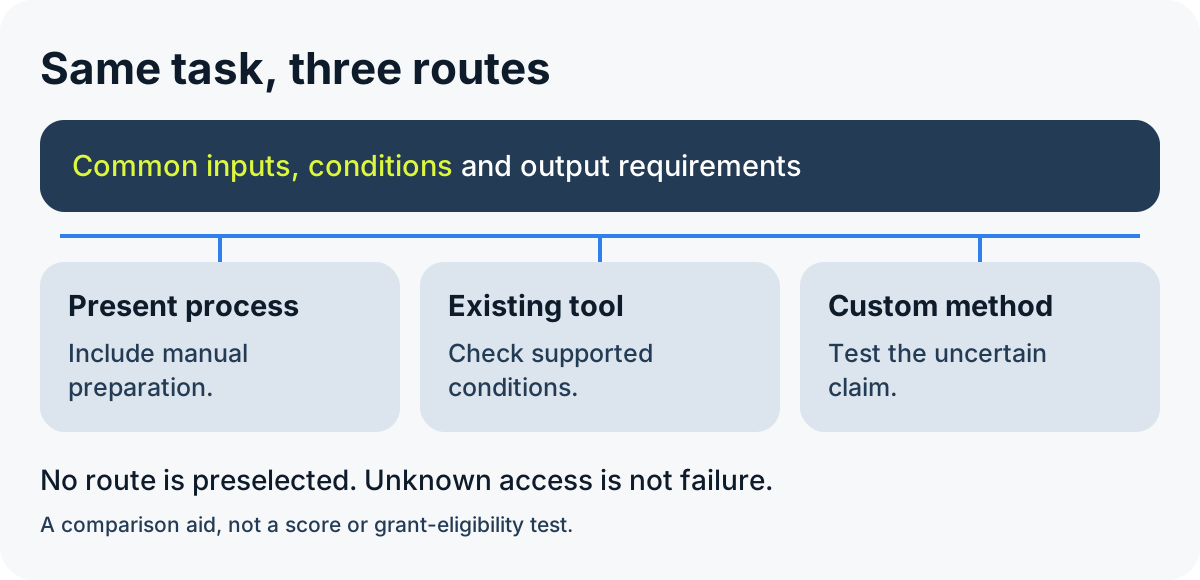
An existing manual process, a ready-made component and a custom research route should face the same question. Otherwise the comparison rewards different promises: one option is judged on its current limitations, another on imagined future capabilities.
Use common inputs, stated test conditions, a relevant baseline and the same output requirements where comparison is possible. Record where an option cannot be evaluated because access, capability or resources remain unknown. Do not convert those unknowns into favorable scores.
Worked illustration: a faster computational estimate
This is an invented, unperformed computational illustration, not a client case, scientific result or Grand Rounds delivery. No cleared real engagement is presented.
Imagine a company whose product helps engineers explore numerical scenarios. Its current process runs an established calculation and asks a specialist to prepare the inputs. The team wants to investigate a faster approximation. The uncertainty is whether that approximation can stay within the receiver's agreed error limits across the intended input range, including difficult boundary cases.
For an initial method check, suppose the team uses an inert synthetic table of input settings and reference outputs. That can support a controlled software comparison. It cannot establish that the reference calculation represents the physical world or that customer inputs have the same distribution.
| Route | What the next check could establish | Important limitation |
|---|---|---|
| Retain the current calculation and manual preparation | Whether the baseline already meets the next milestone, including total preparation and run time. | Specialist effort may remain; it must be recorded, not hidden. |
| Evaluate an existing approximation tool | Whether its supported input range and outputs meet the same need. | Access, configuration, supported conditions and inspectable outputs need confirmation. |
| Investigate a custom approximation | Whether a proposed method can meet agreed error and run-time limits against the same reference. | More compute does not resolve an unsuitable reference or missing representative data. |
The receiving engineer and technical lead would set the acceptable error, the run window and the relevant boundary cases before reviewing results. There is no universal threshold in this example.
Make the decision condition explicit
For this invented arithmetic exercise only, the mock receiver requires relative error of at most 2% on every included case and run time of at most 30 seconds per case before considering a wider trial. These are made-up conditions for the next decision, not engineering or scientific standards. All reference values are positive; a different error definition would be needed around zero.
| Printed synthetic case | Reference output | Approximation output | Relative error | Run time |
|---|---|---|---|---|
| A, ordinary input | 100 | 101 | 1% | 10 seconds |
| B, ordinary input | 200 | 204 | 2% | 12 seconds |
| C, required boundary input | 50 | 52 | 4% | 11 seconds |
The run-time condition is met, but case C misses the error condition. Do not advance the full-range route under this mock rule. Investigate the boundary failure, retain the reference method for that part, or agree a different bounded next experiment. An average error below a chosen threshold would not override a condition explicitly set for every case.
Counter-case: if the next product task legitimately excludes case C and that range was specified before evaluation, a bounded ordinary-input experiment might be worth considering. Dropping C after seeing its result is not evidence that the original full-range claim succeeded. Even a passing comparison to this synthetic reference would establish neither physical validity nor customer performance.
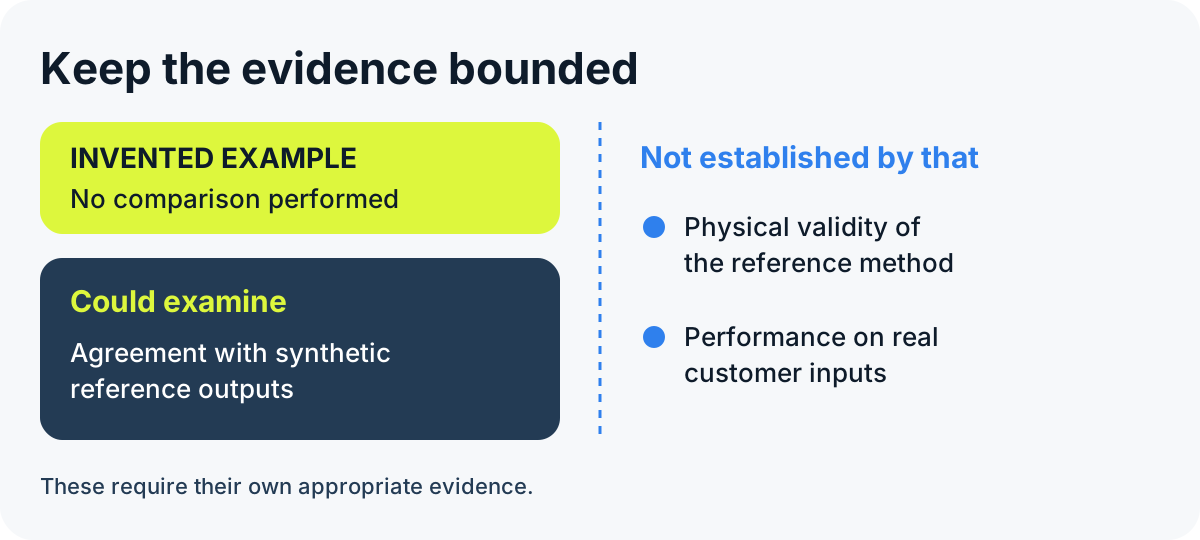
If a real custom route cannot be evaluated without an unavailable reference dataset, the first milestone should expose or resolve that dependency, not promise a completed model. If the current calculation already serves the immediate task, retaining it while investigating the uncertain part may be sufficient.
Build an experiment–data–equipment–milestone record
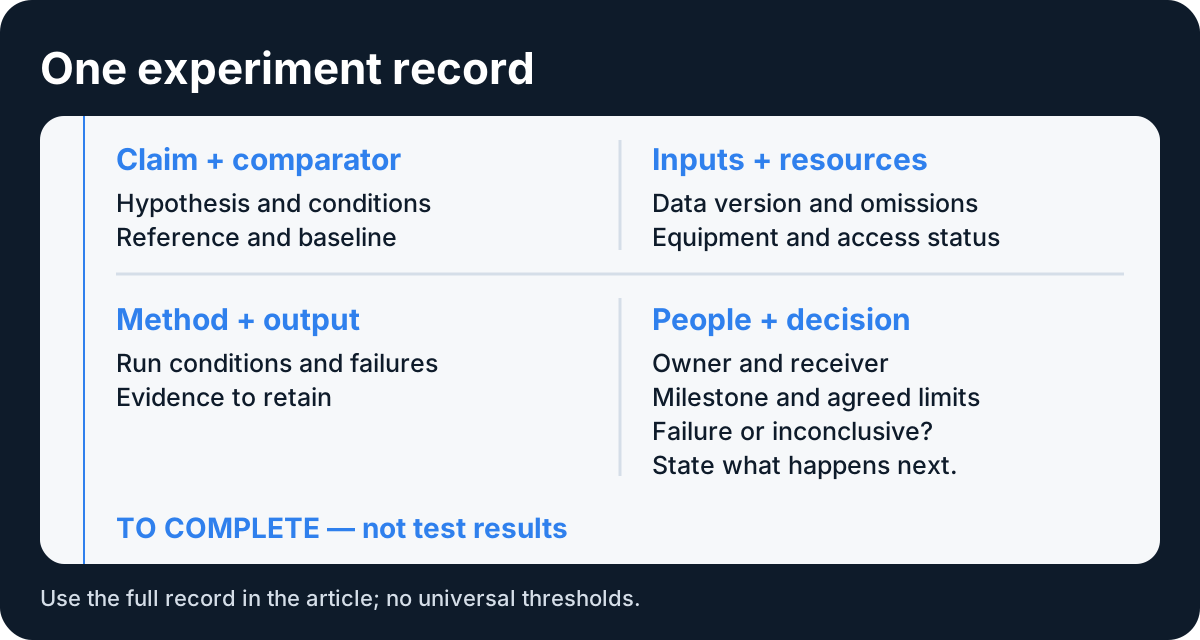
Use one record per consequential experiment. Related activities can share a work package, but the relationship between work and evidence should remain visible.
| Record field | Example content to agree before work starts |
|---|---|
| Uncertainty and hypothesis | Expected approximation behavior within a stated input range. |
| Comparator | The named reference method and current preparation process. |
| Data | Exact input version, selection rationale and known omissions; synthetic versus representative inputs clearly distinguished. |
| Equipment and compute | Required configuration, access status and who confirms availability. |
| Method and retained output | Run conditions, configuration, per-case comparison, failures and manual interventions. |
| Owner and receiver | Who performs the work, who judges the result and who can approve the next commitment. |
| Milestone | An inspectable comparison with enough evidence to choose, narrow or stop a route. |
| Decision conditions | Agreed limits, failure conditions and treatment of inconclusive results. |
In the illustration, a failed comparison is still a result if the inputs, conditions and differences are inspectable. A slide saying “model trained” is not an equivalent technical feasibility report.
Avoid treating a planning assessment as completed execution. The record describes what should happen. Only retained experimental evidence can show what happened.
Make resource dependencies change the plan
Mark each prerequisite confirmed, conditional or unknown, with a responsible person and a consequence if it is unavailable. For example, a compute estimate is conditional if the intended configuration has not been checked; specialist time is unknown if nobody has agreed to provide it.
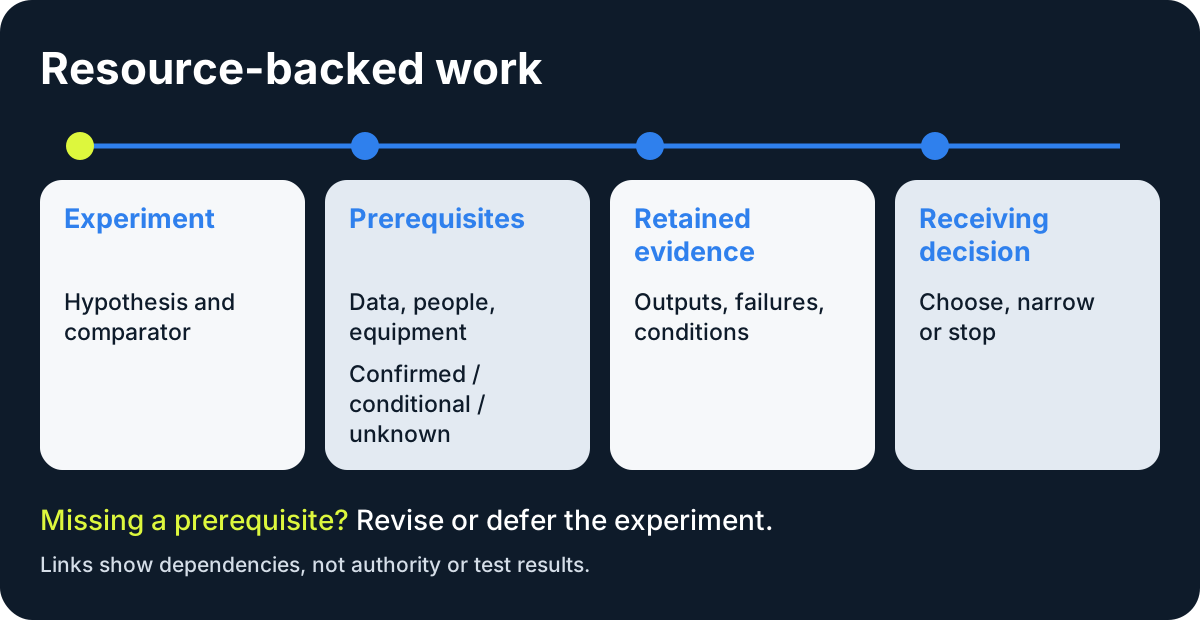
Order dependent work accordingly. A comparison that needs reference outputs should not be presented as independent of producing or obtaining them. A later integration milestone should not assume the uncertain method has succeeded. State what can proceed if it fails: a smaller range, a different approach, the existing tool, or no further work.
Connect the technical plan to the resource estimate: preparation, execution, analysis, specialist review and any repeat needed to investigate an inconclusive result. Finance and the grant adviser must check the relevant budget treatment; this is not advice on eligible costs or reimbursement.
Reconcile the technical record with the actual opportunity
Take the record to your own grant adviser, not an assumed universal application template. Ask which current call requirements affect the work-package description, evidence, timetable, dependencies and resource assumptions. Who checks the current authoritative documents? Which requirements remain unresolved?
The technical lead should be able to explain the comparison. The founder should see what commitment the result enables. Finance should see the resource assumptions. The adviser should identify program fit and application requirements within their remit, with specialist review where needed. Those responsibilities complement rather than replace each other.
If the program is already technically sound, the current team and grant writer may be sufficient. Add a narrow scientific or technical adviser only for a missing contribution. No feasibility plan, however coherent, promises funding or commits Grand Rounds to full R&D delivery.
Your next step: reconcile one experiment and its resources
Choose the work package on which the next commitment depends. Complete the experiment–data–equipment–milestone record, compare sufficient routes on the same task, and mark unresolved resources explicitly. Reconcile that record with your own grant adviser and the current call before expanding the program.
If the unresolved part needs relevant senior technical judgment, talk with the Grand Rounds curator about fit for an upcoming session. It is a session-fit conversation, not a funding promise or an implementation booking.
Boundaries
Grand Rounds is an initiative of Dinarys, and a conversation may lead to cooperation with Dinarys.