
Choose a recovery CTO by the contribution you need next: advice on a recovery plan, leadership of the current team or responsibility for implementation. Compare candidates on analogous personal responsibility, the decisions they could actually change and how they would return control to your team—not the CTO title alone.
Here, recovery CTO means a technical leader brought in after missed product-delivery commitments. The engagement might be interim, fractional or advisory; those labels alone do not define its authority. This guide starts with an existing diagnosis and recovery roadmap. If your current lead or vendor has the trust, authority and resources to execute it, keeping them is a real option.
Do you need a plan, technical leadership or implementation?
Give candidates the same bounded brief so you can compare what each would take responsibility for.
| Contribution | Fits when | What you accept or review | What it does not give you by itself |
|---|---|---|---|
| Advisory plan | You need a recommendation or challenge to the roadmap; the team can execute | A recommendation that answers the agreed decision, with evidence, dependencies and an implementation owner | A built change or someone directing the team |
| Technical leadership | The route is usable, but engineering decisions or coordination lack an effective owner | Agreed decision responsibilities, priorities and regular review of delivery evidence | Additional engineers or authority over retained business decisions |
| Implementation | You need someone to carry out an agreed change | The scoped working result, evidence from the agreed environment and review by the accepting owner | A CTO mandate, ongoing leadership or a completed handover |
A CTO and an implementation supplier may work together, but ask who supplies and leads the engineers. Treat implementation as its own scope, rather than assuming it comes with advice.
If the evidence behind the roadmap is still missing, use The Team Is Busy but Your Product Still Does Not Ship for promised-flow diagnosis. Use Repair, Refactor or Rewrite? to compare technical routes. The question here is who can take the next agreed responsibility. For the role-format decision itself, use Full-Time, Interim or Fractional CTO.
Can this CTO show the contribution your recovery needs?
Start with an analogous decision, not a list of employers or technologies. Ask the candidate to explain a recovery assignment in terms of the responsibility you are considering giving them. A plan can be valuable even when its author did not lead implementation; it supports a different choice from experience directing delivery.
Use a three-part question: What did you personally decide, what did the team execute, and where did your responsibility stop? Follow the boundary through the answer. Did they recommend the approach, organize execution, or remain responsible for reviewing delivery? A team result alone does not establish their individual contribution.
Then ask which business priority shaped their decision, what alternative they set aside and why. A useful answer distinguishes a plan they authored from delivery they personally led, and explains why the approach fit that team. A list of employers, technologies or team achievements leaves that contribution unresolved. Request only evidence they are permitted to share; a confidential client document is not an interview prerequisite.
Finally, ask what they would decline and who would cover it. A recovery leadership remit does not automatically include specialist security or domain review. An explicit limit gives you something concrete to scope, rather than an implied promise of universal expertise.
Which decisions can change, and which stay with you?
Translate the missing contribution into decisions on your existing roadmap. The useful question is not whether someone will have full control, but what they can recommend, decide or approve—and what still needs someone else's agreement.
Discuss four groups with the candidate and the people who hold authority today:
- Delegated decisions: which engineering priorities or technical choices could the CTO change within the agreed scope?
- Retained decisions: which product commitments, spending or vendor decisions remain with you or another authorized owner?
- Excluded decisions: where is a specialist needed, and who arranges that involvement?
- Escalation: who resolves a decision outside the mandate, and how can the team reach them?
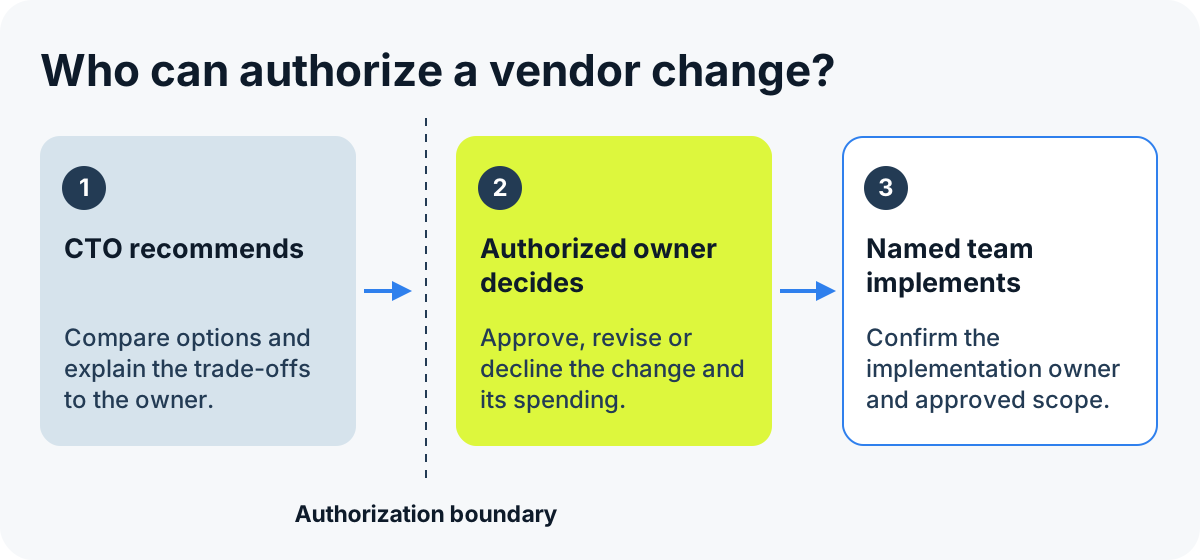
For example, recommending a vendor change is different from authorizing it. Leading an engineering review is different from supplying the engineers who implement its conclusions. Record those differences alongside the access, budget and people the proposed work depends on. Check that the arrangement is workable with the current lead or vendor, not merely understandable to the sponsor.
This adapts the boundary-and-escalation principle in GOV.UK's governance guidance, last updated on May 23, 2016 for UK public services. It is a useful discussion pattern, not a private-company contract standard. Agree the actual decision rights with the appropriate owners.
What exactly will you accept first?
Name the first result before discussing a broader engagement. Use the diagnosis already available to frame the work; investigate only a remaining uncertainty that materially affects that result, rather than automatically restarting the assessment.
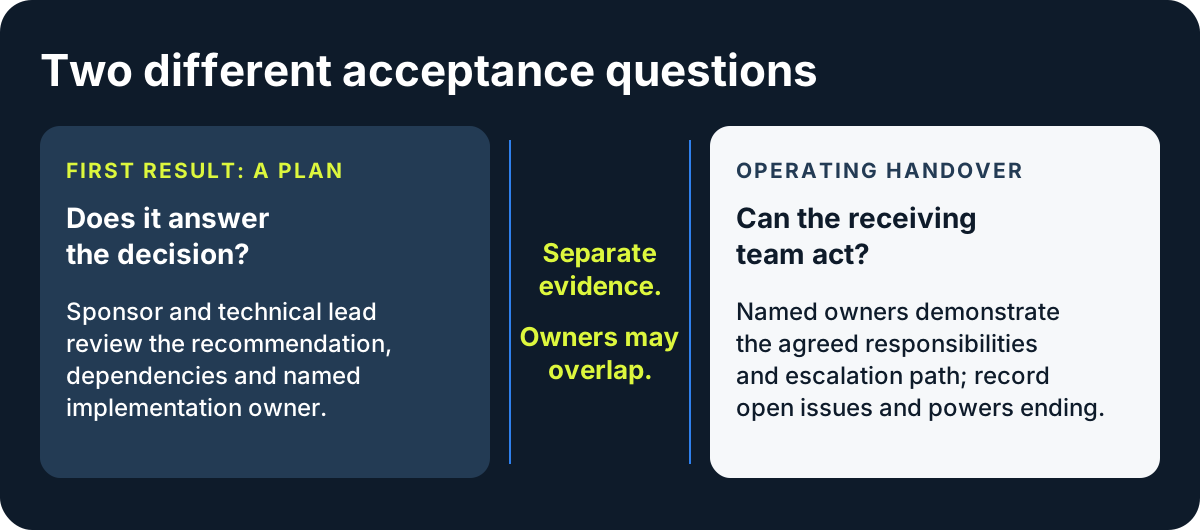
For a plan, acceptance concerns whether the recommendation answers the agreed decision and explains the proposed work. For leadership, specify the decisions and review responsibilities being maintained. For an implemented release, agree what working evidence the acceptor needs, including the environment and any manual, mocked or unfinished steps. A test demonstration alone does not establish production readiness.
Separate the person leading the work, the implementation owner and the person authorized to accept the result. They may be different people. Ask the acceptor what they need to inspect; agree the conditions together. Identify who will resolve a blocked dependency, such as missing integration information or implementation capacity.
After review, who decides whether to proceed, revise the scope or stop? Acceptance of a plan is neither acceptance of a shipped fix nor an automatic commitment to implementation.
How will the CTO work with your team or vendor?
Test the proposed mandate against the team that will execute it. Ask how the candidate would turn the agreed business priority into work moving through product and engineering. Which sequencing decisions would they personally make? Which remain with the current lead? Who would carry out the work?
For comparable past work, ask what delivery cadence they helped establish and why it suited that situation. The useful evidence is their reasoning and responsibility, not the name of a methodology. You are not buying a generic instruction to replace the backlog, restructure the team or adopt a particular ceremony.
For your engagement, agree who maintains priorities, who reviews progress and which evidence informs those reviews. Give the vendor or engineering lead room to identify dependencies and capacity constraints before assigning responsibility. CTO oversight is not a substitute for implementation resources.
Ask: Who can reorder the backlog in the second week, and who tells the vendor? Distinguish engineering sequencing from changing product priorities. Then ask who decides and handles escalation when the CTO is unavailable. Agree reserved capacity—the time the CTO commits to this work, if any—and how decisions outside that involvement are covered.
When a new request changes the priority or required capacity, identify who can approve the change and what existing work it displaces. Keep the review focused on those decisions, working evidence and unresolved blockers—not a second reporting system disconnected from how the team works.
How will control transfer?
Agree the receiving side of control before treating handover as a final administrative task. For the access, code, knowledge and recurring decisions in scope, name the sender, receiver, required authorization and unresolved dependency. Keep the first-result acceptance separate from the later transfer of operating responsibility.
Ask what the receiving person will need to understand and do. Horizon Labs' guidance on observed knowledge transfer, marked “Last substantive review: August 2026,” proposes having the receiver perform relevant work while the knowledgeable person observes. It concerns CTO transitions; apply it here by analogy, not as proof of recovery effectiveness. Agree a suitable walkthrough in an approved environment, within the receiver's permissions, and record unanswered questions.
Keep technical custody separate from ownership and permitted use. Repository access does not settle contractual or intellectual-property questions; route unresolved rights to the appropriate qualified advisers. A CTO cannot grant themselves another party's authorization.
Name who receives ongoing decisions, which temporary powers end, what remains open and what later support, if any, is agreed. Ending the temporary role need not mean every historical problem has been fixed.
Warning signs worth questioning
The sources offer discussion prompts, not a validated candidate test:
- Decision boundaries have no escalation owner. GOV.UK says teams should know their authority, its boundaries and who helps with decisions outside them. Ask the sponsor and candidate to resolve that gap before relying on the mandate.
- The temporary lead becomes indispensable. Horizon Labs lists all decisions and production actions routing through one person as a transition failure mode. Ask which decisions the receiving team will be able to handle.
- Access changes outrun continuity checks, or documents substitute for rehearsal. Horizon Labs flags changing ownership before replacement credentials are tested and accepting runbooks only their author has used. Ask the authorized owners how they will verify continuity and receipt; this is not an instruction to change access yourself.
A mandate that stops at a plan—not a release promise
Invented editorial example, not a client case or an actual candidate interview. A team has a diagnosis of a broken account-preference save flow and a roadmap item to repair it. The team can implement; the sponsor needs an adviser to turn the existing diagnosis into a decision-ready plan. One dependency remains open: whether the mobile client relies on the same settings API. These are proposed terms for the illustration, not an agreement.
| Mandate and milestone field | Proposed entry |
|---|---|
| Contribution and stopping point | Review the existing diagnosis and recommend the repair sequence; stop at sponsor review of the plan |
| Delegated decisions | Sequence the remaining technical checks within the account-settings item |
| Retained decisions | Product owner defines the saved-preference behavior; sponsor approves the release commitment and any scope change |
| Exclusions and escalation | Specialist security review stays outside this advisory remit; sponsor arranges it if needed and resolves scope or spending questions |
| Implementation | Current engineering lead and team, not supplied by the adviser |
| Inputs and acceptance | Sponsor and technical lead review the plan against the existing test recording and issue record; it must explain the shared-API dependency, identify the implementer and specify evidence needed for a later release decision |
| Capacity and cover | Candidate proposes involvement for agreement; engineering lead handles technical questions outside it, with scope and spending escalated to the sponsor |
| Receipt and next decision | Engineering lead receives the annotated plan and open questions; sponsor then chooses whether to commission implementation, request evidence or stop |
Use that same brief to hear how candidates handle the limits. The stronger and weaker responses below are editorial illustrations of scope reasoning, not quotations or a hiring score.
| Ask the candidate | Stronger answer for this brief | Weaker answer for this brief |
|---|---|---|
| What can you commit to before the dependency is confirmed? | A plan showing how a shared API would affect the repair sequence and what must be checked before committing to delivery | A fixed release promise based only on the diagnosis |
| What happens if you recommend replacing the vendor? | Explain the evidence and implications to the sponsor; keep the current remit until a change is authorized | Treat the CTO title as permission to replace the vendor or approve spending |
| Who runs the work when you are not involved? | The engineering lead handles execution; sponsor resolves scope and spending; agree any additional cover explicitly | All decisions wait for the adviser, despite a plan-only remit |
| What would count as your handover? | The lead can explain the plan, dependency and next decision; later operational handover belongs to a separately agreed scope | Send a folder of documents and call both advice and operational recovery complete |
An implementation brief would require a different answer: a plan alone would be insufficient. Likewise, if the current lead already has the decision rights, evidence and capacity to execute an accepted repair, another recovery CTO may add no missing contribution.
Bring the unresolved choice to the curator
Bring the diagnosis, roadmap and the proposed mandate: contribution, decision rights, first result, acceptor, implementation owner and receiving lead. Use the example above as a discussion aid, replacing its terms with your own. Share only permitted material; keep credentials and confidential records out of public forms.
Discuss your recovery question and fit with the Grand Rounds curator. Agree expert participation and the actual leadership scope separately; a conversation does not delegate operational authority.
Boundaries
Grand Rounds is an initiative of Dinarys, and a conversation may lead to cooperation with Dinarys.