
If your practice has bought AI licenses, the visible result may be a faster first draft. The operational question is different: does the team have more capacity once checking and corrections are finished?
Start with the whole deliverable, not the drafting tool. For a COO or practice lead, the useful question is: what work does it take to turn a request into an approved, usable output, and where does that work repeat?
This is a way to investigate. Your existing search, templates and manual review may already be adequate, and a descriptive baseline can reveal a worthwhile change or show that a rebuild would solve the wrong problem.
Why recurring research and proposals can restart from scratch
Research: finding a document is not finishing the search
Consider a recurring market research brief. An analyst locates a relevant report, but still needs to establish its date, scope, source and suitability for this assignment. The team must also know whether it may use that material in the intended environment.
Look for repeated questions: Which sources are authoritative? What changed since the previous brief? Can the reviewer trace a conclusion to the supporting passage? Is an apparent gap genuinely missing evidence, or just something nobody has found yet?
These are candidate explanations. A careful search may be necessary because the question is new, while repeating the same permission check because the earlier decision cannot be found is a different kind of work. Record the distinction before trying to remove either.
Proposals: a previous answer is an input to check
A previous proposal can supply a useful structure, but its client details, pricing, delivery commitments or examples may belong to another engagement. Even approved wording may answer a different scope.
For a recurring research-services proposal, identify what can be reused unchanged, what needs current confirmation and what must be excluded. Ask whether the writer can find the approved version and whether the reviewer knows which sections were reused.
The problem might be an unclear request, missing source ownership or ambiguous approval rather than the act of writing. A well-maintained template might already handle the repeatable part. Adapting the substance to a new client is part of expert service, so do not count it as avoidable work.
Follow one deliverable through approval and handoff
Choose one recognizable operation, such as a standard research brief or a proposal for a defined service, and keep research and business development separate rather than averaging them. State the start, the acceptance point and the recipient of the finished work.
Use this sequence to observe the current process, including any AI assistance already in use:
- Request and preparation. Clarify the question, audience and output. Establish allowed sources, access and reuse permissions, confidential exclusions and the permitted working environment. Include time spent obtaining those decisions or preparing redacted inputs.
- Search and selection. Locate sources or reusable sections, check versions and relevance, and record why material was included or rejected.
- Draft and assembly. Write or adapt the deliverable. Include briefing a tool, preparing inputs, inspecting alternative outputs and assembling the document, beyond generation time.
- Check. Verify material claims against originals. For a proposal, check scope, assumptions, commitments and confidential content as well as factual support. Identify who can accept the result.
- Correction and repeat review. Log what was returned, why, what changed and the work needed to check the revision. Keep further loops visible rather than hiding them inside “drafting.”
- Approval and handoff. Record the acceptance decision, final version, supporting source references, unresolved limitations and delivery to the next owner. Keep any post-approval packaging effort identifiable.
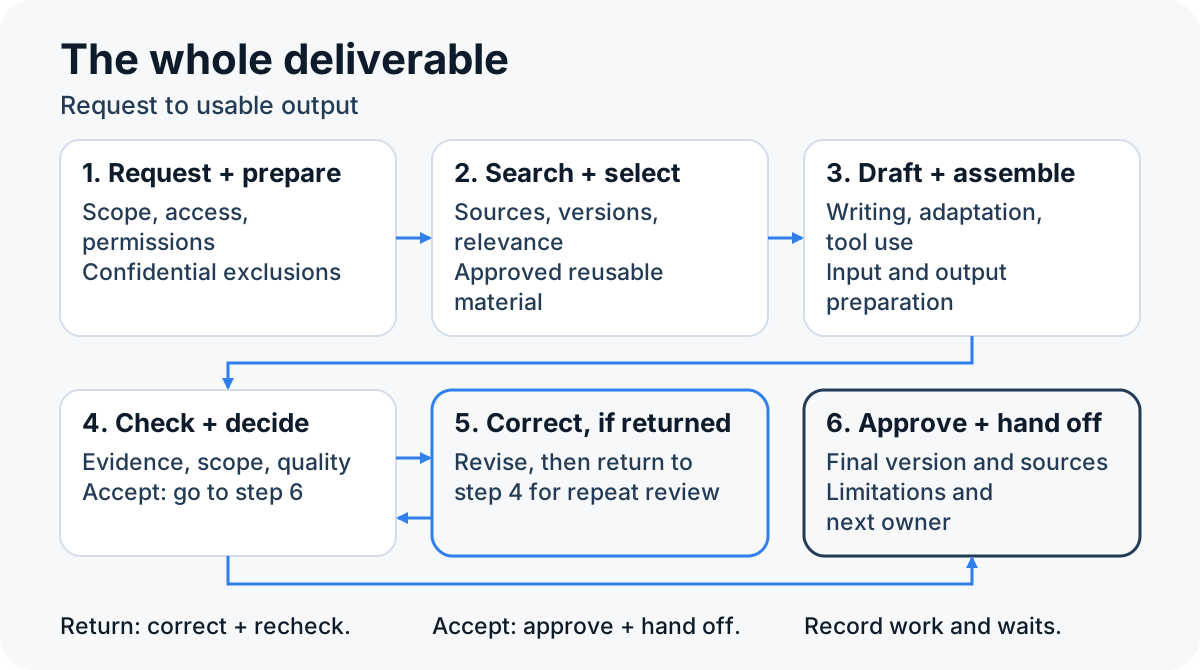
In words: prepare and establish permissions; search; draft; check; correct and check again as needed; then approve and hand over. A quick draft is only one stage in this sequence.
Keep active effort separate from elapsed time
Active effort is the time people spend doing the work. Record it by role and activity, counting each person's time once. Include the reviewer's effort as well as the author's. When two people work at the same time, both sets of minutes count toward effort, while the clock counts that shared interval once. Tag a block of time with a single activity so the same minutes are not counted under two labels.
Elapsed time is the time between the defined start and finish. State whether you use calendar or working hours. Record waits for access, clarification or approval separately, with their reasons. Another colleague may be working during a wait, so waiting labels need not add up.
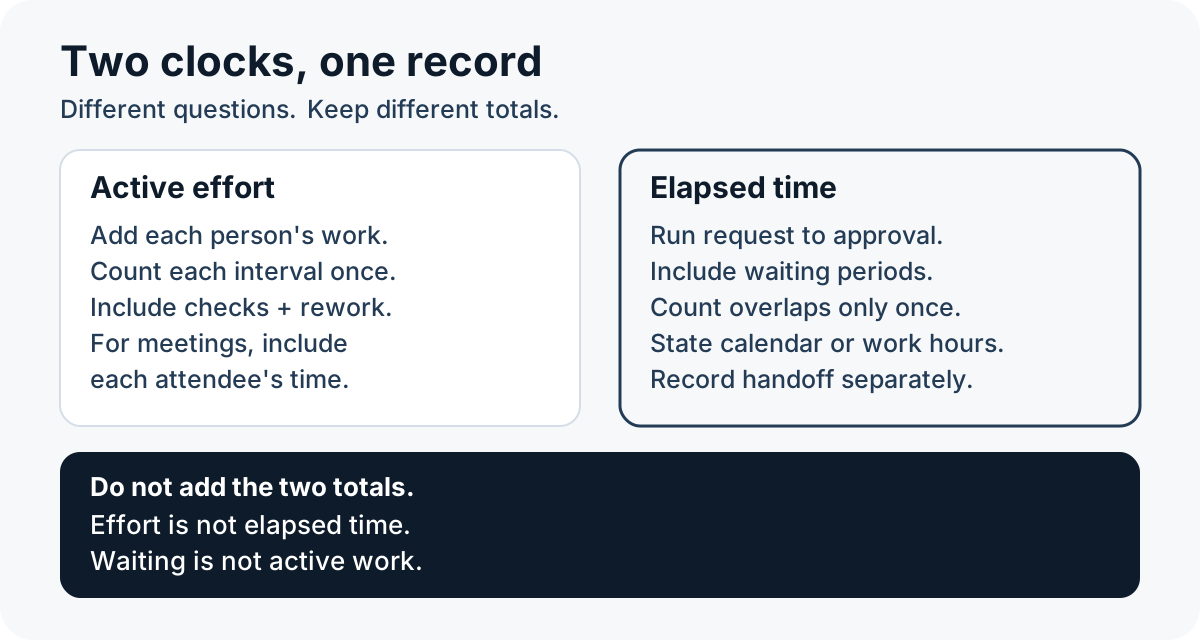
Keep effort and elapsed time as two separate totals. A long approval wait is not automatically recoverable expert capacity, and reduced drafting effort is not automatically additional client work. Those conclusions need evidence about workload, reviewer availability and what the team can actually take on.
A baseline record you can use without a new system
A simple shared record is enough to start, provided it sits in an approved location. Use it to describe the process; individual productivity and staffing are separate questions. Keep links to restricted material access-controlled, so the record itself does not become a new store of client secrets.
Record one completed deliverable
- Boundary: deliverable type, request received, approval recorded and handoff completed; define each timestamp.
- Context: scope, complexity, urgency, source availability and any change to the request.
- Inputs and permissions: source/version references, approved reusable material, exclusions and outstanding access questions.
- Current method: manual steps, templates and any tools actually used; note material settings or instructions needed to understand the work.
- Active work: role, activity, time or bounded estimate, and supporting record where available. Label recalled estimates and missing time as such; record missing time as unknown rather than zero.
- Waiting: when it started and ended, what was awaited and any overlap with other work. Include approval and access queues.
- Review and corrections: issue, seriousness, cause if known, revision and repeat-review effort. Separate changed scope from errors in the original output.
- Acceptance and handoff: who accepted it, against which requirements, final version, open limitations and receiving owner.
Agree quality expectations before interpreting the time record. Could the reviewer trace material claims to suitable sources? Were important contrary findings or uncertainties retained? Did the proposal address the actual brief and keep another client's information and unsupported commitments out? Was the approved output usable by its recipient?
A filled baseline: one fictional research brief
Invented teaching record, not observed practice performance. The mock brief has one author, one reviewer, one correction loop and a permitted source pack. Each person's active time is counted once:
| Activity | Author minutes | Reviewer minutes | What the mock record says |
|---|---|---|---|
| Request and permitted-input preparation | 20 | 0 | Scope and source-use questions clarified |
| Search and source selection | 35 | 0 | Current report located; reusable-source index absent |
| Draft and assembly | 30 | 0 | First draft completed |
| Initial source/content check | 0 | 25 | Reviewer returns one unsupported comparison and one outdated source |
| Correction | 15 | 0 | Comparison narrowed; current source substituted |
| Repeat review | 0 | 15 | Changed claims and their supporting passages checked |
| Approval packaging and handoff | 10 | 0 | Final version and source references delivered |
| Active effort | 110 | 40 | 150 person-minutes |
The invented request arrives at 09:00 and handoff completes at 15:00: six elapsed hours, set beside the 150 active person-minutes rather than added to them. Access and review waits would need their own timestamps before assigning a cause to the elapsed delay.
Drafting is 30 of the 150 person-minutes; the correction/recheck loop is another 30. That identifies where to investigate; whether either block can be removed is a separate question. First ask whether the missing current-source index explains repeated search or outdated citations across comparable briefs. A faster drafting tool leaves that question open.
Counter-case: if the next brief uses a genuinely new evidence base, redoing the source search may be necessary quality work. If a tool shortens drafting but increases correction and review, the whole-deliverable record may show no additional capacity. First-draft speed alone cannot settle either conclusion.
Where AI is involved, testing it in a realistic setting matters. The NIST AI RMF Playbook, MEASURE 2.1 and 2.3 suggests documenting test sets, metrics and tools, and demonstrating performance under conditions similar to deployment. That guidance concerns AI risk measurement; a time saving for your practice is a separate question for your own baseline. This baseline is a starting record, not a full AI assurance process.
Repeat the observation before deciding what to change
One deliverable shows how one case went. Observe further comparable cases, including ordinary work and relevant exceptions. Keep an urgent bespoke proposal separate from a routine renewal, and distinguish a clean source pack from one requiring access resolution. Explain exclusions rather than quietly removing difficult cases.
Look at the records with the people responsible for the work. Does the same approved section keep being reconstructed? Do corrections arise from weak evidence, a changed brief or unclear acceptance criteria? Is elapsed delay mainly a review queue while active effort is already modest? Are source checks doing necessary quality work?
The response can be smaller than a new AI workflow. Clarifying the request, making approved material easier to find, updating a template or making review ownership explicit may be sufficient, and keeping the current method is also a valid conclusion. Choosing a tool, commissioning a build or selecting a partner is a later decision.
Start with your process, quality and IT owners
Select one recurring operation and bring its process owner, quality reviewer and IT/security owner together. Confirm the boundary, lawful and permitted use of examples, acceptance requirements and how to capture effort and waiting without burdensome surveillance. Then describe the next comparable deliverables through approval and handoff.
The output should be a shared account of where work goes, which exceptions matter and what remains unknown. If outside technical decision support would help, you can ask the Grand Rounds curator whether an upcoming session fits that specific question. Begin with your own evidence, then compare it with anyone else's productivity claim.
Boundaries
Grand Rounds is an initiative of Dinarys, and a conversation may lead to cooperation with Dinarys.