
Before you compare providers, decide who the review is for. A founder preparing for investor questions and an investor testing a founder's claims need different evidence, different access and a different report recipient. Several providers serve both, so the same firm can offer a founder-side or an investor-side mandate with different conflicts.
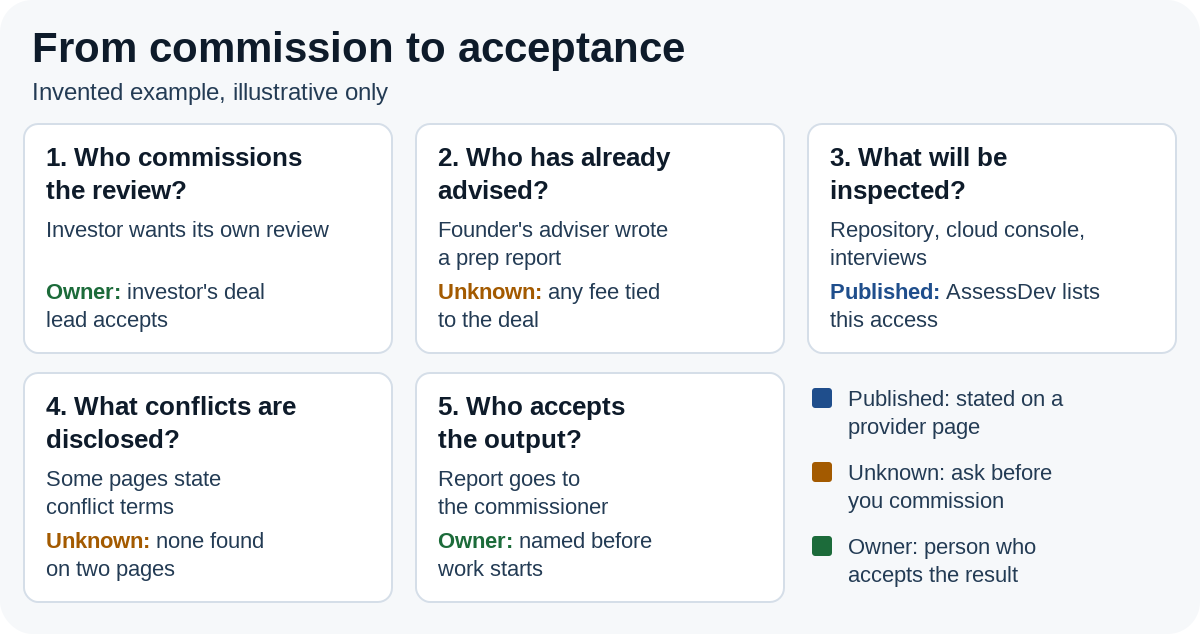
Short answer. Choose founder preparation or investor-side review first. Then compare each provider on what it says it inspects, who receives the report, which conflicts it discloses, whether you can see a sample, and who accepts the result. A founder's adviser is not automatically an independent investor reviewer. Anything a page does not say stays unknown below.
Our interest. Grand Rounds is an initiative of Dinarys, and a conversation may lead to cooperation with Dinarys. Grand Rounds has its own technical due diligence service (Technical Due Diligence: Founder Preparation or Investor-Side Review?), so it appears below as the publisher's own option, in its own published words. This page is an illustrative shortlist, not a ranking or a census of the market, and it names no winner.
Who commissions and relies on the review?
Table 1 uses only what each provider's own page said when we read it on 18 November 2026; the last row is a prompt for you, not a finding. No page carried its own publication or update date, so treat each row as a snapshot and re-read before relying on it. We did not request quotes, speak to providers or see any gated report. Quotation marks show the provider's own words.
Table 1. Scope, evidence and conflict statements as published
| Route | Who the page addresses | What it says it inspects | Conflict statement published |
|---|---|---|---|
| Grand Rounds (publisher's own service) | Founder preparation; investor-side review is described as a separate mandate for the commissioning investor | "The relevant product and version, artifacts, sources, access and method, including inspection limits" | Conflicts to be "addressed openly"; founder preparation "is not automatically an independent investor conclusion" |
| AssessDev | Investors (VCs, angels, accelerators, grant givers); founders through a Fundraising Readiness Check | Product, code, architecture, security, engineering team and technical claims; 243 criteria in 14 areas; read access to repositories, cloud console and task board | "We have no financial interest in the startups we review"; reviewers do not say whether to invest; an investor is told of an earlier check on the same startup |
| TechCXO | Commissioner not named for the due diligence service; the page is headed "Investor & Transaction Services" and lists a separate Sell-Side Tech Assessment | Product, architecture, deployment, IT, process, team, security and AI | None found on the page; the page also describes post-close fractional support |
| Metamindz | "companies, investors, scaleups and startups"; diligence recipient not stated | Code, architecture, infrastructure, security, AI claims and team | None found on the page; a CTO retainer and optional board oversight are listed separately |
| WearNex | Investors, acquirers, boards, companies choosing a partner, founders preparing | Rapid desk review, or full review with physical Lab testing of key claims | "Before each engagement we check for conflicts of interest, and our findings are our own independent view" |
| Inverisla | Founders and boards | Read-only code access, hosting and deployment set-up, time with whoever runs the system | Any referral arrangement "disclosed before you act on a recommendation"; work with a direct competitor disclosed before starting |
| Your current adviser or CTO | You decide | Whatever you commission | Ask who benefits if the deal closes or the work continues |
Read the table as a map of questions, not a score. A published conflict statement tells you what the provider says, not how it applies to your deal.
Matched career evidence
The two named cases below are personal career work, not Grand Rounds engagements. Both bear on line 8 of the scope sheet below (named reviewers and relevant specialisms): ask a reviewer which public markers, records or sale artifacts they personally prepared or checked.
If the company under review is a credentials or identity product, the closest case on our site is Marton Csernai's, Taking a digital identity protocol from research to mainnet. It describes Marton's role at KILT as Research Lead, Product Owner and Full Stack Developer, with dated public markers: mainnet live on 8 September 2021 after KILT won the sixth Kusama parachain auction, a crowdloan that reached the 220,000 KSM cap, and a May 2023 announcement of Deloitte KYC and KYB credentials on KILT. The page does not show diligence work, availability, certification, independent verification or the same result for a new client.
For a sell-side question, Running a consultancy's technology and SaaS products through its sale describes Neil Taggart's work as Chief Technology Officer. GP Strategies completed the acquisition on 2 February 2017 and named the firm's intellectual property and consulting methods as a reason for the deal. The case does not describe a diligence process.
Limits that should stop a commission
Treat each of these as disqualifying for an investor-side mandate unless it is resolved in writing:
- You cannot name who receives the report and may rely on it.
- Access is narrower than the claims to be tested, for example security claims but no environment access.
- The provider or its reviewers could gain from the outcome (a fee tied to the deal, follow-on work, a referral) and cannot say how that is handled.
- A founder-side preparation report will be presented to an investor as independent.
- The provider cannot say which reviewer does the work.
What will be inspected rather than repeated from the deck?
Ask each provider to list what it will open itself and what it will take from you as a statement. The pages differ in detail:
- AssessDev lists read access to code repositories, the cloud console and the task board, interviews with the CTO, two or three engineers and the product lead, and the architecture overview, pitch deck and product analytics.
- Inverisla says it needs read-only repository access and the hosting and deployment set-up, not production write access or customer data. Its two-day assessment can run from documentation and interviews, and the report states what that limits.
- WearNex says Lab testing of key claims is part of its full review. It describes the rapid review as a desk review, demonstrations and interviews and does not mention Lab testing for it.
- Grand Rounds lists "access and method, including inspection limits" and says findings are separated from "assumptions, estimates, third-party statements and untested plans".
What a sample shows. AssessDev's page shows a preview of a report on Frostrel, "a made-up startup that makes fridge sensors", with claim checks, a scorecard and a risk register; the full sample is sent on request and we did not see it. TechCXO's page describes a "high-level investor dashboard" and "very granular technical recommendations", and we saw no sample. A visible example is evidence of the proposed format, not proof that a provider's outcomes beat any other's. Ask every provider for one redacted or fictional report and check that each finding points to an artifact, record or interview.
Specialist boundaries. AssessDev says its GDPR and EU AI Act checks are not legal advice and that financial models, valuation, tax and the cap table are outside its review. The Grand Rounds page does not promise financing and says its handoff is not a legal IP opinion. WearNex lists wearables, smart garments, connected products and medical and health technology as specialist areas, and the page does not equate that with SaaS review. Domain specialists and the decision owner keep acceptance.
Is the output useful to both investor and operating team?
Table 2. Output, time and price as published (excluding VAT where the page says so)
| Route | Output as published | Time stated | Price as published |
|---|---|---|---|
| Grand Rounds | A "proposed technical handoff": what was examined, what the evidence supports, what remains open, next steps, recipient and maintainer. A separate Technology Assessment page describes a "proposed" decision memo | Not found on the page read | No price; estimates depend on "scoping factors, not a rate card" |
| AssessDev | PDF with one-page summary, claim checks, scorecard, risk register; founder check gives a prioritized list of fixes | Quick Check about 5 working days; Full Review 2 to 3 weeks; Readiness Check 1 to 2 weeks | No figures; "fixed fee, quoted once we know the size of the startup"; Quick Check fee credited against a Full Review |
| TechCXO | Investor dashboard, Key Findings, granular recommendations | "promptly"; no timeframe | No figure; "reasonable cost" |
| Metamindz | Summary for decision-makers and detailed report | 2 to 4 weeks | £5,000 to £25,000 fixed quote, VAT excluded; optional board oversight £500 a month |
| WearNex | Written report, risk register, decision-maker summary, presentation, test results where testing is used | Not stated | No figure stated |
| Inverisla | Written report and prioritized list; working session with leadership or board | Two days, one week, or two weeks for complex estates | Initial assessment from £2,000; full review fee agreed on a scoping call; VAT treatment not established |
Recipient and reliance. AssessDev says its report is for the client who ordered it and that anyone else may read it only with its consent. If a founder commissions a review that an investor will want to rely on, ask in advance about consent and follow-up questions. For what reliance means legally, ask a solicitor; this page cannot say.
Both audiences. An investor needs a decision-ready summary with open items; the operating team needs ordered fixes with owners. Several pages describe a short summary plus a detailed report, which may serve both if the findings share one evidence trail. Remediation is a separate question: the Grand Rounds page says neither a discussion nor a review automatically includes remediation, while TechCXO and Metamindz describe follow-on roles. Ask whether follow-on work is quoted separately and whether the reviewer would take it.
Which proposal fits the same scope and timing?
Providers quote against different scopes, so a price gap may only be a scope gap. In Table 2, Metamindz's range and Inverisla's starting figure measure different things, and four pages give no figure.
Table 3. Worked example (invented, for illustration)
A 12-person software company has an investor's term sheet and a 21-day window that opens when a provider is engaged. The days add up as follows: access granted, days 1 to 3 (3 days); inspection and interviews, days 4 to 12 (9 days); draft to the commissioner, days 13 to 14 (2 days); questions and acceptance, days 15 to 21 (7 days). A published "2 to 4 weeks" is 14 to 28 days. If the clock starts when access is granted, 14 days ends on day 17 and fits; 28 days ends on day 31 and does not. The pages we read do not say when their clock starts, so ask.
| Decision | Answer in this example |
|---|---|
| Evidence-backed choice | Commission an investor-side review, because the only existing report is a founder-side preparation |
| Unresolved condition | Whether the founder's adviser earns any follow-on fee: unknown |
| Accountable next action | The investor's deal lead sends all shortlisted providers the same scope sheet before the window opens; the founder's technical owner confirms the access list by day 3 |
Send every provider the same scope sheet:
- Commissioner, recipient and who may rely on the report.
- Product and version to inspect.
- Access list and who grants it.
- Interviews required.
- Deadline and when the clock starts.
- Conflicts, referrals and follow-on work to disclose.
- A sample report, redacted or fictional.
- Named reviewers, relevant specialisms and what each personally prepared or checked.
- Price unit, VAT and what is quoted separately.
- Handover and the person who accepts the output.
A proposal fits only when two providers answer the same ten lines. If one cannot, record the gap and do not compare prices yet.
Next step
First use this comparison with your current team: pick founder or investor side, write the scope sheet and name who accepts the result. If a decision or expertise gap remains, take the decision, deadline and evidence to the relevant Grand Rounds service or curator; any engagement is separately scoped.
If the open question is whether the technology can support a business decision before any leadership mandate, see Technology Assessment & Architecture Review. To see the experience of our network, read Meet the CTOs. To discuss whether your company could be selected for the next Grand Rounds event, use Talk to the person shaping the room. The Grand Rounds technical due diligence page says the conversation does not commission diligence or establish current expert availability or engagement terms.
Unknowns on this page
- No page carried its own publication or update date; nothing was verified beyond each page's own text on 18 November 2026.
- TechCXO and Metamindz state no conflict policy on the pages read; TechCXO and WearNex give no fee figure on the pages read, which says nothing about what they charge.
- Provider claims, such as AssessDev's 243 criteria, are self-reported and not independently verified.
- Current availability, full contracts and the gated AssessDev sample were not inspected.
Pages read, 18 November 2026
AssessDev, TechCXO, Metamindz, WearNex, Inverisla, Grand Rounds technical due diligence, Grand Rounds technology assessment.