
Buy for an enforcement point you can inspect, not a governance label. A recorded event, a blocked operation and an authorized decision are different findings: a runtime pause does not supply the authority to approve an action.
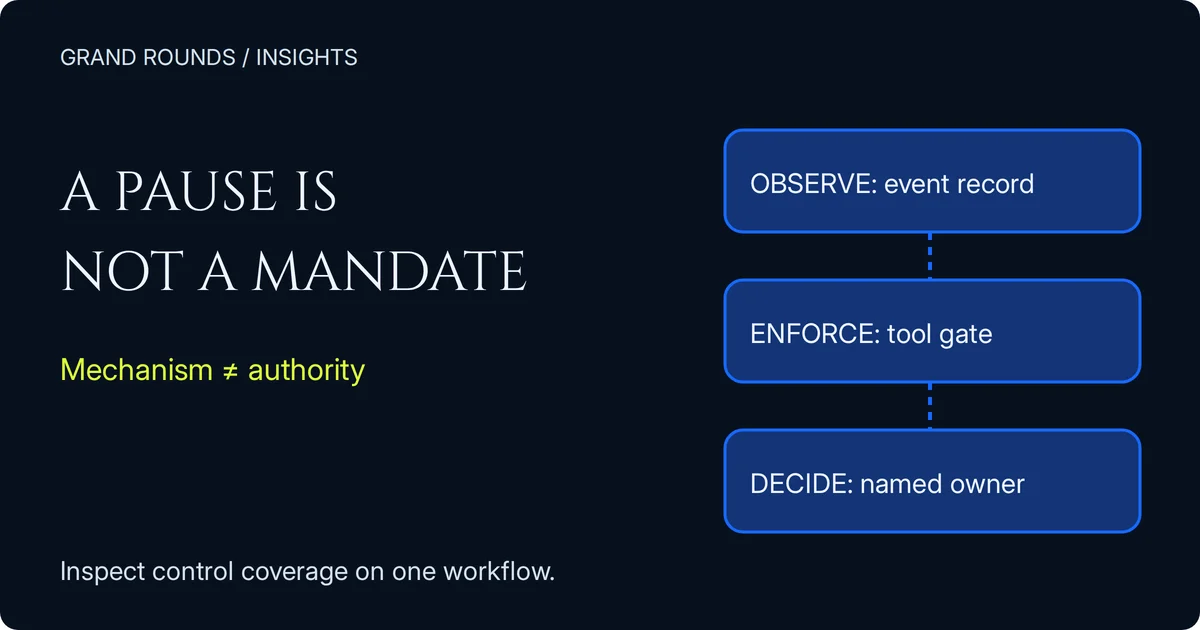
What can a governance platform enforce—and which decisions still need a named owner? A dashboard that records an agent's behavior, a runtime that pauses a tool call, and a person authorized to release a financial case note perform different jobs.
This is not a ranking of governance suites. Three documented framework controls below illustrate one layer: pausing a proposed operation. Apply the coverage matrix to a suite, runtime control or current process on the same workflow. The category may be sold as an AI agent governance platform or an agentic AI governance platform; neither label establishes coverage. Existing search, a fixed review process or your current provider may suffice.
Keep one workflow constant
Use this invented editorial workflow throughout the comparison: prepare an internal financial-document case note from permitted sources, present claim-level evidence to a qualified reviewer, and propose attaching the reviewed version to a case-management record. No investment decision, payment, client message, or autonomous financial sign-off is included. No system has been run or action performed for this example.
Identify who may authorize the proposed attachment, which domain reviewer judges its support, and who accepts access and operating controls. Technical configuration and business authority need separate evidence; a role named in a plan is not an accepted responsibility.
Compare every candidate—including the current manual process—on the same permitted packet, user, review question, and destination. Otherwise a narrower task can look like a more capable platform.
Separate observing, enforcing, and deciding
- Observing records an event or flags a concern. Ask whether it happens before or after restricted data or an external action has crossed a boundary.
- Enforcing prevents or gates a defined operation through a mechanism you can inspect. Ask where it applies, which paths bypass it, and what happens when a dependency fails.
- Deciding establishes whether the evidence supports the use and who may authorize it. A technical mechanism does not supply that mandate.
A platform can contribute at several layers. Do not infer retrieval authorization from an output filter, or competent human review from a pause/resume feature. A useful comparison identifies the enforcement point and the residual responsibility for each control.
What current primary documentation actually establishes
The examples are runtime/control components, not complete governance suites. Their primary documentation describes the behaviors below; the selected version, application and integrations still matter. None was tested on the invented case. If engineers are building on one of these frameworks, ask about its documented pause behavior. If buying a suite, apply the matrix to that vendor's own evidence instead.
| Component and primary documentation | Documented contribution | Boundary still to address | Fit conditions to test — inference, not a ranking |
|---|---|---|---|
| OpenAI Agents SDK: human-in-the-loop | Tools can require approval; pending calls surface as interruptions; saved run state can resume after approval or rejection. | The application must authenticate and authorize the reviewer. Deserialization does not authenticate snapshot or submitter; approval does not guarantee exactly-once external execution. | Fits an SDK application with server-side pending state and reviewer checks. Falls short when those are absent or a repeated call cannot be handled safely. |
| LangGraph: interrupts | Pause for external input, checkpoint state and resume using the thread identity. | Production persistence needs a durable checkpointer. The interrupted node restarts; earlier side effects can repeat. | Fits when persistence exists and pre-interrupt work can safely run again. Non-idempotent side effects before the pause need a different arrangement. |
| Amazon Bedrock Agents: return control | Return proposed API/function inputs and an invocation ID to the application instead of fulfilling the action through Lambda. | Returned control is not human approval, reviewer authorization or an end-to-end recovery record. | Fits when the application owns execution and records who decided what. Falls short if the buyer expects the return-control feature alone to supply those checks. |
These are different integration shapes: approval-bearing tool call, graph interruption and action proposal returned to the application. The last column gives conditions to test, not a winner. For approval-packet design and changed payloads, see Human-in-the-Loop AI Agents: Who Can Approve External Actions?
Keep vendor claims and your observations separate. “Documented” means the source describes a capability. “Configured” means your implementation includes it. “Observed” means a permitted check produced inspectable evidence. “Accepted” requires the responsible owner's decision within a stated scope.
Compare platforms with the control-coverage matrix
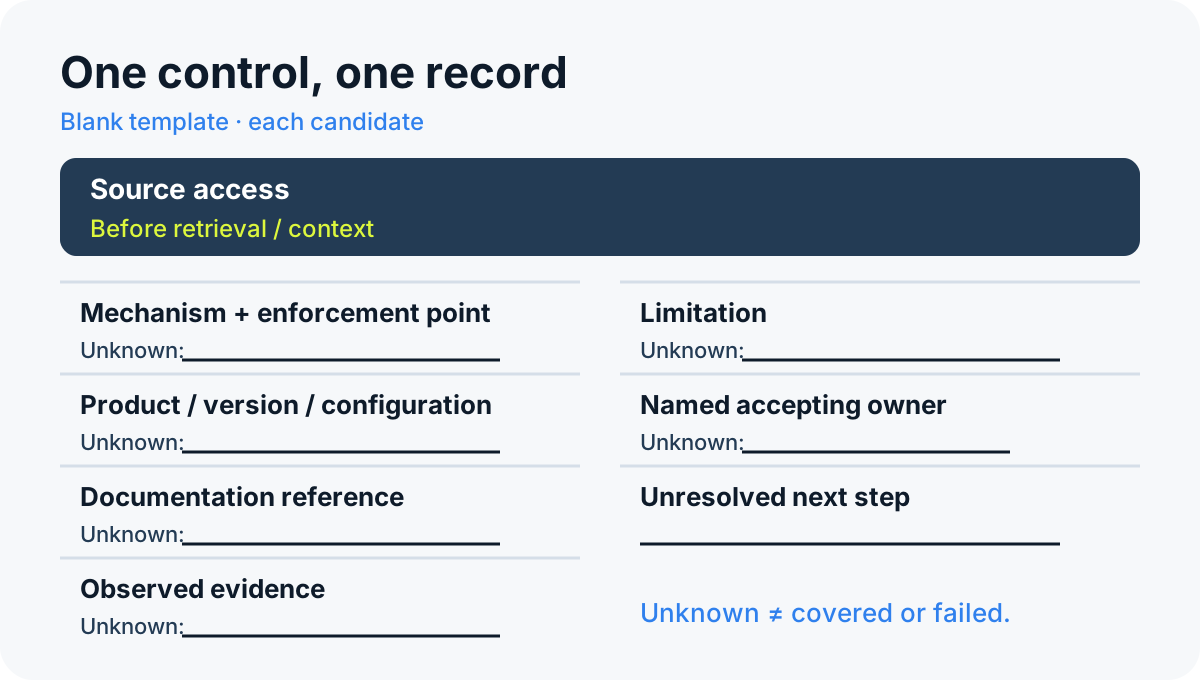
Create one copy per candidate and one for the current process. For each row, record mechanism and enforcement point; product/version/configuration; documentation reference; observed evidence; limitation; named accepting owner; unresolved next step. Start unverified fields as Unknown, not “covered.”
| Control on the same case-note workflow | Evidence to request or plan in an authorized evaluation | Responsibility that remains human |
|---|---|---|
| Source access before retrieval/model context | Which identity and source permissions are used; a permitted/denied-role comparison; what reaches context | Data owner and security reviewer accept the relevant boundary |
| Source support and applicability | Exact supporting fragments, document versions, missing/conflicting material | Domain reviewer judges whether claims are supported |
| Proposed attachment | Destination, proposed output version, action details, and where execution is gated | Authorized person decides whether this version may be attached |
| Reviewer identity and scope | Evidence that the responder is entitled to decide this pending case/action, not merely signed in | Authority holder confirms the mandate; IT/security evaluate its implementation |
| Rejection, no response, or changed evidence | Behavior while approval is absent or conditions have changed; expiry/re-review policy | Process/risk owners define when to stop or obtain a fresh decision |
| Failure after an attempted attachment | Action identity, destination result, repeated-attempt handling, unresolved outcome | Operational owner accepts recovery/escalation; uncertainty is not assumed safe to replay |
| Evidence retention and operation | Accessible decision/action records, permitted retention, support ownership, review effort | Data, operations, and relevant specialists accept their respective parts |
This matrix is a coverage record, not an additive score. An attractive result on five rows cannot compensate for an unresolved required permission boundary. Conversely, an unmeasured control is not automatically an observed failure: identify what evidence is missing.
For source permissions and claim-support testing, see AI Evidence and RAG Evaluation: What Should a CTO Accept?.
A difficult variant changes the purchase question
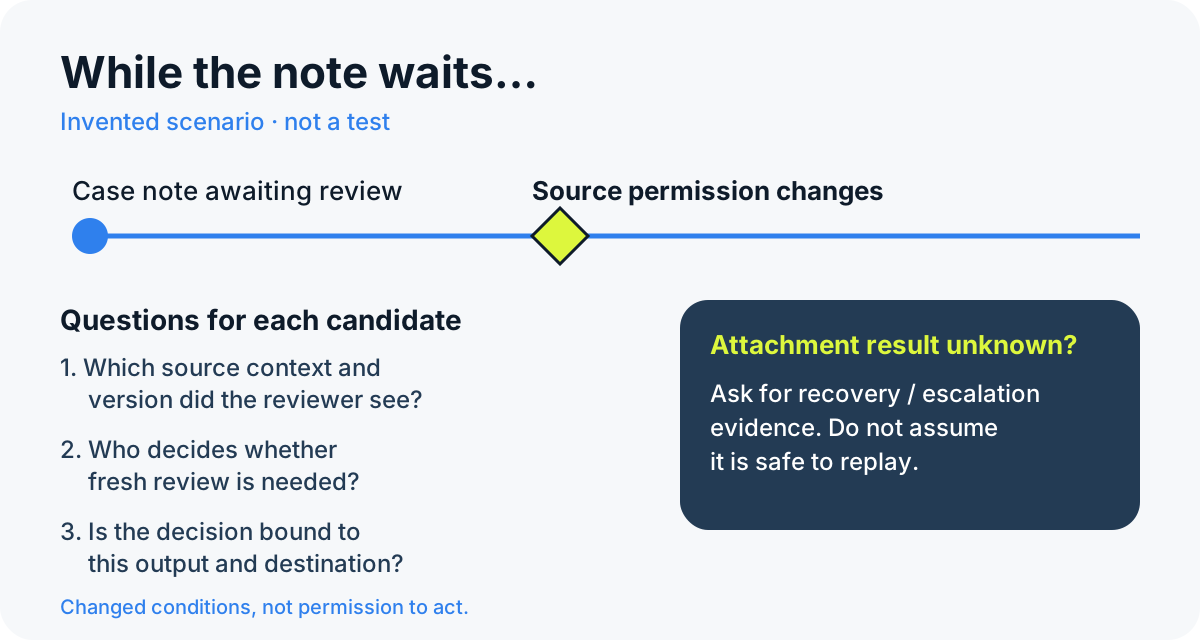
In this invented, unperformed workflow, the source permission changes while a note waits for review. Compare the surrounding authority and evidence controls, not just the pause button.
For every candidate, ask the same questions: what version and source context were presented; who decides whether the pending note needs fresh review; how is the resulting decision bound to the intended output and destination; and what happens if the attachment's external result is unknown?
A monitoring product might expose the sequence without blocking it, and a fixed workflow might handle the narrow action adequately. Neither possibility is a test result for the hypothetical case.
Make a bounded coverage decision
Use the matrix to name one of three outcomes: existing coverage is sufficient for the agreed use; a specific integration/control gap needs repair; or an alternative merits a controlled comparison. Include review time, support burden, and fallback—not only the visible pause button.
Take the unresolved rows to the people with authority over them. Do not deploy a live financial workflow to discover whether a demo's claims are true; evaluation needs explicit authorization, an appropriate environment, and synthetic or otherwise permitted data. Technical evaluation does not waive specialist risk, security, or legal review where required.
If the gap crosses several systems and decision owners, ask the Grand Rounds curator about that control-coverage question. Bring the unresolved rows; a conversation does not establish an available CTO or a platform recommendation.
Boundaries
Documented controls are not observations from your workflow. Human authority, permitted information and destination recovery still need their own evidence and accepting owners.
Grand Rounds is an initiative of Dinarys, and a conversation may lead to cooperation with Dinarys.