
A vivid quote can dominate an AI call summary. Check recurrence against account-level evidence before treating it as a buying reason.
This article is for a product company or expert-service firm whose CMO cannot yet reconcile the reasons for wins, losses and churn, and for the technical reviewer who checks how an insight was produced.
A claim-level evidence record makes this checkable. For each insight it keeps the exact wording and scope, the source passages, the accounts it covers, the counterexamples and the reviewer's decision. This article shows how to build that record on one segment decision, and how to use it to compare CRM tags, a classifier and retrieval-based analysis on the same labeled accounts.
Short answer. Pick one decision, one segment and one period. Label a sample of accounts by hand. Run each candidate on those accounts. For every proposed insight, check the cited passage, the label and the denominator separately. Where support is missing, the record says "insufficient evidence". Then choose the simplest approach that meets the bar your CMO and technical reviewer set in advance. That may be the CRM you already have.
What a claim-level evidence record contains
A claim-level evidence record is a table with one row per proposed insight. Each row carries the claim's wording and scope, authorized source passages, a support label, the denominator, counterevidence and a named reviewer. Use four support labels: stated by the customer, inferred by the reviewer, contradicted, insufficient evidence.
| Item | Required evidence |
|---|---|
| Claim | Exact wording and scope: for example, a requirement reported by a defined set of accounts |
| Supporting sources | Authorized source IDs, versions/dates, passages or timestamps, and account/event links |
| Support judgment | One of the four labels: stated by the customer, inferred by the reviewer, contradicted, or insufficient evidence |
| Denominator | Eligible accounts, matched accounts, reviewable accounts, and the subset used for this claim |
| Counterevidence | Won accounts with the same objection, resolved concerns, and conflicting passages |
| Review status | Named internal reviewer, corrections, unresolved questions, and permitted next use |
Give all three options the same job
Define one segment/offer decision, one period, one event and the account population. Give CRM tags, classification and retrieval the same job and the same permitted sources. The CMO owns the categories and interpretation.
| Approach | What to compare | Main limitation to examine |
|---|---|---|
| CRM tags and reporting | Existing reason fields, definitions, and linked source notes | A tag may reflect a rep’s interpretation, not a customer statement; missing and inconsistent tags remain visible |
| Classifier | Whether each account’s permitted material matches a defined category | A correct-sounding label may lack supporting evidence or miss negation, timing, and context |
| Retrieval-based analysis | Whether relevant passages can be found and used to support a bounded answer | Relevant retrieval is not automatically a supported claim; omitted counterevidence can change the answer |
Build one manual reference set
Label the account sample by hand before comparing methods. Separate positive, negative, conflicting and missing-source cases. Preserve account/event mapping and have disagreements adjudicated by the named reviewer.
Put CRM notes, call passages and tickets under one account ID first, and keep unmatched contacts out of account-level counts. The reason–source–account map shows how to keep those joins visible.
Invented comparison: was the buyer evaluating a competitor?
All accounts, sources and results below are fictional. The positive label is: the buyer was actively evaluating a named competitor at decision time.
| Account / outcome | Manual reference and source | CRM tag | Classifier label | Retrieval-based answer |
|---|---|---|---|---|
| B01 / lost | Yes; C01, passage 4: buyer says a named competitor is in a parallel trial | Negative | Yes | Yes, cites C01:4 |
| B02 / won | Yes; C02, passages 2-3: buyer compared two vendors before choosing | Yes | Yes | Negative; finds only the late contract passage |
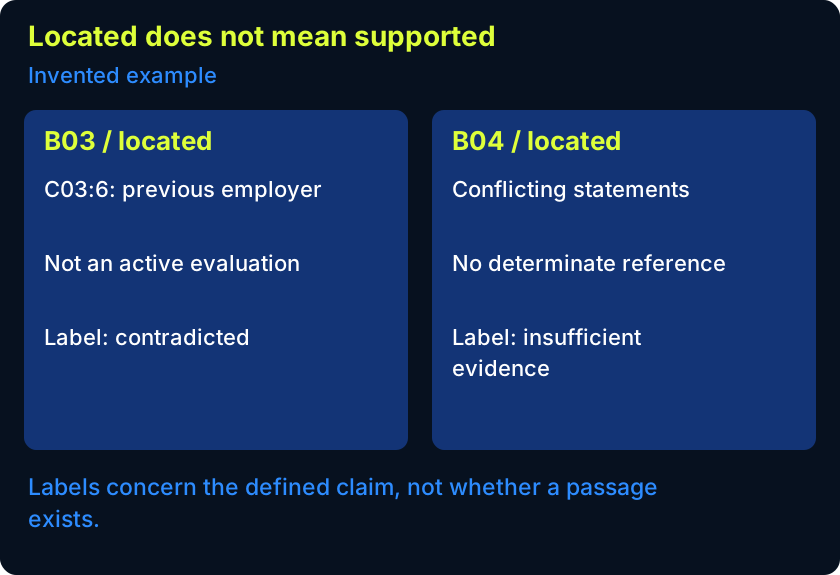
| B03 / lost | Negative; C03, passage 6: buyer mentions a competitor used at a previous employer | Yes | Negative | Negative, cites C03:6 |
| B04 / lost | Unknown; C04 contains conflicting statements about other vendors | Yes | Yes | Abstains and shows the conflict |
| B05 / won | Negative; C05, passage 3: buyer says no other vendor was considered | Negative | Yes | Negative, cites C05:3 |
| B06 / lost | Unknown; permitted customer text unavailable | Negative | Abstains | Abstains; missing source |
For the claim “evaluating a named competitor,” the manual support labels are: B01 stated by the customer (C01:4); B02 stated by the customer (C02:2–3); B03 contradicted in this reference set (C03:6 concerns a previous employer); B04 insufficient evidence (conflicting statements); B05 contradicted in this reference set (C05:3 says no other vendor was considered); B06 insufficient evidence (no permitted text). Yes, Negative and Unknown map to stated, contradicted and insufficient. No account here uses inferred by the reviewer.
Recurrence, not the vivid quote, is the claim: 2 of the 4 determinate accounts evaluated a competitor and 2 did not; 2 further accounts are unknown. Leading with C01 alone would hide that denominator.
Evaluate the four determinate accounts B01, B02, B03 and B05 separately from unknown B04/B06. Precision is correct positive labels divided by all positive labels on those determinate cases; recall is identified positives divided by all manually labeled positives.
| Method | True positives | False positives | Precision | Recall |
|---|---|---|---|---|
| CRM tag | 1 | 1 | 1/2 | 1/2 |
| Classifier | 2 | 1 | 2/3 | 2/2 |
| Retrieval answer | 1 | 0 | 1/1 | 1/2 |
Citation support is a separate check: an existing passage can still fail to establish the label. Outside the fractions, CRM said Yes on B04 and Negative on B06; the classifier said Yes on B04 and abstained on B06; retrieval abstained on both. An abstention reduces recall when a positive case is established; these unknown cases leave the fractions above unchanged. This six-account illustration shows arithmetic only.
Within this invented set, retrieval alone meets a “no false positive” bar, while the classifier alone misses no reference-positive case; CRM meets neither and no method meets both. That shows how a pre-agreed bar changes the choice; another sample, an access failure or an unmanageable review burden can change it.
Make citations carry the claim—not just decorate it
A reviewer checks the exact claim against the cited passage, account, period and counterevidence. Retrieval locates passages; label correctness and citation support each require an explicit disposition. Keep insufficient evidence as a usable result.
Check missingness, bias, and access before choosing
Show which accounts have permitted text and why others are missing. Review selection, deduplication and access before generalizing. Compare total review effort, including identity correction and disputed labels.
Access needs its own acceptance check, because a citation can point to a passage the reader may not be allowed to see. Two questions decide it: is retrieval blocked for restricted roles, and are permission and deletion changes reflected in derived outputs such as summaries and generated views?
Your next step: label the first accounts by hand
Before comparing any method, label a first batch of accounts by hand against one decision, with the named reviewer settling disagreements. The six-account table above only shows the arithmetic; your batch should be large enough to include the segment's difficult cases, and the CMO and technical reviewer should agree its size in advance. Then run CRM tags, a classifier and retrieval on that same batch and choose the simplest method that meets their bar.
Settle the size-setting checklist under "Your next step" in Why Customer Calls, CRM and Churn Data Tell Your CMO Different Stories before you start. Method choice also depends on how mature your reason categories are, who can review labels and whether your current CRM already covers the need. A CTO helps choose the approach, set the evaluation criteria and define controls; your team or the provider you select builds it.
If the first pass leaves identity matching, permissions or reruns unresolved, the next question is who owns that design. Choosing a CTO Adviser for a Trustworthy Customer Insights System turns it into six questions to put to a candidate. To discuss your first labeled results and whether a CTO conversation fits, start with the Grand Rounds curator.
Boundaries
The comparison in this article covers one segment, one period and one decision, and works on permitted, read-only extracts. It tests whether an insight is supported by your records, and it leaves open why an account bought or left. The responsible data and security owner approves which sources may be used and how.
Grand Rounds is an initiative of Dinarys, and a conversation may lead to cooperation with Dinarys.