
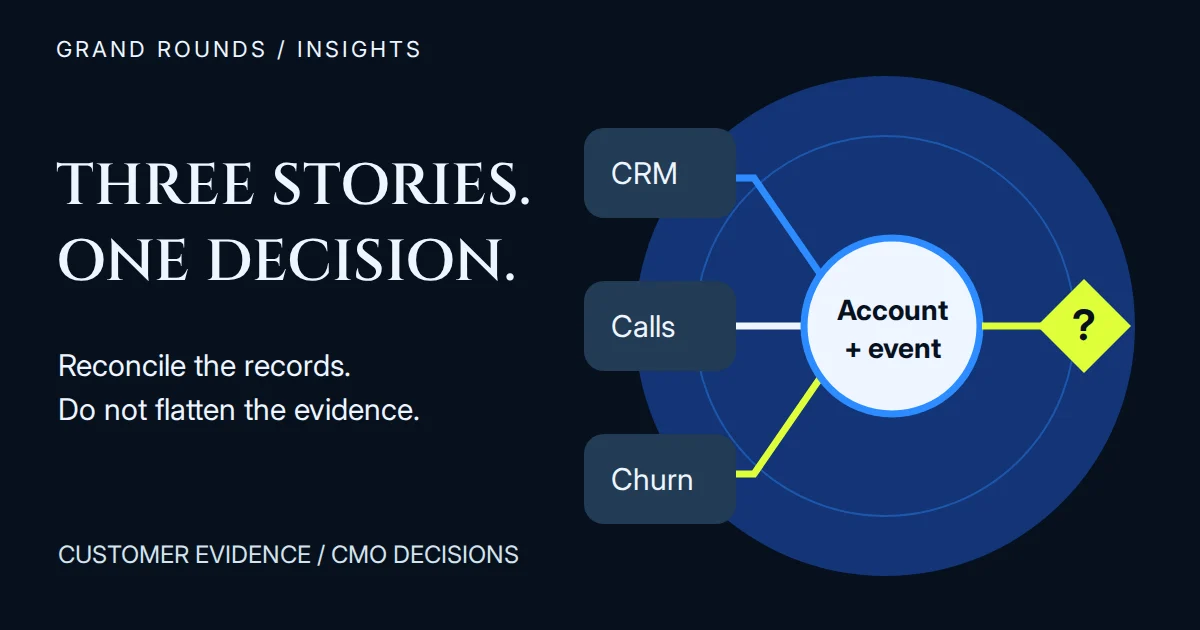
The CRM says "too expensive." The sales call says "we need an integration." The churn report says "low usage." Which story should shape your next offer?
Short answer: all three can be accurate, because each records a different thing about a different set of accounts. A CRM loss reason is a category someone selected. A call is what a participant said in one conversation. A churn record is an event that happened to a customer after they bought. Before you read the gap as a contradiction, check whether the three sources cover the same accounts, the same decision event and the same period.
This article is for the CMO or product-marketing lead who has to choose a segment or change an offer, and for the founder, CRO or RevOps owner who signs off the decision. It shows how to find out which differences are real and how to take a bounded decision while some evidence is still missing.
Different records answer different questions
Treat seller-selected CRM categories, buyer statements and customer churn events as different observations. Match accounts, event dates and periods before reading them together; identify each source’s covered population.
| Record | What it can establish | What still needs checking |
|---|---|---|
| CRM reason: price | The opportunity was coded as a price loss | Who coded it, when, and from what evidence? Was price decisive or one objection? |
| Call: integration requested | A participant raised an integration need | Was it a purchase requirement, a preference, or a request later resolved? |
| Cancellation record | An account ended or reduced its relationship, as defined | What preceded the event? Does a customer explanation exist? |
| Usage or ticket record | A recorded behavior or reported issue | Does it concern this account and decision window? Does it support the proposed explanation? |
Choose the decision before the taxonomy
Write the CMO decision first, then define outcome and reason categories with the reviewers. In the worked example below the decision is narrow: should next quarter's offer for midmarket operations teams lead with price, or with a clearer integration path? That wording tells reviewers which reasons matter (price, integration, no decision) and which source passages count as evidence.
Begin with a manual sample, preserving the customer’s wording and separating stated reasons from reviewer inference.
Build the reason–source–account-ID map
Link every reason to a permitted source passage, account ID and decision event. Keep duplicate contacts attached to the same account and mark unresolved identities outside counted claims. Log corrections and reviewer decisions.
| Field | What to put in it |
|---|---|
| Account and event | Stable account ID, opportunity/renewal ID, segment, and identity-match status |
| Outcome and date | Won, lost, no-decision, retained, or churned; definition and source record |
| CRM reason | Original category, author/date if available, with changes logged separately |
| Customer evidence | Permitted source ID, date, exact passage or timestamp, and surrounding context |
| Candidate reason | Reviewer’s category; distinguish an explicit statement from an inference |
| Conflict or gap | Contradictory evidence, absent call, uncertain link, or unresolved outcome |
| Review and action | Reviewer, review status, and the limited decision the evidence supports |
Worked example: three sources, three populations (invented)
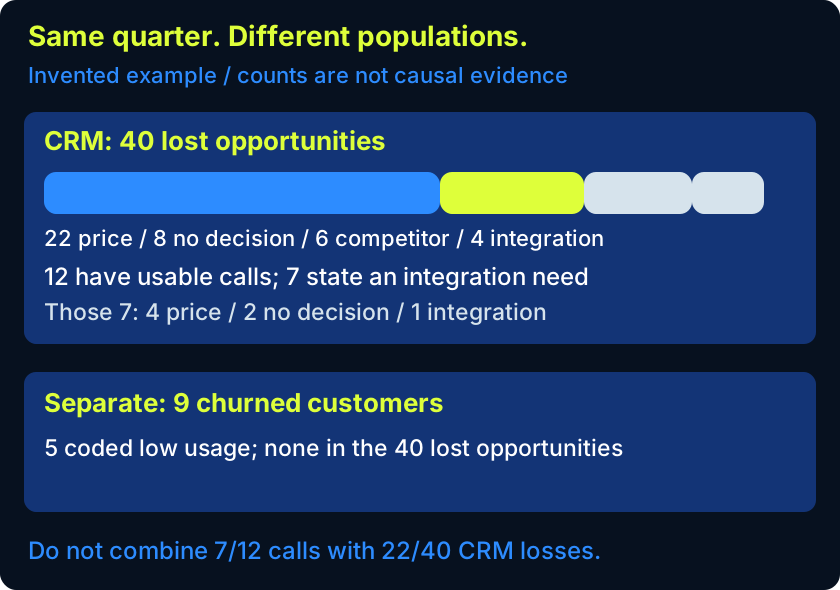
Invented example, fictional teaching material. One quarter, one segment (midmarket operations teams). Every number below is fictional.
| Source | What it holds | Fictional count |
|---|---|---|
| CRM | Closed-lost opportunities and the reason the rep selected | 40: Price 22, No decision 8, Competitor 6, Integration 4 |
| Calls | Lost opportunities with a recording the company may use for this analysis | 12 of the 40; in 7 of those 12 the buyer states an integration requirement |
| CRM and calls together | How the CRM coded those 7 opportunities | Price 4, No decision 2, Integration 1 |
| Churn | Customers who left in the same quarter | 9, of which 5 coded "low usage"; none is one of the 40 |
The 22/40 fraction describes seller-selected CRM reasons. The 7/12 fraction describes integration statements among the 12 usable calls; 28 opportunities remain outside that call sample. Churn describes a separate customer population. Compare matched opportunities and events before drawing an inference across these denominators.
Within the 12 usable calls, 7 buyers state an integration requirement but CRM coded only 1 of those 7 as Integration. That is the gap to investigate, subject to how the 12 calls came to be recorded.
Review the 4 Price-coded opportunities whose calls state an integration requirement, and how the 12 calls were selected: late-stage demos, one team or one region? Until that review is done, the sample neither supports leading with price nor rules it out, so do not commit to either a price-led or an integration-led offer on this evidence alone. After that review, choose between a limited test of a clearer integration path, keeping a price-led offer, and deferral. Causation and the effect of a price change require separate evidence.
The churn row answers a retention question and stays out of this offer decision: none of its 9 customers is among the 40 lost opportunities. Churn would join the decision only if the offer is meant to change retention.
To go from a review list to a counted, citable answer with account and event IDs, see AI Customer Insights That Link Every Claim to Evidence.
Is the gap in the evidence, the process or the tooling?
The field where the map remains incomplete identifies the next repair:
- Outcome definitions or owners are missing: agree what won, lost, no-decision and churned mean before anything else.
- Labels are inconsistent: revise the reason categories and review a sample by hand; your current CRM reporting may be enough.
- Source-to-account links are unresolved: repair identity matching and event dates before counting reasons.
- The review repeats across several sources: compare CRM tags, a classifier and retrieval. The guide linked above walks through that comparison on one set of accounts.
- The customer’s explanation is absent: record the gap and seek permitted direct evidence.
Your next step: choose one segment or offer decision
Choose one segment or offer question, one period and a bounded review list; for the example above, that list is the four Price-coded opportunities. Settle these points first, because they set the size of the work:
- how many sources are involved (CRM only, CRM plus calls, plus tickets or product events)
- whether account and event IDs exist across those sources, or must be matched by hand
- whether you hold the right to analyze the call material for this purpose, and who confirms it
- whether you want a one-off review or a process your team can rerun
- who inside the company owns the reason definitions and who signs off the decision
Keep your first pass read-only: one decision, one population, permitted evidence.
If the review shows that reliable joins and reruns are beyond your team, the Grand Rounds curator is the route to a CTO conversation about them.
Boundaries
The reason–source–account map describes record support and leaves open why an account bought or left. The privacy/legal owner confirms permitted recording, reuse, retention and access. Preserve originals and record corrections separately.
Grand Rounds is an initiative of Dinarys, and a conversation may lead to cooperation with Dinarys.