
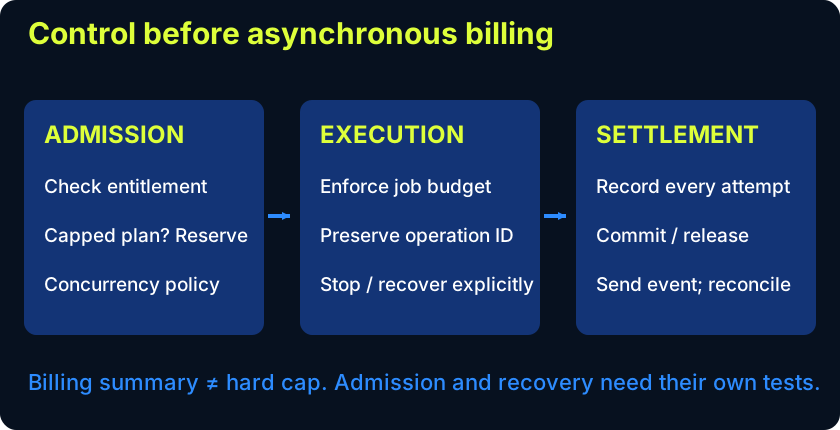
Short answer. Meter a unit the customer can verify and keep an operation-level ledger. Check plan entitlement—what the customer's plan allows—before admitting work, then enforce a budget during execution. For a promised hard allowance, test concurrency-safe reservation before spending; billed-overage plans need their own approved exposure policy rather than an assumed hard cap. Reconcile the ledger with billing events. Change a model, limit or pricing plan only after testing quality and paid access on the same workflow. This is design advice, not a tested implementation.
A cost spike can prompt a cheaper model, tighter limits or a new pricing plan. Each can affect what the customer values: evidence quality, paid access or whether attempts rather than results are charged. This guide compares controls on one workflow; it does not rank billing software or pricing models. Test whichever platform you use.
Start with a unit customers can understand
This page is about unit, metering and controls; it does not rank pricing models such as seat, flat or outcome-based pricing. Product and finance agree the customer-visible unit: a delivered result, credit or another verifiable event. Define retries, reruns, failures, cancellation and correction treatment explicitly, then give engineering a stable identity for each job and attempt.
| Possible unit | Why consider it | Boundary to resolve |
|---|---|---|
| Technical consumption, such as tokens or tool calls | Closely exposes an underlying usage measure | Can the buyer predict and verify it? Which attempts, tools, and failures count? |
| Completed job or delivered result | Maps to a recognizable customer action | What is “complete,” and what happens after rejection, review, or partial delivery? |
| Product credits | Can express different workloads within one allowance | Is the conversion visible and versioned? Can customers understand why actions consume different amounts? |
Separate the controls that act before work from the records that arrive after it
| Control | Answers | Acts when |
|---|---|---|
| Entitlement | May this tenant use the feature? | Before admission |
| Quota/reservation, where a hard allowance is promised | Is allowance available for this job? | Before admission and at settlement |
| Concurrency limit | How many jobs may run together? | At admission and completion |
| Runtime budget | How far may this job run? | During execution |
| Billing meter | Which usage was recorded? | After event processing |
Compare ready billing software with a bounded integration—not an engine rewrite
Test the current billing product and supported configuration first. Add a bounded layer only for the demonstrated cross-system gap in reservation, outcome policy or identity. The implementation team demonstrates the same edge cases on each option.
| Route | Useful when | Test before expanding |
|---|---|---|
| Existing billing and native controls, with existing traces | Unit and access rules fit the available facilities | Correct customer mapping, event replay behavior, reporting delays, and whether limits act before or after execution |
| Ready billing plus a narrow workflow integration | Jobs, retries, costs, and entitlements require a shared identity or reservation rule | Durable event delivery, recovery, concurrency, reconciliation, and ownership of each adapter |
| Larger replacement or custom billing engine | Only after requirements show the smaller options cannot meet the job | Migration risk, operational burden, specialist capacity, and a separately justified scope |
Ask any billing vendor: Can a limit stop a job before it starts or only after event processing? Does each event have a unique replay key? How are late or corrected events handled after invoice finalization? What happens to in-flight work on a plan change? Can you export raw events and leave?
Use a cost, quality, and entitlements matrix
Compare an intervention against the same customer outcome and quality standard. Include execution, review, rework, support and the access promise. Inspect the evidence column before approving a model, limit or pricing plan change.
Before switching models, compare the complete cost of an accepted result on the same tasks, not the rate alone. The method and a dated price sample are in LLM provider cost comparison.
| Intervention | Cost question and evidence to collect | Quality guardrail | Entitlement / customer guardrail |
|---|---|---|---|
| Metering and ledger correction | Are real attempts and costs assigned to the right workflow and tenant? Collect the job-to-attempt-to-event trace, reconciliation differences and late or corrected records. | No change to the output standard | Replay does not consume allowance twice; valid usage is not lost |
| Model or tool routing | What happens to total execution and human rework, including review? Collect route/version, task outcomes, review effort, and failure and fallback records. | Run representative evaluations; retain required evidence, completeness, and reviewer acceptance | Allowed data paths and promised features remain valid for each tenant |
| Caching | Does repeated work qualify for reuse in this workflow? Collect cache eligibility, isolation tests, stale-data cases and usage treatment. | Check freshness, source version, and suitability for the current request | Respect tenant and permission boundaries; make billing treatment explicit |
| Quotas, reservations, and concurrency limits | Does the system bound work before spending, including in-flight jobs? Collect burst/race tests, reservation recovery, queue behavior and customer-visible status. | A queued or stopped job is not silently replaced by a lower-quality result | Preserve the stated allowance, grace policy, and treatment of already admitted work |
| Pricing or allowance change | Does the proposed unit match value and the finance-approved cost scope? Collect the product/finance decision, usage examples, and access and billing regression tests. | Do not redefine poor output as complete to fit a plan | Approve policy/version, customer communication, and effective timing |
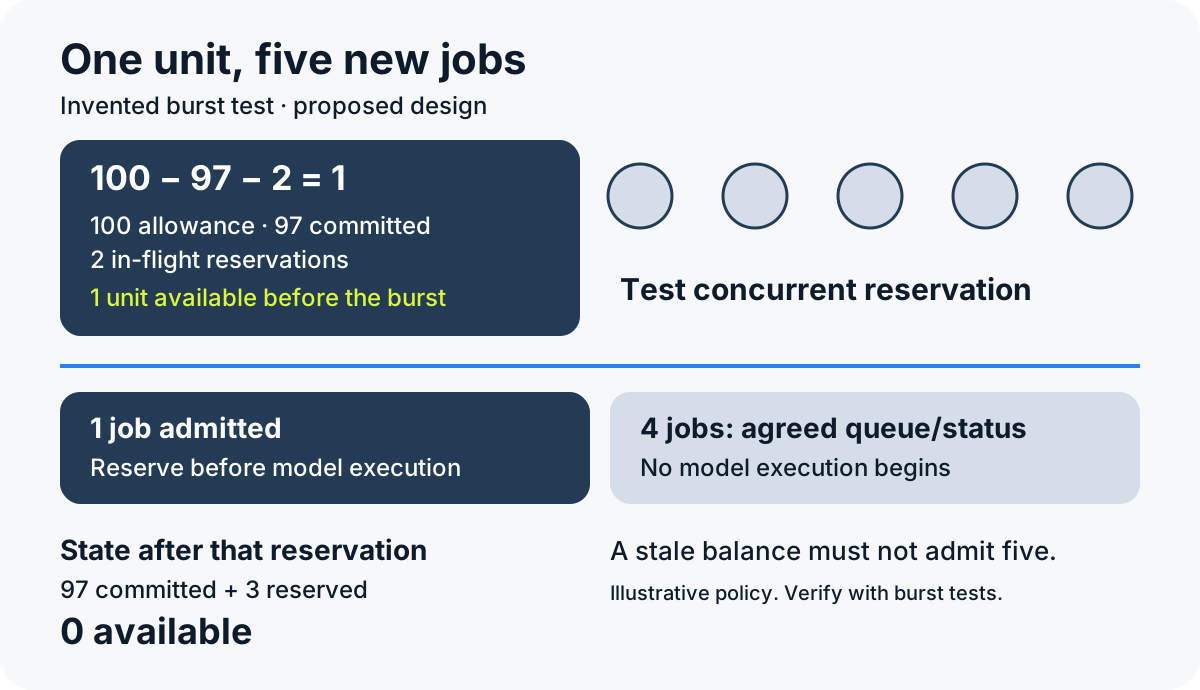
An invented test: one remaining unit, five simultaneous jobs
Invented policy: a SaaS delivers reviewed call summaries with 100 units per period, overage disabled and one unit per delivered job. At 97 committed and 2 reserved, 1 remains. Of five simultaneous requests, a concurrency-safe reservation admits one; the other four receive the agreed queue or denial status. Admission leaves 97 committed and 3 reserved; after delivery it is 98 committed and 2 reserved. Every attempt stays in cost while replay preserves one allowance deduction.
Test recovery and reconciliation as part of the choice
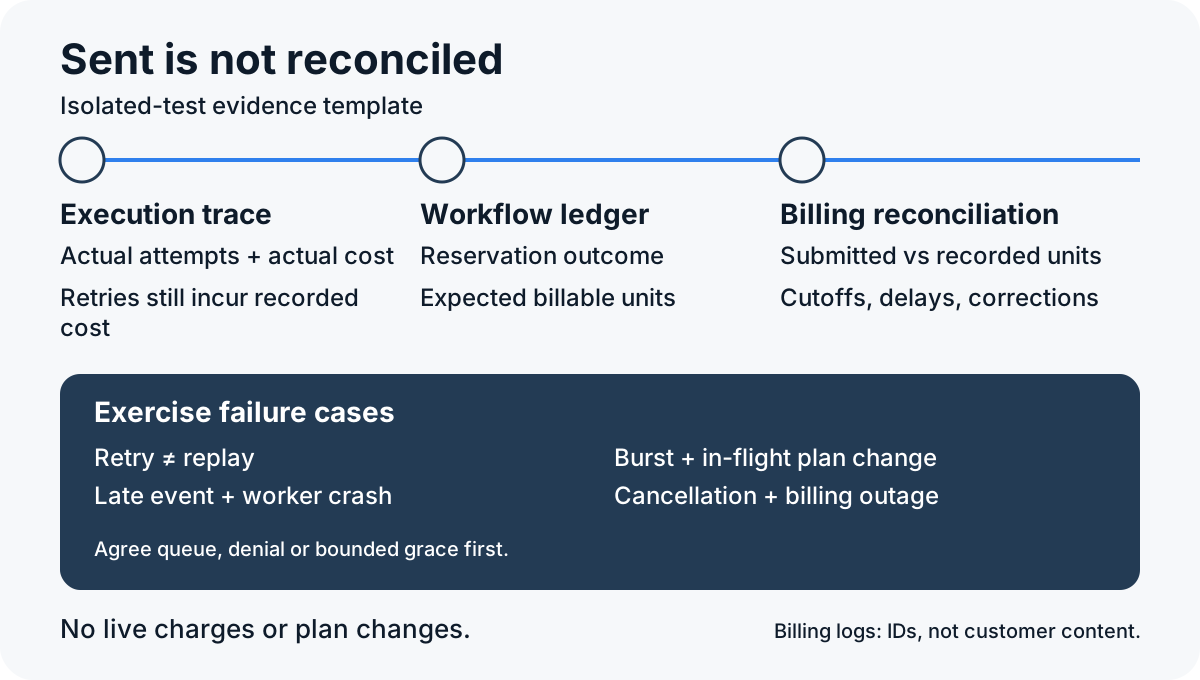
Exercise replay, automatic retry, delayed events, worker crash, bursts, cancellation and plan changes with in-flight work. Reconstruct expected units in an isolated, non-billable environment and compare them with the billing preview, including cutoffs and corrections.
Set limits without cutting paid access: bound the spend of one job
Set and test an owner-approved limit for steps, elapsed time and cost per job, with a stop path for agent loops. Agree what happens at the allowance boundary: block, queue, bounded grace or separately agreed overage.
For concurrent admission, compare patterns in your environment: an atomic conditional balance update; tenant-serialized admission; or an identified reservation with expiry and release after failure. These are patterns to test, not tested code. Reconcile reservations, completed jobs and billing events across retries and cutoffs.
Stripe’s usage recording documentation describes asynchronous processing; inspect its current integration recommendation and finalized-invoice behavior before relying on meter summaries. A summary is a reconciliation record, rather than your admission gate.
Choose one workflow experiment
Complete the matrix for one workflow and selected test tenants. Keep supported billing facilities, scope the demonstrated gap and expand after reconciliation, quality and access conditions have accepted evidence.
To discuss relevant CTO experience for the cross-system decisions, describe the workflow to the Grand Rounds curator. The conversation does not reserve a person or include implementation.
Boundaries
The concurrency example and its numbers are invented. This guide compares controls and tests rather than ranking billing vendors or supplying a tested implementation. Tax, financial treatment and contract wording stay with the relevant specialists.
Billing-engine replacement and company-wide cost programs are separate decisions.
Grand Rounds is an initiative of Dinarys, and a conversation may lead to cooperation with Dinarys.