
The cheapest token is not always the cheapest accepted answer.
For an AI SaaS company with real usage and paying customers, a provider comparison answers a product question: which route delivers the same required result, at acceptable latency, for a cost you can explain? A lower list rate is one input. It is a reason to run the comparison, and the acceptance standard stays where it is.
Product defines the customer task, the quality or domain owner defines acceptable output, engineering connects jobs to attempts and tokens, finance agrees the cost basis, and the founder or confirmed budget holder authorizes the decision.
A small dated API-price comparison, not a ranking
Prices below were read on 9 November 2026 on two vendor pages: OpenAI standard pricing and Anthropic model pricing. Figures are the published USD rates per one million tokens, quoted as listed. They are selected rows, and the models are not interchangeable.
| Model label as listed on the page | Base input | Output | Cached input / cache hit |
|---|---|---|---|
| OpenAI / gpt-6-luna (short context, up to 272K input tokens) | $0.10 | $0.50 | $0.01 |
| OpenAI / gpt-4.1-mini | $0.40 | $1.60 | $0.10 |
| Anthropic / Claude Haiku 5.5 (prompts up to 100,000 tokens) | $0.10 | $0.50 | $0.01 |
| Anthropic / Claude Haiku 5.5 (prompts over 100,000 tokens) | $0.50 | $2.50 | $0.05 |
| Anthropic / Claude Haiku 4.5 | $1 | $5 | $0.10 |
Anthropic prices Claude Haiku 5.5 by prompt length, which is why it has two rows. The OpenAI page also lists a long-context rate for gpt-6-luna above 272K input tokens, which is higher than the short-context row shown here; the table gives only the short-context rates. gpt-4.1-mini and Claude Haiku 4.5 are earlier model labels that the pages still list, and the gpt-6-luna and Haiku 5.5 short-prompt rows are listed at lower rates than those two earlier labels. Both pages list further models, and the sample is deliberately small. Recheck the exact endpoint, model version, processing mode and terms before estimating a workload. Partner-cloud billing needs its own price source.
The table leaves out tools, infrastructure, cache creation (both pages list cache-write rates separately: Anthropic for 5-minute and 1-hour writes, OpenAI by write duration for gpt-6-luna), discounts, taxes and other modifiers. No quality, latency, access or workload result was measured. A lower published rate in this selection does not establish a lower cost per accepted task.
Keep the workload and acceptance question constant
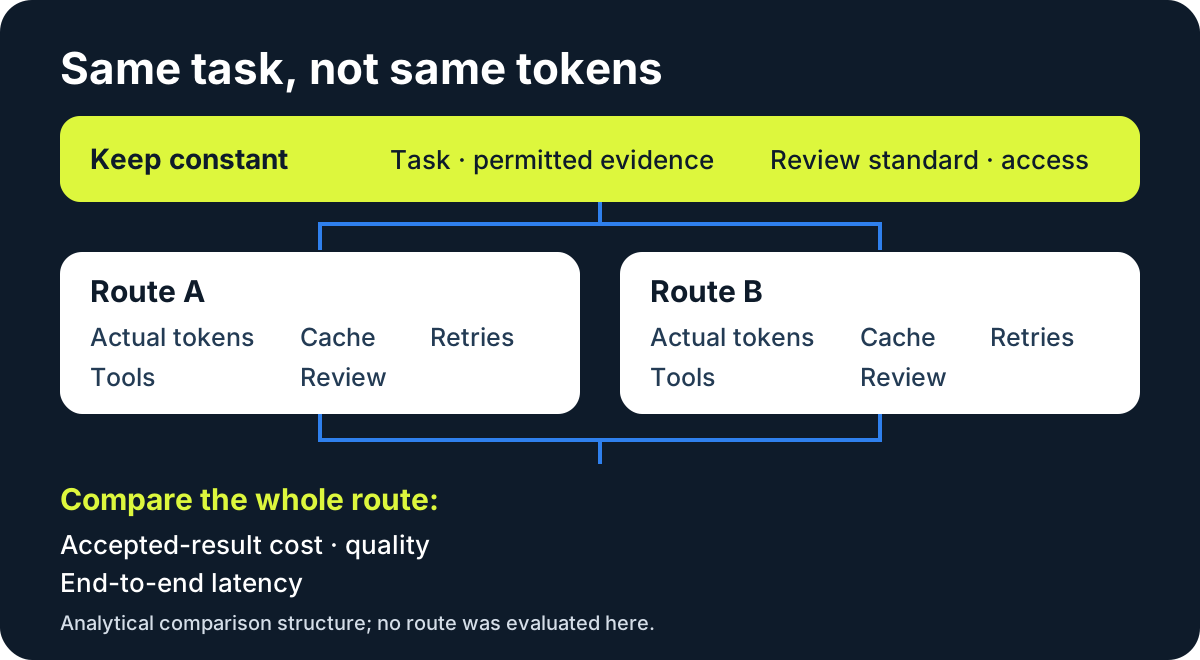
Select one customer workflow, for example producing a source-supported research brief for a reviewer. Use the same permitted source packets, task mix, output requirements and review standard for every route, including the current provider and any viable simpler process.
Equalize the task and the evidence rather than the token counts. Each route's tokenization, prompt overhead, intermediate calls and output length belong in its own usage record, together with the exact model version, prompt and workflow configuration. A route given a shorter task or a cleaner dataset is a different comparison.
Agree these requirements before evaluating:
- Required evidence, completeness, unsupported-answer behavior and human acceptance.
- Routine and difficult cases, including missing or conflicting sources.
- Data permissions, freshness and permitted processing destinations.
- End-to-end latency definition, concurrency and the deadline that matters to the customer.
- Allowed retries, fallback and review, with a limit on repair loops for any one candidate.
Keep a held-out evaluation set separate from the cases used to adjust the route. Qualified owners set the criteria, and an unacceptable permission or quality gap stays visible instead of disappearing into an average score.
Turn token prices into cohort cost
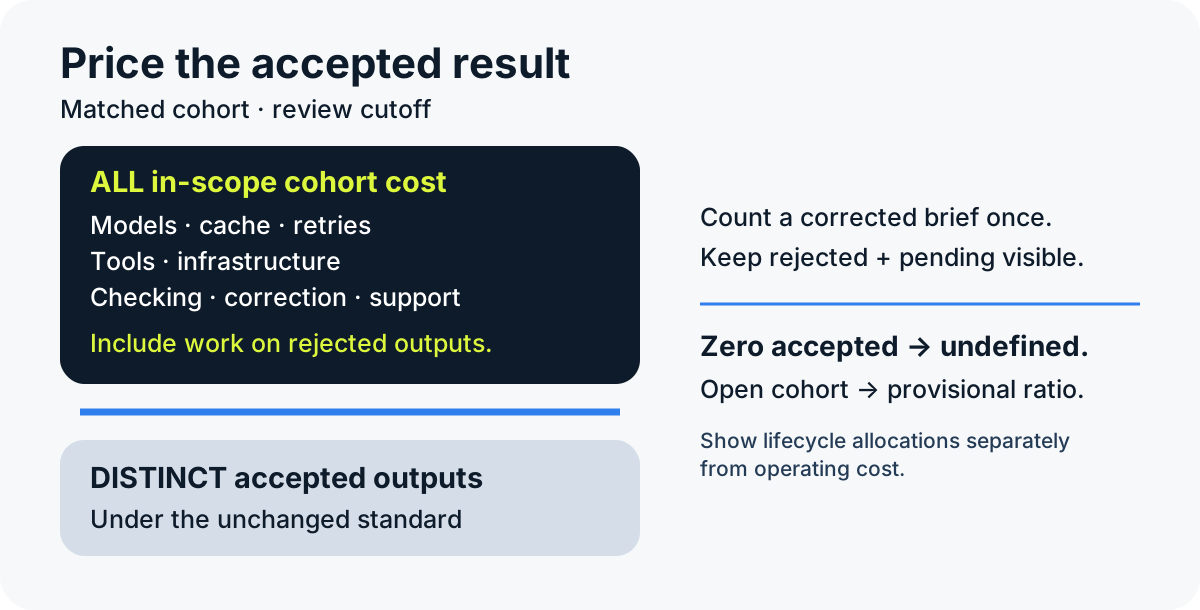
For each attempt, apply the applicable rates to its billable categories. In a worksheet, the token subtotal is:
Sum of each billable token category × its rate per million ÷ 1,000,000, plus applicable non-token charges.
Keep categories mutually exclusive: a cached token is priced once, at the cached rate, unless the provider's documented billing says otherwise. Reconcile against invoices and usage records, since a calculator can differ from the bill.
Then add the work around inference: retrieval, tools, storage, serving and monitoring allocation, human checking, corrections, repeat review and support. Show migration, integration, evaluation and maintenance allocations separately from operating cost.
For a matched cohort through a defined review cutoff:
Cost per accepted result = all in-scope cohort cost, including rejected work ÷ distinct accepted outputs under the unchanged standard.
Count a corrected brief once, however many attempts it took. Keep accepted, rejected and pending counts visible. With zero accepted results the ratio is undefined, and an open cohort gives a provisional ratio.
Hypothetical arithmetic: the cheaper model line loses its advantage
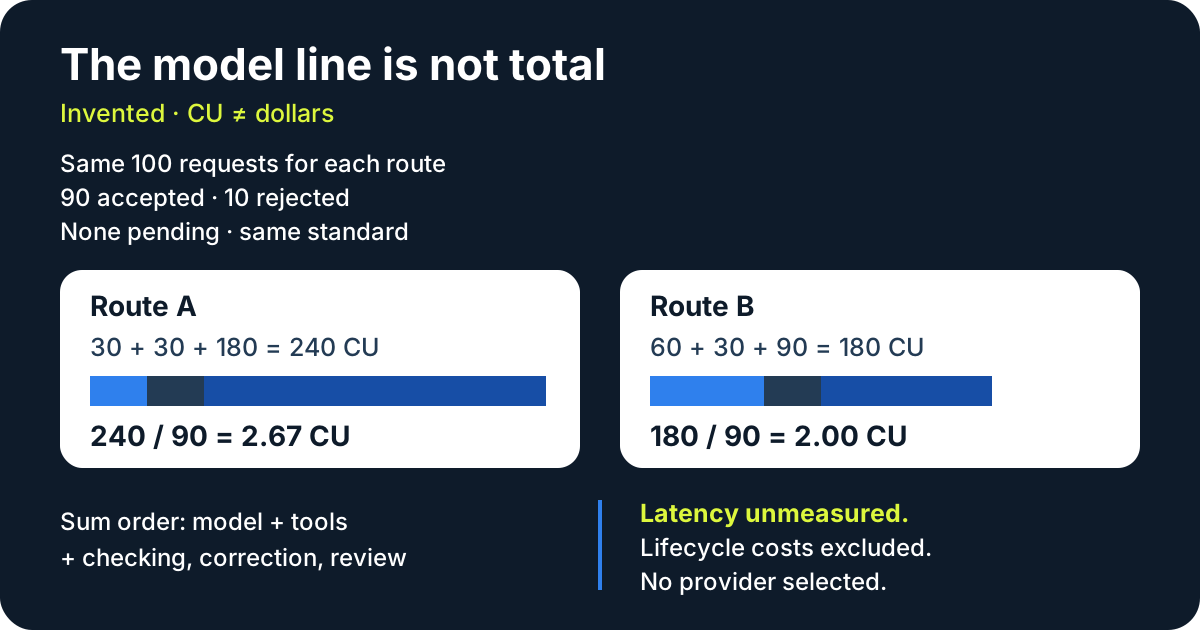
The routes, figures and counts in the table below are invented. CU means fictional cost units, not dollars or the rates in the table above. No models were called.
Assume both routes receive the same 100 brief requests. Under the same fictional review standard, each closes with 90 accepted and 10 rejected briefs, none pending. All work on rejected briefs is included.
| Invented observation / cost | Route A | Route B |
|---|---|---|
| Actual model attempts, including retries | 120 | 100 |
| All model cost | 30 CU | 60 CU |
| Tools/infrastructure allocation | 30 CU | 30 CU |
| Human checking, correction and repeat review | 180 CU | 90 CU |
| Operating total in this example's scope | 240 CU | 180 CU |
| Cost per accepted brief | 240/90 = 2.67 CU | 180/90 = 2.00 CU |
A's model line is smaller, but its complete operating total is larger. The example assumes that B's dearer model line comes with half the review effort; that difference is an assumption chosen for the arithmetic, not a finding about any real model. The lesson is only that the total decides, not the model line. If A's review effort were instead 60 CU with the same acceptance, its total would be 120 CU and its cost 1.33 CU per accepted brief, and A would be cheaper.
Latency is left unmeasured in this example, so B cannot be selected yet: a cheaper accepted result that misses the customer's deadline is a different task. Migration and lifecycle costs are also excluded here and belong in an actual decision.
Cache, retries and routing can change the comparison
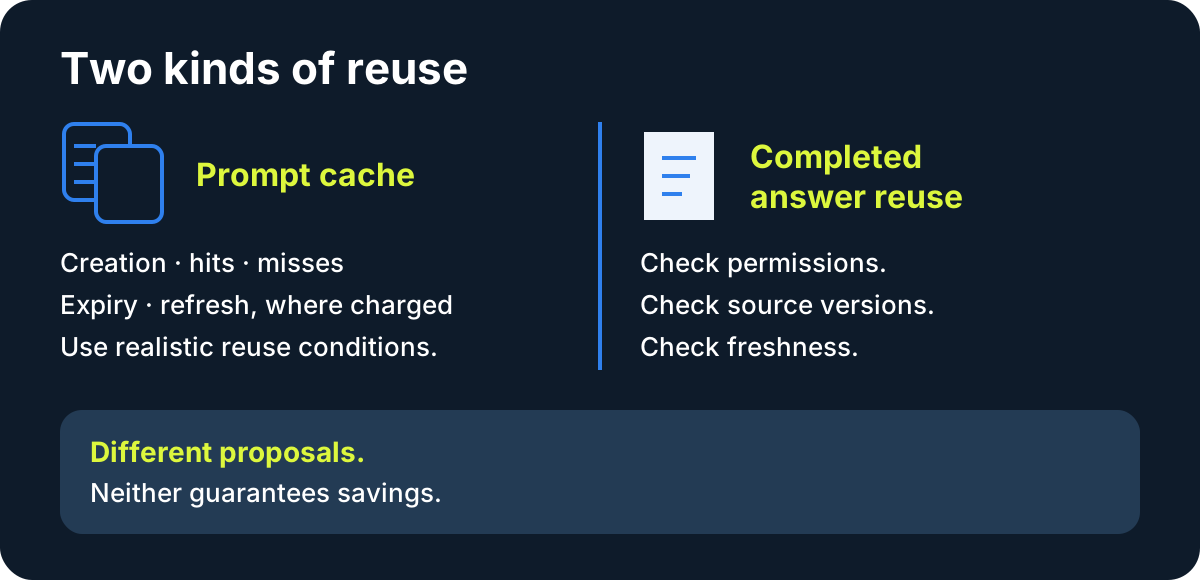
Compare cold and realistically reused workloads. Include cache creation, expiry, misses and refresh where charged, and expect that only some repeated requests qualify. Prompt caching and reusing a completed answer are different proposals; reusing outputs also requires the right permissions, source versions and freshness.
Keep every retry and fallback in the cost trace, so a successful final response leaves the preceding work visible. Provider charges and customer-billing policy are separate: extra execution cost does not automatically create another billable result.
If routing uses different models for different cases, evaluate the route as a whole and by task segment, including the router, escalation and review burden. A pooled average can hide an expensive or unacceptable exception path.
Compare providers on cost, quality and latency
Create one comparison card per route: task/cohort; model and endpoint/version; dated price source; token categories and tools; retries/fallback; cache conditions; accepted/rejected/pending counts; quality findings; full review effort; end-to-end latency distribution; operating and lifecycle costs; exclusions; data/access constraints; owner and next decision. Mark unmeasured fields unknown.
Use existing authorized traces and invoices first. A new evaluation needs its own permissions and budget; this article authorizes no paid benchmark, live model calls or provider change. Keep the current route if it meets the need and switching is unjustified. Repair measurement first if the comparison is incomplete.
Your next step is to compare providers on cost, quality and latency for that one workflow, then record whether to retain, investigate or propose a bounded change. If the decision spans usage attribution, quality and customer entitlements, a Grand Rounds curator can discuss relevant CTO decision support. No provider winner, price reduction or margin improvement is promised.
Boundaries
Grand Rounds is an initiative of Dinarys, and a conversation may lead to cooperation with Dinarys.