
Check ten areas before relying on a vendor for one deliverable: input and output rights, provider data use, retention, access, security assurance, evaluation, cost, service scope, change and exit. Keep each answer tied to the product, plan and configuration you would buy. A demo or an average feature score does not settle an essential unresolved condition.
The vendor demo works. What happens to your data, cost, and exit options after signing? For a consultancy buying help with recurring research and proposals, those questions belong beside output quality—not in a renewal discussion after the team depends on the tool.
This is vendor due diligence for a business workflow, not investor diligence or fundraising preparation. The decision is whether a specific product, plan, and configuration can support one deliverable under your review, data, support, and continuity requirements. A strong demo is a reason to investigate, not evidence that those conditions are settled.
Start with your workflow and responsible buyer
Choose one repeatable output: for example, a research-services proposal draft assembled from approved research and reusable sections, then reviewed by the practice. Define the permitted materials, confidential exclusions, output structure, professional commitments requiring approval, and handoff destination.
Confirm who may authorize spending, who operates the workflow and who reviews its professional commitments. Technical/security, privacy/data, procurement and legal decisions need their respective owners. A champion is not automatically the budget holder or the accepting reviewer.
Compare a new vendor with existing licenses, maintained templates/search, and any justified bounded integration on that same task. Do not compare a polished vendor example with your most difficult live case. Keeping the existing route is a valid decision.
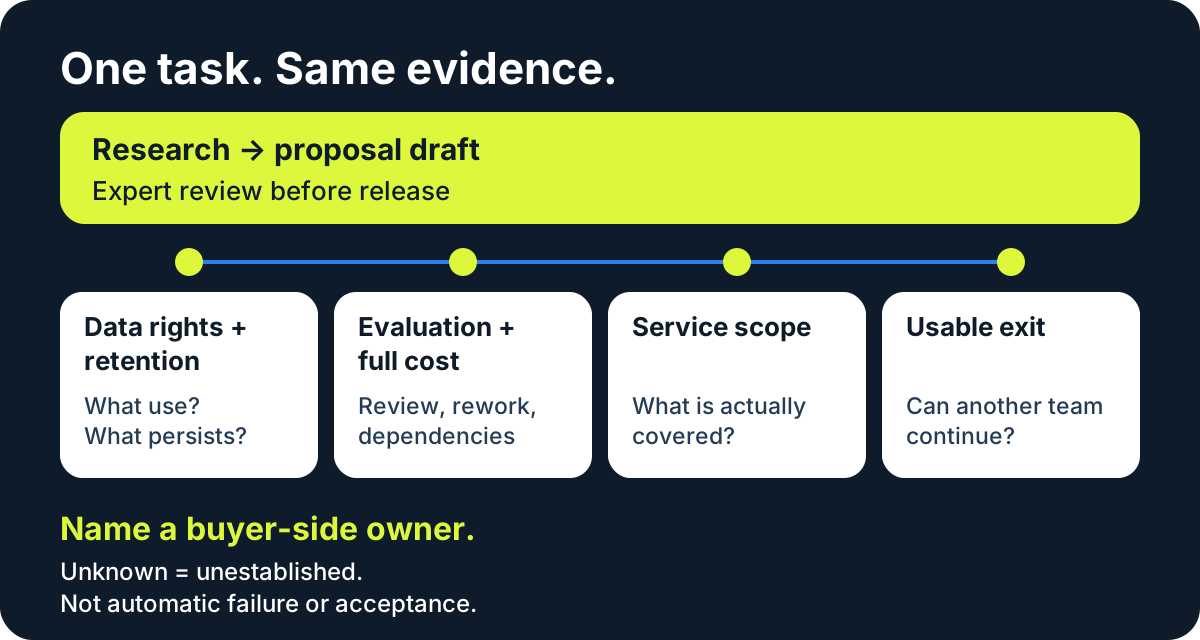
Keep evidence attached to the exact product and plan
For each answer, retain the product/plan, feature or endpoint where relevant, configuration, source URL or document/version/date, supplier answer, evidence actually inspected, and unresolved applicability. A general policy statement may not cover a connector, optional feature, reseller, or downstream provider.
Separate four statuses: claimed, documented for this scope, observed in an authorized evaluation, and accepted by the responsible owner. A sales answer does not prove behavior; an observed behavior does not by itself establish contractual rights. Unknown means unestablished, not automatically unacceptable.
Use the AI vendor due diligence checklist
Create one copy for each viable route. Add a responsible owner, evidence location, status, and next action to every row. This is an evidence checklist, not a weighted procurement score or legal contract template.
For the security boundaries behind these rows, see AI Security Risk Assessment.
| Area | Questions to resolve | Evidence to request or inspect |
|---|---|---|
| Input and reuse rights | May these sources be processed and prior proposals reused for this purpose? Which materials are excluded? Who owns the outputs, and what claims does the supplier make about them? | Source/reuse inventory, actual permitted-use decisions, relevant product terms reviewed by the appropriate rights/legal owner |
| Provider and downstream data use | What may the supplier and its subprocessors use prompts, files, outputs, feedback, and telemetry for? Which settings and terms apply? | Plan/feature-specific data-use documentation, data-flow/subprocessor information, relevant terms and confirmation of applicable settings |
| Retention and deletion | What persists in application state, indexes, logs, backups, support records, and connected services? How are deletion requests, exceptions, and account closure handled? | Data-category retention table, deletion process and limits, configuration evidence, and qualified review of applicable commitments |
| Access and source lifecycle | Who can retrieve, inspect, export, or support the material? What happens to revoked access, amended sources, and previously generated outputs? | Identity/permission design, source/version handling, controlled evidence for relevant allowed/denied and changed-source cases |
| Security assurance | Which independent reports or certifications cover the product, service scope and period you would use? Is the AI feature included? How are incidents notified? | Actual report or certificate, scope and date inspected by your security owner—not a sales-page logo |
| Evaluation and review | Can reviewers verify material claims, missing evidence, source versions, and proposal commitments on our task? What work remains manual? | Same-task evaluation pack, before/after outputs, claim-to-source evidence, review/rework effort, failure and no-answer records |
| Cost and dependencies | What is included, metered, limited, or separately charged? Which tools, connectors, model providers, setup, review, support, and migration work remain ours? | Dated applicable commercial material, workload assumptions, full cost scope, dependency and responsibility inventory—not an undated headline rate |
| Service and support scope | What precisely does the SLA measure? Which components, regions, exclusions, support hours, response targets, and remedies apply? | Actual SLA/support documents for the purchased scope; incident/escalation path; operational fallback and receiving owner |
| Change and continuity | Who controls source, model, connector, and workflow changes? How are relevant changes notified, evaluated, and accepted? | Change/version records, available notice/deprecation information, evaluation responsibility, support and fallback plan |
| Exit and usable transfer | What can we take away, in which form, with which rights and effort? Can another team inspect and use it? What remains retained? | Sample export specification or authorized demonstration, rights/format review, migration dependency list, deletion/retention explanation, named exit owner |
Do not upload confidential materials to obtain these answers. Begin with documentation, a permission-safe workflow description, and synthetic or explicitly permitted examples in an authorized evaluation environment. Specialist security, privacy, domain, and legal review is not waived by completing the checklist.
What should stop or escalate a purchase?
The following is a proposed purchasing rule, not a validated scoring method or a claim that every product must hold a particular certificate. Agree what is essential with your qualified owners.
| Finding after a specific evidence request | Proposed response |
|---|---|
| Supplier cannot state in writing whether prompts/files are used for training under your plan. | Stop the affected purchase/use until answered. |
| No retention answer by data category for your plan/features, after asking in writing. | Stop until answered. |
| Supplier will not support a same-task evaluation using permitted or synthetic material. | Stop rather than substitute a demo for your acceptance evidence. |
| Subprocessor or telemetry use is unknown. | Escalate to legal/privacy; a clear training answer does not settle this row. |
| Independent assurance does not cover the proposed service, or allowed/denied and revoked-access behavior cannot be shown safely. | Escalate to your security owner for the necessary assurance. |
| Only an undated rate is supplied, an SLA misses a dependency, or change-notification/evaluation responsibility is unstated. | Escalate to the commercial and operating owners. |
| Export does not support the next step you need after exit. | Escalate to the receiving owner; evidence review may need source IDs and decisions, whereas plain archiving may need less. |
“Not used for training” is not a retention answer
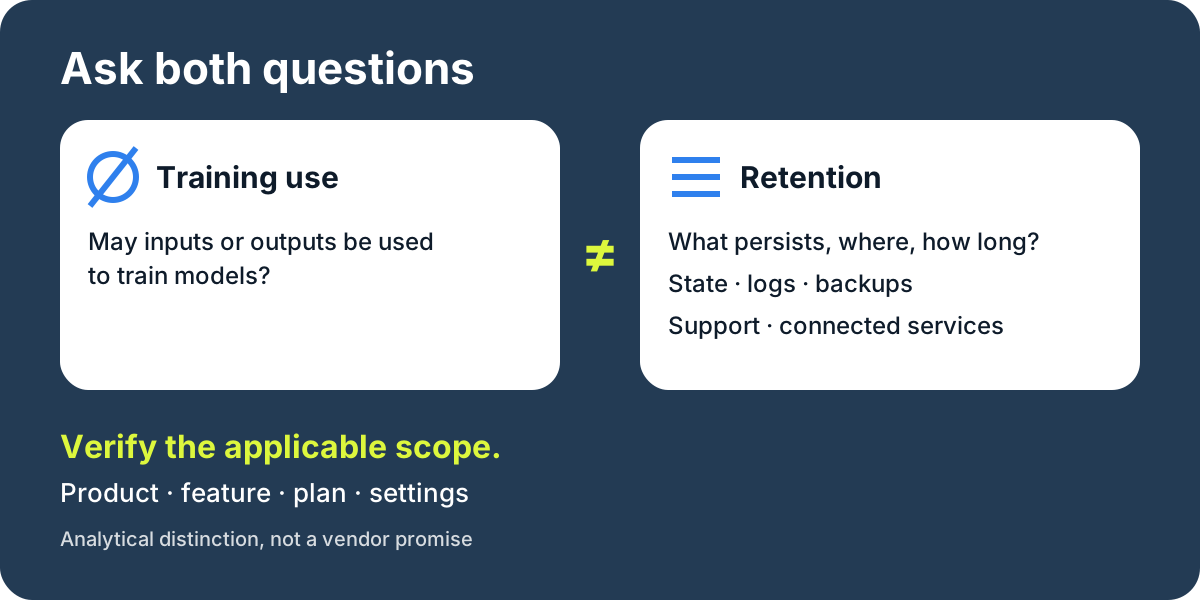
As an example of why scope matters, OpenAI's API data-controls documentation, checked on November 2, 2026, says API data is not used for model training unless the customer opts in. The same page separately describes abuse-monitoring logs, application state, endpoint-specific retention and approval/limitations for special retention controls.
Those are different questions. Do not extend an API statement to another product, a vendor wrapper, a connected service, or your account's actual configuration. Ask which data travels through each component and have the relevant owners verify the terms and behavior that apply. This example is not a recommendation of a provider or a promise that a retention option is available to you.
Read the SLA's unit of service
An availability measure is not an acceptance rubric for a research proposal. For a concrete illustration, the Amazon Bedrock SLA, marked “Last Updated: October 4, 2023,” defines availability using requests without its defined errors in five-minute intervals; its “Error” definition is a request returning a 500 error code. It also specifies exclusions and a service-credit process.
That tells you what that document measures—not that your source support, draft quality, end-to-end integrations, or review turnaround are guaranteed. For any shortlisted service, ask the supplier and responsible procurement/legal reviewers to distinguish the service commitment from your operating requirements. This article does not interpret enforceability or recommend contractual language.
Make exit observable before dependence grows
“Export supported” is an incomplete answer. Identify what the receiving team would need to continue the same task:
- Permitted source originals or usable references, with identities, versions, and relevant rights/access context.
- Drafts and accepted outputs, including claim-to-source links and reviewer decisions where needed.
- Reusable templates, instructions, workflow settings, and custom work under the actual ownership/license terms.
- Evaluation cases and results, known exclusions, dependency/support records, and unresolved issues.
- An explanation of what cannot be exported or reused, what needs rebuilding, and how remaining data is retained or deleted.
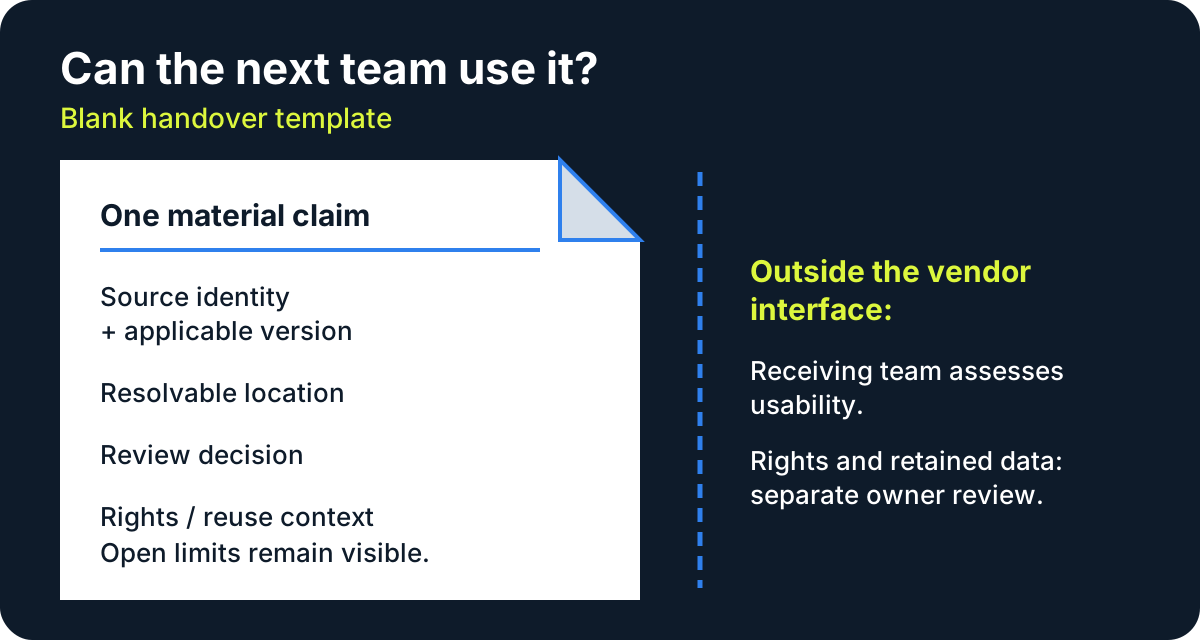
Plan a small, authorized handover exercise with non-sensitive material. Ask a receiving colleague to inspect the exported package outside the vendor's interface and explain whether it supports the required next step. A file that opens is not necessarily a reconstructable evidence record. Do not assume portability of a proprietary index, configuration, model behavior, or licensed corpus.
Invented comparison: two exports, neither a completed exit
This scenario is invented and unperformed. It describes no real vendors or observed product capabilities. A specialist consultancy wants proposal drafts from the same permitted research pack and approved sections, with expert review before any client release.
The fictional proposal for Option A describes an export of rendered drafts. The fictional proposal for Option B describes drafts plus source identifiers and review comments. The current template/manual route keeps the underlying sources in the practice's approved repository. These are hypothetical specifications, not accepted commitments or test results.
| Same-workflow question | Option A | Option B | Existing route |
|---|---|---|---|
| Can a new reviewer reconstruct material support? | Source links/version transfer not established | Identifiers/comments described; resolvable locations and applicable versions unverified | Existing references still need inspection for completeness |
For both options, rights and the template/migration questions stay unknown until the sample package and applicable terms are reviewed.
Option B's richer proposed export addresses one potential evidence need; it does not establish a usable exit or make B the winner. A rendered draft may be enough for simple archiving but insufficient for continued evidence review. The buyer must decide which outcome it needs and verify the affected row.
The next bounded request could be a permitted sample package preserving one claim, its applicable source/version and location, and the review decision. The receiving team would assess usability; data/rights and procurement/legal owners would assess their parts. No export, test, review, or acceptance has occurred in this example.
Finish with a purchasing decision you can explain
Use the checklist for one workflow and the same requirements across shortlisted alternatives. Name the buyer-side owner for each unresolved area. End with a bounded decision: retain the existing route, seek specific evidence, run an authorized limited comparison, narrow the intended use, or decline the option.
Do not replace an unresolved stop item above with a higher average feature score. Record who accepted which evidence, remaining limits, operating resources and what change would reopen the decision. Revisit at renewal, a material feature/subprocessor change or a new source/use requirement. For the wider engagement, see Technology Vendor Selection; this checklist does not establish a booking or contractual scope.
If the unresolved choice spans source rights, evaluation and several tools, ask the Grand Rounds curator about the relevant next conversation. It does not replace legal/procurement review or vendor commitments and is not an offer of implementation.
Boundaries
Grand Rounds is an initiative of Dinarys, and a conversation may lead to cooperation with Dinarys.