
Choose the candidate who can connect a customer job to its execution costs and billing treatment—and explain the differences when those records disagree. On your own sanitized workflow, they should be able to locate a duplicate, a failure, and a late record, identify the decision each requires, and show who can authorize it. A spending dashboard alone is insufficient evidence.
For an AI SaaS company with paying customers, that means testing two kinds of fit: the CTO's ability to lead cross-system decisions and the implementation lead's experience with the selected billing system. They may be the same person; verify both contributions.
This guide focuses on selecting that leadership through usage reconciliation, cost attribution, and quality-preserving decisions. For the cost-per-accepted-result method, use AI inference economics. For quota and concurrency mechanics, use AI usage-based billing.
Five units can still be the wrong bill
Use this counterexample in a candidate discussion. The research product, billing rule, jobs, and preview values in this example are all invented. No system or model was tested.
The example's rule is one unit per delivered brief, no extra unit for an automatic execution retry, and no unit for a failed, undelivered job. A replay means the same usage message arrives again; it is not new customer work. All six jobs belong to one test customer and intended service period.
The usage ledger is the record of units counted per job. Compare it with the billing preview row by row:
| Job and outcome | Execution attempts | Expected units | Preview units |
|---|---|---|---|
| J1 — delivered | 1 | 1 | 1 |
| J2 — delivered after automatic retry | 2 | 1 | 1 |
| J3 — failed without delivery | 2 | 0 | 0 |
| J4 — delivered | 1 | 1 | 1 |
| J5 — delivered; usage message replayed | 1 | 1 | 2 |
| J6 — delivered; event received after test cutoff | 1 | 1 | 0 |
| Total: 5 delivered, 1 failed | 8 | 5 | 5 |
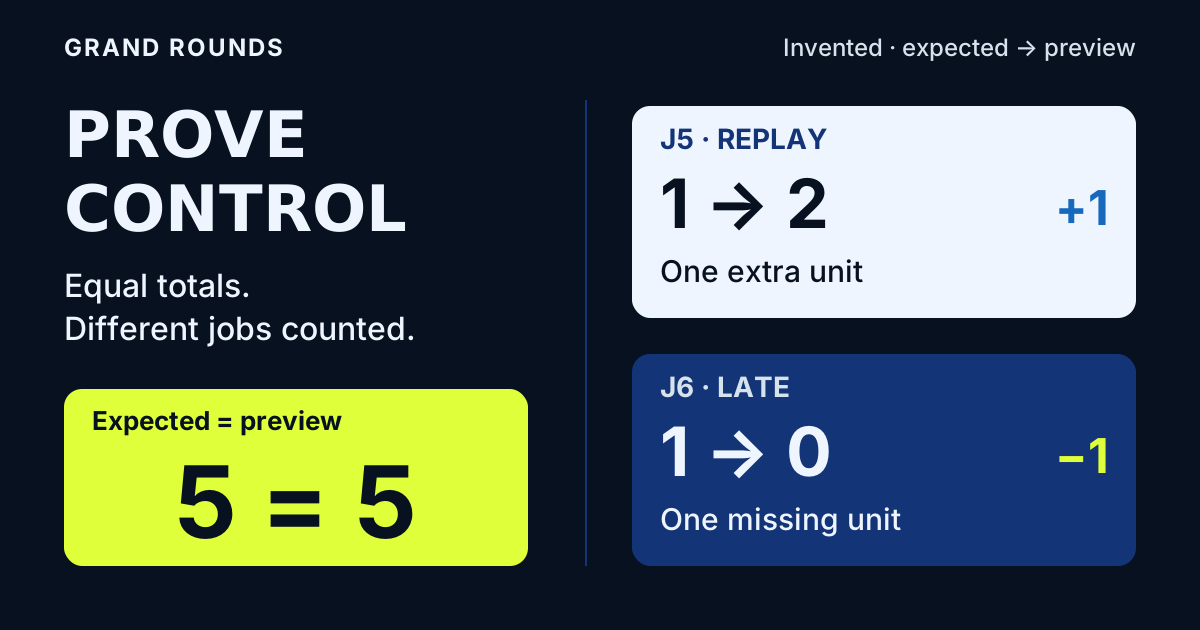
The totals agree. The reconciliation does not. J5 contributes one unintended extra unit; J6 is missing from the intended period. The errors cancel in the total, but they still need separate explanations and treatment.
Ask the candidate what evidence would distinguish a recording defect from an approved timing rule. Do they inspect the job and event identities, customer mapping, policy version, and service-period cutoff? Or do they accept “five equals five” as the answer?
Listen for three different explanations, not one fix
J5: a repeated message is not another delivered brief
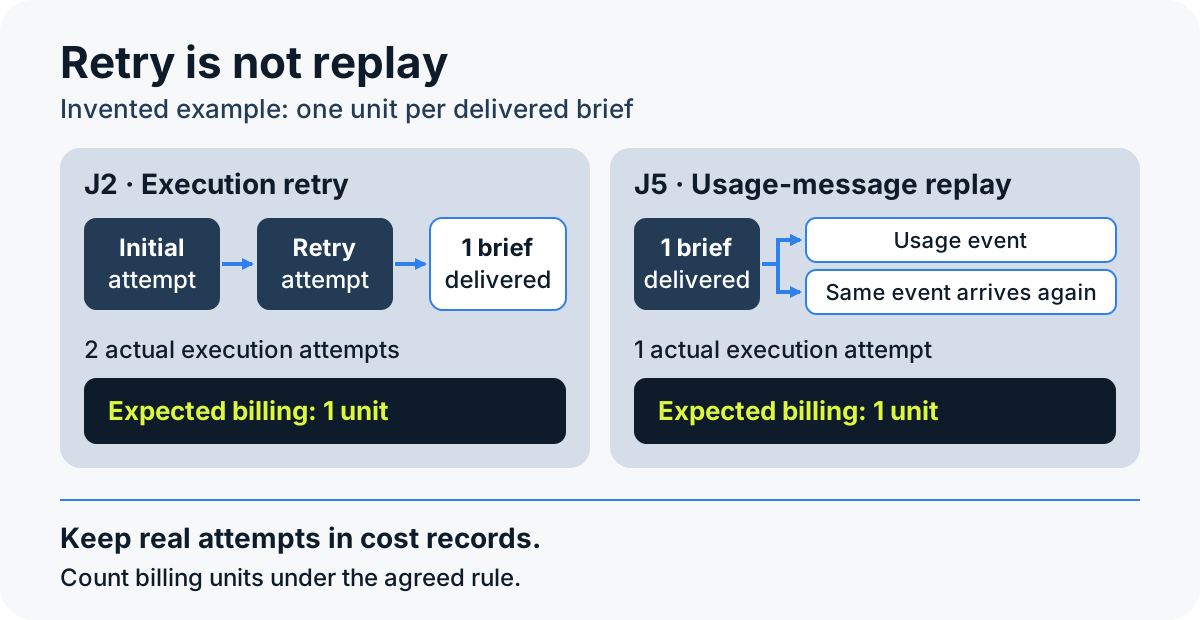
A useful answer separates the customer job, actual execution attempts, and deliveries of the usage message. Ask where the system recognizes the same billable event and which record proves that replay cannot add another unit under the chosen policy. Deduplication means recognizing and counting that repeated event only once.
“We use retries” does not answer this question. J2 genuinely ran twice; J5 did not. Removing a duplicate usage entry must not erase a real attempt from the cost record.
J6: receipt of an event is not proof of invoice inclusion
Ask which timestamp determines the service period, when the billing system stops including usage, and how the team explains or corrects a difference. The candidate should distinguish expected usage from what the selected integration can actually place on an invoice. They should identify who approves any customer-facing correction rather than silently moving a charge.
In Stripe's usage-recording documentation, read November 2, 2026, accepting a meter event does not guarantee invoice inclusion. Stripe says it might accept an event after finalization and include it in meter summaries without updating the finalized invoice or adding the usage to the next invoice. That is a documented behavior of this integration path, not a rule for every billing platform.
The candidate's answer should therefore name the applicable documentation and a test for your integration—not infer a completed reconciliation from an API acknowledgment.
J2 and J3: billing treatment does not remove incurred cost
J2 uses two attempts to deliver one brief. J3 uses two and delivers none. Under the invented rule, their expected billing units are one and zero, but all four actual attempts remain in the cost trace. Across the table, all eight attempts need attribution, along with applicable tools, review, and support work.
For limits, ask the candidate to identify the test that proves whether a new job may start when several requests compete for the remaining allowance. The billing guide's quota fixture supplies the detailed concurrency example. Here, the selection question is whether the candidate can assign its implementation, explain recovery, and define the evidence needed to accept it.
Ask for evidence from a decision they owned
Reasoning through an invented ledger is useful, but it does not establish past delivery. Follow the walkthrough with a relevant system the candidate actually worked on. Ask what they personally decided, what they implemented, what other people owned, and what evidence remains available for permitted inspection.
| Candidate-owned evidence to request | What makes it useful for this decision |
|---|---|
| A sanitized decision record connecting a customer action to a billing unit | It shows the alternatives they evaluated, the rule selected for retries and failures, and who approved the commercial treatment. |
| An event-to-ledger-to-billing reconciliation they designed or investigated | They can explain the identities, a specific difference, its cause, and how resolution was checked—not just present an aggregate usage chart. |
| A relevant integration or recovery example | They identify their own contribution, the billing product and integration path, the failure condition, and the operating team that received it. |
| A cost or routing decision with its evaluation record | They explain the cost scope, output standard, rejected work, and why the evidence supported retaining or changing the route. |
| A reference conversation, arranged with permission | The reference can corroborate the candidate's responsibilities and the team's ability to operate the result afterward. |
Use sanitized artifacts or permission-controlled references; confidential prompts, customer records, and personal data need not become interview material. When an artifact cannot be shared, ask for a permitted explanation of the design and a way to corroborate the person's role. Record the narrower evidence you actually receive.
AI product leadership, payments integration, analytics, infrastructure cost work, and durable workflows are relevant experience. Distinguish them from a verified usage-based billing rollout on your selected system. A former employer's scale supplies context; the candidate's decisions and corroborated contribution establish fit.
A strong CTO candidate may also explain why a billing specialist should implement a particular adapter. That is useful boundary-setting, provided someone with the required implementation experience is identified before the work depends on them.
Keep cost and quality in the selection decision
The J1–J6 ledger exposes billing errors; it does not establish margin. To assess economic control, ask the candidate how they would join job and customer records to actual execution, tool, review, and support costs. Finance should be able to inspect the cost basis and explain an individual line, while engineering can trace its source. Ask for a distribution across relevant jobs or customers, not only average token cost.
If the proposed intervention is a cheaper model, caching, or routing, ask what could cause the team to reject it. A substantive answer names representative permitted tasks, the unchanged output-quality standard, review and rework evidence, and a fallback or rollback condition. Lower spending is not sufficient if the output stops meeting the agreed standard.
Use the cost-per-accepted-result method for that comparison rather than inventing savings during selection. The discussion can establish the candidate's measurement plan; measured performance requires actual results from the agreed evaluation.
Choose the missing contribution and bound its authority
Start with your existing billing setup and technical lead. If supported configuration resolves the problem, use it. If the policy and architecture are settled and only an adapter is missing, choose the relevant implementation specialist. CTO decision support is useful when product policy, finance, quality, and engineering decisions cross teams without a clear technical mandate.
For a first assignment, agree one AI workflow, one billing system, and selected test customers. Name the pricing-plan owner alongside the technical lead. Product and finance agree the customer-visible unit and commercial treatment; the CTO leads architecture and technical acceptance design; the client's team or selected supplier implements and tests. The quality owner retains the output standard.
Use the ledger differences to agree expected behavior and name the accepting owner before implementation. After testing, record the observed result and its evidence reference. The receiving owners should be able to reconstruct a selected billing line, explain the J5/J6-type differences, and inspect the quota-test result. Planned tests stay separate from observed results.
Have the receiving team repeat the reconciliation and recovery procedure without the adviser driving. Transfer the relevant policy, event schema, code/configuration under agreed terms, fixtures, results, and operating instructions. Name who can release the integration, authorize a billing correction, and stop rollout. This makes handover a demonstration of control rather than a file delivery.
Before continuing beyond the first workflow, review the unresolved differences with those owners. A wider billing-engine replacement or company-wide cost program needs its own justification and scope.
To discuss relevant CTO experience, bring a nonconfidential summary to the Grand Rounds curator: the workflow, current billing system, disputed behavior, implementation capacity, and proposed pricing-plan owner. The curator is the route for assessing fit and setting up work with a CTO; confirm the specific contribution and scope through that conversation.
Boundaries
Grand Rounds is an initiative of Dinarys, and a conversation may lead to cooperation with Dinarys.