
Short answer: choose against personal decisions at the boundary where hardware, firmware, data, model and app meet, not title or sector alone. For one interface or review, a vendor or narrow adviser may be enough. Name the missing decision and who receives its engineering evidence before comparing candidates.
Here, a field pilot means limited use of a device outside the lab. A CTO's technical receipt covers the engineering milestone only.
This guide shows how to test a candidate's personal integration experience, write a bounded technical remit and keep a record your team can use. To explore which experience in the Grand Rounds CTO network is relevant, bring your configuration, your failure-mode plan and the intended technical receiver to the Grand Rounds curator.
Choose the missing contribution, not a new CTO by default
Name the missing cross-disciplinary decision. A current R&D lead, vendor or narrow adviser may cover it; a scoped CTO mandate fits uncovered authority across hardware, firmware, data, model and app.
If you have not traced why the prototype differs outside the lab, start with the lab-to-field diagnosis; for route comparison, see MedTech pilot readiness.
Check personal hardware, software and domain match
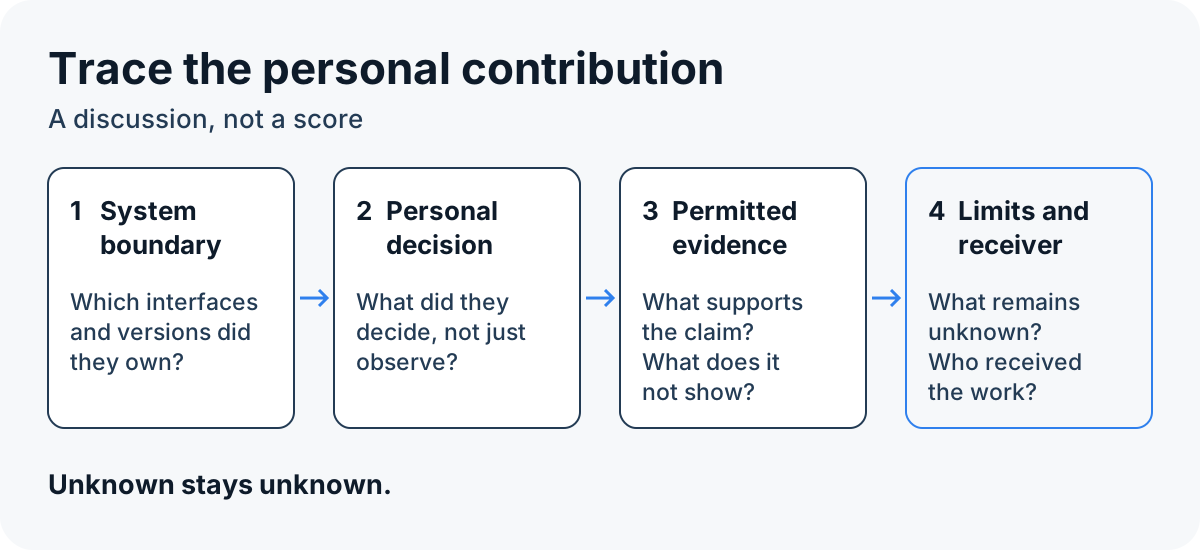
Ask each candidate the same four questions and record the answers:
- Which hardware/firmware/data/model/app interface did you personally own?
- Which decision did you take, and what changed?
- What permitted record or authorized reference can corroborate it?
- Who received and accepted the technical result?
Keep self-reported and corroborated answers separate. The table below gives warning signs to investigate.
Relevant device and integration experience
As stated in Reon Smits's profile, he co-founded Mentech and was its CTO, and served as interim CTO of SARA Robotics, leading a 20-person team. As stated in Gabriel Wainmann's profile, his work includes regulated medical-device technology at Nanosonics and robotics/automation in Cochlear's manufacturing operations.
These are device, data and multidisciplinary engineering contexts. Ask separately which firmware, interface and field-evidence decisions were the person's own, and who received the result.
Agree a technical milestone with a receiving owner
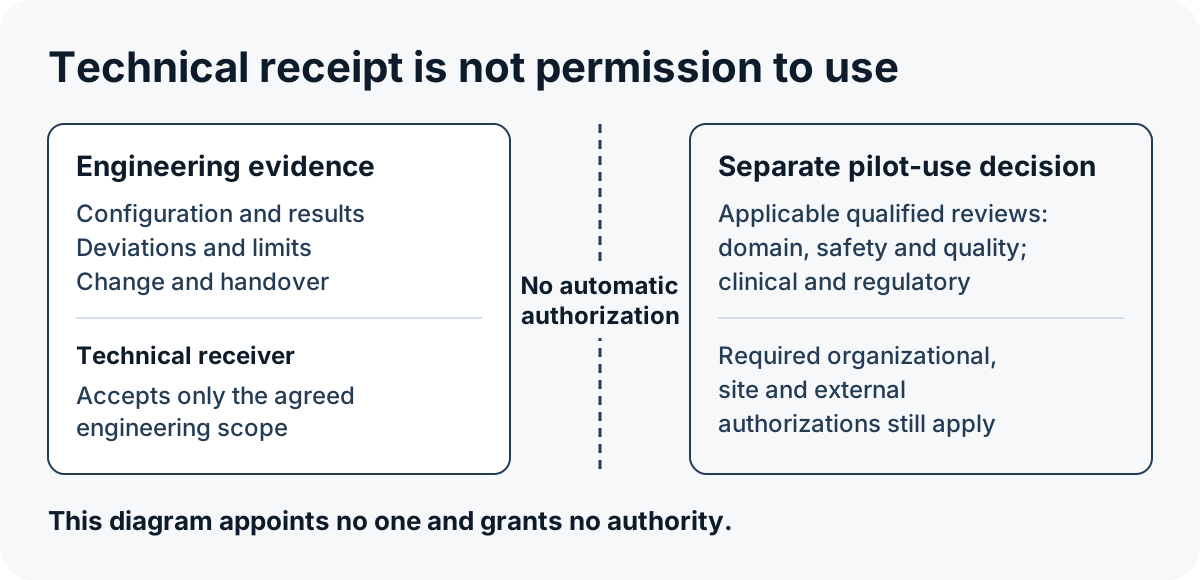
Agree the configuration, technical result, evidence locator and receiving person before work. A one-page technical receipt can hold hardware revision, firmware build, model version and app build; results against the agreed plan; deviations and limits; open issues with owners; and handover artifacts, rerun instructions and rollback evaluation. The named technical receiver accepts the engineering milestone, not permission to use the device.
Separate the technical remit from permission to use
Keep engineering receipt and permission to use in separate records. Clinical, domain, quality, regulatory, privacy and security owners decide their relevant matters for the intended setting.
Build a descriptive evidence and remit record
Copy the record with the sponsor and technical receiver. Keep the contribution, evidence, uncertainty, access, responsibility and receiving criteria descriptive and versioned.
What to check in a candidate's answer
| Check | A usable answer shows | Warning sign |
|---|---|---|
| Interface owned | Named firmware-to-model or other interface and version | Only team-level experience; no interface identified |
| Decision taken | Personal decision and what changed | Decision was observed or belonged to someone else |
| Evidence | Permitted record or authorized reference; reporting distinguished from corroboration | Unclear support, or certification presented as their own decision |
| Receiver | Named role that accepted the technical result | Cannot identify who received it |
“We” prompts a follow-up, not automatic rejection; even a detailed answer needs permitted corroboration.
An invented, nonclinical selection discussion
Invented, nonclinical example. Ask, “Who owned the firmware-output/model-input contract, and who accepted it?” A says, “I defined sample rate and timestamps, rejected a firmware build that broke the contract, and can offer an employer-authorized redacted change record.” B says, “The team handled interfaces.” Ask A what the rejection record showed and who received the result; ask B which part was theirs. If B cannot name it, keep that evidence team-level and unverified. A still needs corroboration. A proposed receipt would list the contract version, agreed-check result, open issues and accepting owner; neither answer grants pilot permission.
Scope depends on the missing decision, suppliers, configuration, technical receiver/review owners, implementation capacity, permitted evidence and the handover your team needs to operate alone.
Discuss the missing contribution with the curator
Bring the configuration, failure-mode plan, exact missing decision and named technical receiver to the Grand Rounds curator. Participation and any later mandate are agreed separately.
Boundaries
This guide covers choosing a technical leader and writing the remit. Qualified domain, quality, clinical and regulatory owners decide on safety, clinical use and pilot permission, and your organization names the technical receiver. The selection example is invented and nonclinical. CTO experience described here is as stated in each CTO's profile on grandrounds.tech. Grand Rounds is an initiative of Dinarys, and a conversation may lead to cooperation with Dinarys. The curator conversation explores relevant experience and session scope; it does not by itself confirm availability or approve a pilot.