
The buyer is ready to discuss a contract. Your product solves the users’ problem. Then onboarding stops: IT needs a different sign-in process, security asks for evidence about data separation, or a pilot exposes slow reports. Your team starts collecting “enterprise readiness” tickets, but nobody can say which one is actually holding up the signature.
For a founder or product leader with a working product and a team to change it, the first task is not to design a more enterprise-looking architecture. It is to identify what this buyer requires before the next commercial milestone, who can accept it, and what evidence is missing.
A working product and an approvable purchase are different things. Before prioritizing “enterprise readiness” tickets, ask the responsible buyer reviewer which requirement blocks the named milestone. A demo, questionnaire item or enthusiastic sponsor cannot establish that on its own.
Build a gap list for this deal—not a universal enterprise checklist. A useful first version separates a buyer-confirmed blocker from an unconfirmed request, and a missing capability from a capability you have not yet demonstrated.
Why a working product can still fail the buyer’s acceptance process
“It works” and “we can approve this purchase” answer different questions. A successful demo shows a user doing a job. The buyer also needs to know how its employees will get access, what happens when someone leaves, which data they can reach, and how the service behaves under the intended workload.
Treat the customer as several decision-makers rather than one. For this deal, identify:
- The business sponsor: wants the outcome and can explain why the purchase matters.
- The users or operational owner: know the workflow that must work in practice.
- The IT or security reviewer: evaluates the relevant technical requirements and may control a specific approval.
- Procurement, legal, and the authorized signatory: handle their respective commercial and contractual decisions.
Ask which roles apply and who owns each decision. A sponsor’s enthusiasm leaves security’s view open, and a questionnaire lists requests, some of which may not block signature.
Name the stalled milestone precisely: contract signature, a limited pilot, or production activation. A requirement due before production may fall after signing; the buyer’s actual process and agreed terms settle that. A completed questionnaire is one input to approval, not the approval.
Separate the symptom, the requirement, and the cause
“The enterprise buyer won’t accept us” is a symptom. It is too broad to scope engineering work.
Translate it into a requirement with a source: “The buyer’s IT reviewer says employees must sign in through its identity provider before it will approve the purchase.” Then check the current product and evidence. The cause could be an unsupported integration, an existing configuration nobody has demonstrated, or an unresolved question about the buyer’s setup. Those call for different next steps.
If the concern is access or data separation
Split “SSO required” into its parts rather than opening one ticket for every identity and security concern. Clarify sign-in, account removal, permissions, and tenant boundaries separately where relevant. Microsoft’s multitenant identity guidance treats authentication, authorization, federation, and account life-cycle management as distinct considerations. A sign-in demonstration shows that sign-in works; it does not show how an account is removed, what permissions it carries or where tenant boundaries lie.
For each requested behavior, ask what the buyer needs to see and in which part of the product. For example, does the request cover interactive users, API access, or both? Who will judge the evidence? Judge a feature by what it demonstrably does rather than by its name.
If load has increased latency or errors
Keep two questions separate: is there a measured product problem, and has the buyer confirmed that it blocks this milestone?
Ask the engineering lead to assemble a baseline for the affected workflow: workload and data size, environment, response-time distribution, errors, and relevant resource constraints. Google’s SRE guidance on monitoring distinguishes symptoms from causes and explains why average latency can hide a slow tail of requests. “The report felt slow” is a starting observation, not a diagnosis of the database or a reason to adopt microservices.
Agree on the buyer-relevant workflow and acceptance measure before comparing fixes. Any new performance testing needs an authorized environment, data, scope, and owner, and should stay away from the buyer’s live systems.
Build a buyer-specific gap list
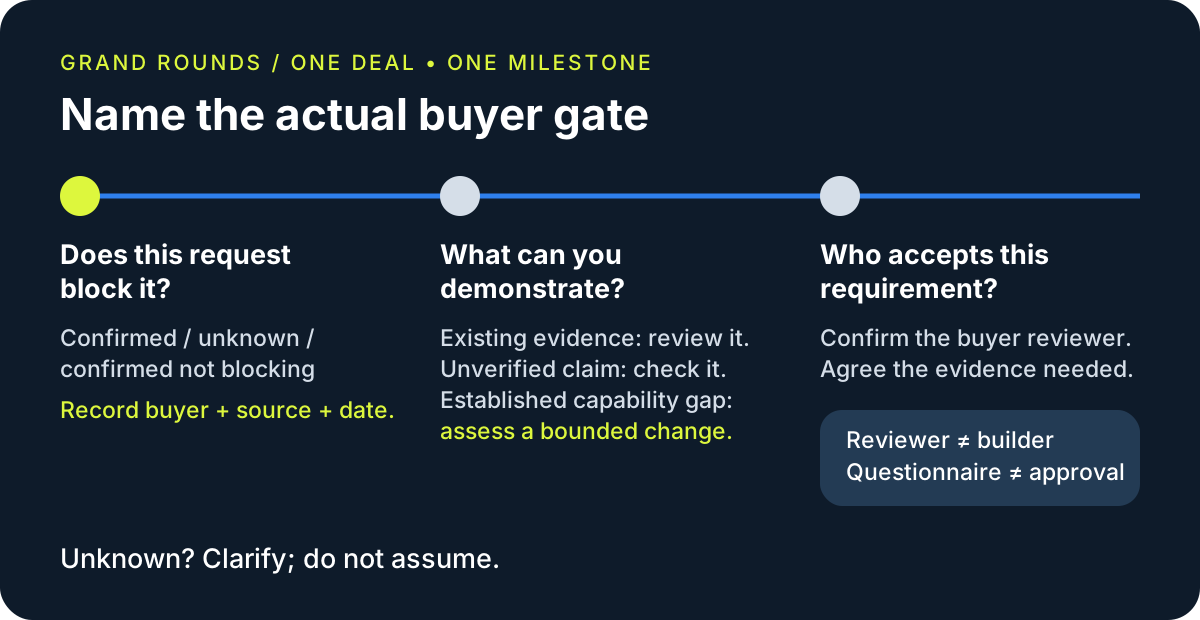
Start with one deal, one milestone, and the actual requests received. Use the buyer’s questionnaire, correspondence, meeting notes, or proposed contract language as the source of each row, rather than a competitor’s feature list.
Copy this record once per requirement into your own document or spreadsheet:
Deal / buyer:
Milestone being held up:
Requirement ID and exact requested behavior:
Source: document + section, or buyer role + date:
Blocker status: confirmed / unknown / confirmed not blocking
Buyer confirmation and the milestone it applies to:
Current capability and evidence: reference, date, scope, limits:
Gap type: clarification / evidence / capability / not yet known:
Buyer acceptance reviewer: confirmed role, or not identified:
Acceptance evidence or criterion: agreed, proposed, or unknown:
Internal next-action owner: accepted, proposed, or unassigned:
Next clarification or action, recipient, and follow-up date:
Keep three distinctions visible when you fill it in:
Blocker status belongs to the buyer’s decision. Mark a blocker “confirmed” only when a buyer role responsible for that decision has said it is required for the named milestone. Record who said so, when, and where. If all you have is a questionnaire item or a salesperson’s interpretation, use “unknown.” “Confirmed not blocking” also needs a buyer confirmation; your team cannot grant itself permission to defer work.
Evidence status belongs to what you can demonstrate. An architecture diagram describes intent; a scoped test record describes an observation. Record what each piece of evidence actually covers. “Not yet checked” is different from “the product cannot do this.” If a check reveals a real security concern, route it through the responsible security process whether or not the buyer calls it a deal blocker.
A reviewer is not an implementation owner. Your engineering lead can own a change without being able to accept it on the customer’s behalf. Treat a suggested buyer reviewer as unconfirmed until that role is agreed, and an internal owner proposed in a spreadsheet as unassigned until they accept the work.
An invented gap list that is deliberately unfinished
The scenario, correspondence and product details below are invented, not a client result.
A small software company sells a shared reporting product. Its prospect’s operations sponsor wants to buy it, but the purchasing process is paused. The founder has three tickets labeled “enterprise blockers.” The source review produces a less certain picture.
G01 — Employee sign-in
- Requirement and source: employees must use the buyer’s identity provider. A fictional email from the buyer’s IT reviewer says this is required for IT approval before contract signature.
- Blocker status: confirmed for that approval. This is not confirmation that all other approvals are complete.
- Current evidence: the engineering lead has verified that the product supports only local accounts, with no implemented federation path. The team has an identity-integration design, not a working integration.
- Gap and reviewer: capability work is needed for the requested sign-in behavior. The IT reviewer is confirmed for identity acceptance; the precise acceptance procedure is not agreed.
- Next clarification: ask IT which identity provider and federation protocol apply, and what demonstration it will accept. The engineering lead has accepted ownership of that clarification, not a delivery date. Record the buyer’s reply and agree a follow-up date.
G02 — Data separation
- Requirement and source: the fictional questionnaire asks how one customer’s data is kept separate from another’s. It does not specify a deployment model or say when the answer is due.
- Blocker status: unknown. The founder has assumed the buyer wants a dedicated database; nobody at the buyer has confirmed that.
- Current evidence: a diagram describes tenant-scoped access. No verification record covering the buyer’s requested scope has been assembled. That is not evidence either of a breach or of adequate separation.
- Gap and reviewer: not yet known; the acceptance reviewer is not identified.
- Next clarification: the founder will ask the buyer to identify the reviewer, required boundary, and acceptable evidence. The technical lead must then establish what existing evidence covers before recommending a deployment change. No buyer response or follow-up date is recorded yet.
G03 — Slow report generation
- Requirement and source: the sponsor described a report as “too slow” during a fictional demo. There is no agreed response-time target or representative workload.
- Blocker status: unknown. A delay was observed in the fictional demo; its effect on signature has not been confirmed.
- Current evidence: the demo recording shows a delay, but the team has no comparable measurement of workload, errors, or resource contention.
- Gap and reviewer: diagnosis and acceptance criteria are missing. The operational acceptance role is proposed, not confirmed.
- Next clarification: product will ask which reporting task and data volume matter, who accepts it, and whether this is a purchase condition. Engineering measurement is proposed but has no accepted owner or scheduled check yet.
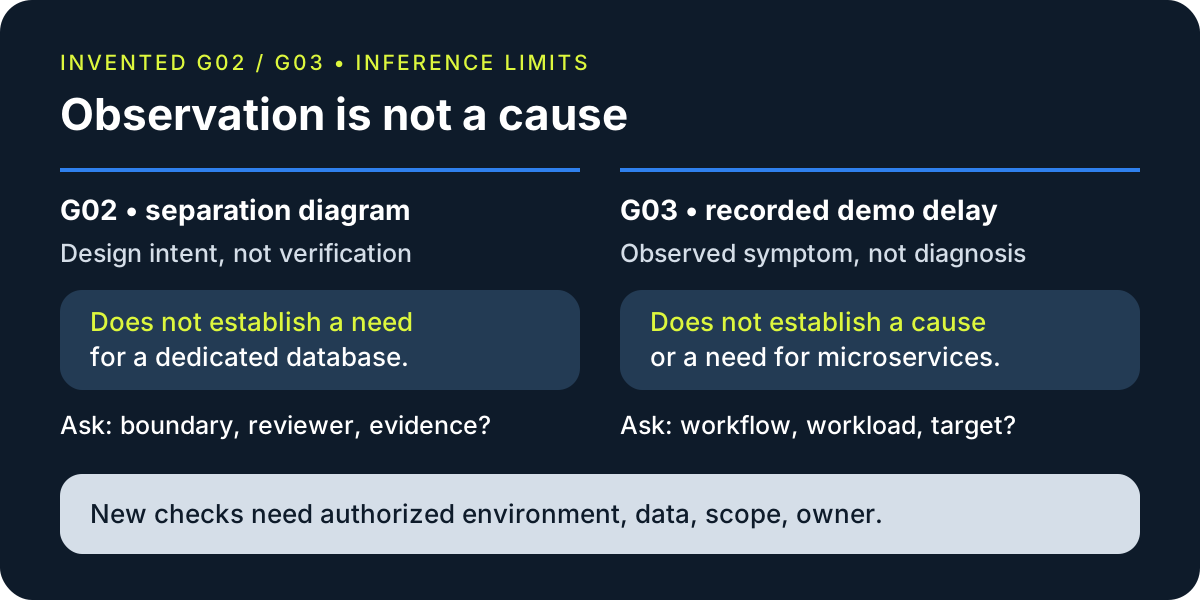
There is no successful ending to this example. G01 identifies a confirmed gate and a capability gap; G02 does not justify a dedicated-database project; G03 does not establish a performance cause. The list has become useful precisely because it no longer presents three assumptions as three equally certain engineering commitments.
Decide what to clarify before deciding what to build
As a practical handoff, move to comparing responses for a requirement once the responsible buyer role has confirmed it blocks the named milestone, its source/date and reviewer are recorded, and the gap type is no longer unknown. In the invented example, G01 supplies that basis; G02 and G03 still need clarification. This is editorial guidance, not an approval test: a pilot gate is not automatically a signature gate, and a buyer’s answer does not waive legal duties or a genuine security concern.
Use the first gap list to choose the next action for each requirement:
- The buying condition is unclear: ask the buyer to confirm the milestone, required behavior, and reviewer. Keep any delivery estimate conditional on the unresolved requirement.
- The capability exists but the evidence is insufficient: assemble the relevant evidence and ask the reviewer whether it addresses the request. Do not rebuild a feature merely to improve a questionnaire answer.
- A gap is established: compare bounded responses in the enterprise-readiness guide; it covers configuration, managed tools, manual arrangements and redesign.
The founder or product leader owns the commercial priority, and the technical lead defines the technical decision and criteria. The buyer’s reviewer keeps acceptance of its requirement; legal, security and regulatory decisions stay with the responsible specialists, and implementation belongs to your team or a separately selected provider.
Keep a dated snapshot and revisit it when the buyer changes the milestone or a check reveals new evidence.
Your next step: identify the actual blocker
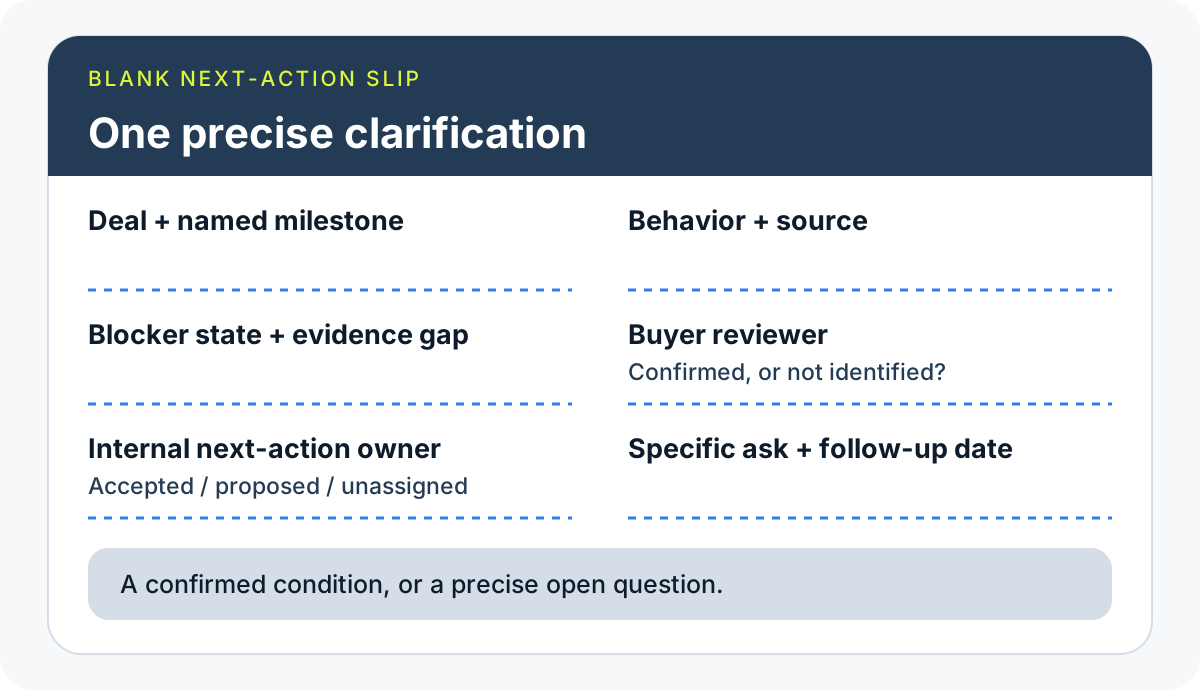
Choose the stalled deal and fill in one gap record for the requirement currently described as “blocking.” Find its source, mark its blocker status honestly, and identify the missing buyer confirmation or product evidence. Send that specific clarification to the appropriate reviewer through your agreed channel.
The useful output is one of two things: a buyer-confirmed condition for the next milestone, or a precise unanswered question with an owner and follow-up date. You can reach that decision without declaring the whole product “enterprise ready.”
If the list reveals a technical decision spanning product, engineering, and buyer acceptance that needs senior leadership, you can ask the Grand Rounds curator about fit. Grand Rounds supports technical decisions; the inquiry itself does not establish implementation scope or buyer approval.
Boundaries
Grand Rounds is an initiative of Dinarys, and a conversation may lead to cooperation with Dinarys.