
Enterprise-ready does not mean rebuilding everything. A buyer may need a particular sign-in path, tighter permissions, and evidence that a critical workflow will keep working—not a new architecture for its own sake.
For a product company with a working SaaS product, engineers, and a real enterprise opportunity, the decision is which changes this buyer’s next milestone requires, which can wait, and what will demonstrate the difference. A new identity service, a narrow product fix, an agreed operating procedure, and a larger redesign are not interchangeable ways to answer that question.
When an enterprise buyer runs a SaaS security assessment as part of its third-party risk review, the request may arrive as a questionnaire. Turn each material answer into a chain: requirement → chosen response → evidence → responsible owner → buyer acceptance. Evidence is a dated artifact or observation that addresses the actual question within a stated scope—not a readiness score or a security certification.
This guide starts with the buyer’s requirements already on the table. Its output is a readiness plan: must-have / later / needs-clarification priorities, bounded options, and an agreed, safe test of the critical flow. If you have not confirmed which requests block the milestone, start with your product works but the enterprise buyer still cannot sign. Keep its blocker record and extend it with the response and evidence plan below.
Turn questionnaire answers into decisions, not a bigger backlog
A SaaS security questionnaire is an input to assessment, not an architecture specification. For example, the Cloud Security Alliance describes its CAIQ questionnaire as a way to document existing cloud security controls through yes/no questions.
Keep the buyer’s original question and answer format intact. Link each material answer to a decision record; do not quietly redefine the question to make your product fit. “Supported,” “planned,” and “demonstrated in this scope” are different statements.
What counts as evidence for a questionnaire answer?
Match the evidence to the question. A written policy describes the intended rules. A configuration export or screenshot records a setting at a date. A scoped test record describes observed behavior for a particular build and environment. An independent report, such as an audit report or penetration-test summary, covers its stated scope and period—if you have one.
If the question asks whether you hold a particular certification or report, answer the question directly: provide the artifact if held, or say no. Alternative evidence is a separate proposal for the buyer to consider, not a way to turn no into yes. Record the reference, date, scope, and limits so the reviewer can judge what it establishes. These are evidence examples, not a universal list of required artifacts.
Which work is necessary for this milestone?
Keep the milestone from the initial blocker record: a limited pilot, production activation, or a wider rollout. A confirmed blocker becomes must-have; an unknown blocker becomes needs clarification. A request confirmed not to block this milestone becomes later only when the relevant decision-makers accept its deferral and operating arrangement. Use three planning categories:
- Must-have: a requirement confirmed for the named milestone, or a prerequisite needed to meet it. Record the required behavior, bounded response, evidence, owner, and acceptance reviewer.
- Later: work explicitly deferred for this scope by the relevant decision-makers. Record why deferral is acceptable, the current operating arrangement, and the date or event that reopens the decision.
- Needs clarification: required behavior, scope, timing, evidence, or acceptance authority is unresolved. Record the exact open question, who will resolve it, and when to revisit the plan.
A confirmed must-have stays must-have when supporting evidence has not yet been produced. Record that evidence gap alongside the requirement; do not use “needs clarification” to lower its priority.
These categories prioritize a commercial readiness plan; they do not classify security risk. A serious concern still goes to the responsible security or domain reviewer, even if it is not a purchase condition. “Later” cannot waive legal obligations or your own security responsibilities. Unknown is not a failed control—and it is not permission to proceed.
Keep the original requirement ID, source, current capability, evidence, reviewer, and acceptance criterion in the initial blocker record. Add only these four fields to the same row or a linked sheet; do not start a second gap list.
- Priority: must-have / later / needs clarification; confirmer and source/date; next action or deferral expiry/review trigger.
- Route: options considered → selected bounded response; dependencies, effort/cost assumptions; implementation owner and acceptance of ownership.
- Exclusions: behavior, users, data, paths, or rollout stages not covered.
- Operating owner: accepted owner and backup, coverage, escalation, and expiry for any procedure; otherwise not applicable.
Agree the required behavior and evidence before committing to a delivery date. A buyer reviewer’s agreement to a test plan is not acceptance of an unbuilt change. Naming an engineer in the matrix is not accepted ownership until that person or team has agreed.
A worked example: one pilot, not a whole rebuild
Everything in this example is invented: the product, buyer requirements, reviewer agreements, and technical situation. It is not a Grand Rounds engagement or a customer result.
A maintenance-planning SaaS company is preparing a 30-person enterprise pilot. In this scenario, the buyer’s IT and security reviewers confirm the following access requirement:
Before the pilot, employees must use the approved corporate sign-in path. Dispatchers can assign work orders; observers can read but cannot assign them. Neither role may access another customer’s work orders. Removed pilot users must lose interactive access, including existing sessions, within two staffed business hours of a request through the agreed channel. End-user API access is outside this pilot’s scope.
That removal window is a fictional, buyer-specific condition—not a recommended security standard.
The fictional product already has a corporate identity integration that the buyer’s IT reviewer accepts for evaluation. Its application currently gives both pilot roles assignment rights. Tenant-scoped access is described in the design, but the relevant verification evidence has not been assembled. The team also creates and removes accounts manually.
The buyer’s IT reviewer accepts a named-operator account-lifecycle procedure for this limited pilot, subject to demonstrating the agreed removal behavior. That agreement does not extend to a larger rollout. “High availability” appears elsewhere in the questionnaire without a defined service window or recovery expectation.
The example readiness and evidence matrix
The roles and agreements below are part of the invented scenario. Evidence is still to be produced; no row records an executed test or buyer acceptance of the finished product.
A1 — Must-have: pilot access
- Route: retain the existing sign-in integration for evaluation; change application permissions so only dispatchers assign work. Verify the customer-data boundary in scope.
- Evidence and owners: engineering accepts implementation and evidence ownership. Buyer IT reviews sign-in; buyer security reviews access behavior and boundary evidence. Demonstrate permitted and denied actions with synthetic accounts and records.
- Exclusion and trigger: this covers the named pilot, not a wider rollout. Reopen the option comparison if the integration or boundary cannot meet the requirement.
A2 — Must-have: account setup and removal
- Route: use the agreed manual procedure, including loss of interactive access and existing sessions within the fictional two-staffed-hour window.
- Evidence and owners: support accepts operating ownership and backup coverage; engineering accepts ownership of required product behavior. Buyer IT reviews the lifecycle evidence, including the request channel, staffed hours, and removal observations.
- Exclusion and trigger: end-user API access is excluded from the pilot. If timing or coverage cannot be met, revise the procedure or product response before requesting acceptance.
A3 — Later: automatic directory synchronization
- Route: defer synchronization, not access removal; use A2 during the pilot.
- Evidence and owners: buyer IT accepts the limited deferral; product and support accept the operating burden. Link their agreement and the procedure. Describe it as manual, not automated provisioning.
- Exclusion and trigger: no extension to a larger rollout. Revisit at pilot end or before expansion, whichever comes first.
A4 — Needs clarification: “high availability”
- Route: clarify before selecting a reliability change; those words alone do not justify multi-region deployment.
- Evidence and owner: product accepts the clarification task with the buyer’s operational and IT reviewers. Required evidence remains unresolved.
- Next action: establish the critical task, service window, workload, recovery expectations, and acceptable evidence; agree a follow-up date with those reviewers.
This matrix changes the engineering decision. The visible permission gap is in the application; a different sign-in tool is not, by itself, a response to it. Missing boundary evidence does not yet justify a dedicated deployment. And deferring directory synchronization does not defer the required ability to remove access.
Compare bounded options against the same buyer requirement
Use A1 and A2—the complete pilot access requirement above—as the common comparison. Keep the user scope, required behavior, and acceptance criteria unchanged between options. Otherwise, a cheaper option may only look cheaper because it solves less of the problem.
The options can be combined. In this example, a narrow product change may still need a managed identity integration and a manual operating procedure. Compare the remaining gaps, not just the names of the solutions.
Narrow product/control change. Retain the existing identity path, change role enforcement, and address any verified boundary or removal gaps. This targets the known dispatcher/observer gap while preserving what may work. Choose this route only if the existing foundations can meet the requirement; engineering still needs evidence for sign-in, data access, and removal. A small ticket is not evidence of a small risk.
Existing managed tool. An identity service is a candidate for sign-in or lifecycle work if compatibility and integration are demonstrated. It may complement the product change, not replace it. Microsoft’s multitenant identity guidance distinguishes verifying identity from enforcing permissions within a tenant. Do not assume a login service enforces work-order permissions or the application’s customer-data boundary. Check coverage, data handling, dependency behavior, and recurring cost before selection.
Process workaround. Named operators can manage the agreed manual lifecycle portion if they can meet timing, coverage, and evidence requirements. This cannot supply corporate sign-in or make a write-capable observer read-only. It requires reviewer acceptance, an operating owner, backup, and expiry—not shared accounts or bypassed controls.
Larger architecture change. Evaluate redesign when a demonstrated structural constraint prevents narrower responses from meeting the same requirement. Separate infrastructure alone does not demonstrate correct application permissions or removal. Include migration, regression checks, and ongoing operations in the comparison.
For the invented situation, the bounded response to evaluate first is the existing sign-in path plus a narrow permissions change and the agreed pilot lifecycle procedure. That is a proposal to verify, not a finding that the product is secure or the pilot can start. A failed or inconclusive boundary check would change the plan; it would not be averaged away by successful sign-in.
Include operating effort and cost in the same comparison
For reliability requirements, compare options against an agreed workload and outcome; a short rehearsal alone cannot establish a long-term availability commitment.
For manual onboarding or support, include recurring steps, staff time, coverage, and escalation ownership—the workaround is not zero cost just because it avoids a new subscription.
Use the same pilot size and period for infrastructure, managed-tool charges, and staff effort across routes. Show implementation and migration effort separately from recurring cost, with assumptions for finance to assess.
Agree a safe critical-flow test before running it
Choose the smallest end-to-end flow that addresses the buyer’s material requirements—not the easiest feature demo. In the example, that means approved sign-in, the dispatcher/observer distinction, the customer-data boundary, and account removal under the agreed procedure.
Keep the claim narrow. OWASP describes its Web Security Testing Guide as a methodology and technique reference, not a compliance standard, and distinguishes engagements by authorization and rules of engagement. The acceptance rehearsal here is narrower still: it cannot replace a security assessment or specialist review.
Before a run, the technical owner and relevant reviewers should agree a written test record covering:
- Requirement and expected observations: IDs from the matrix, permitted behavior, denied behavior, and any agreed timing or workload measures. Unresolved criteria remain unresolved; do not invent a universal target.
- Authorized scope: system-owner permission, environment, build/configuration, test accounts, synthetic data, allowed actions, and any dependencies. Use an isolated non-production environment for this rehearsal. Any buyer identity service or external integration must be explicitly in scope and authorized; otherwise use an approved test substitute and record what that cannot establish.
- Safety and recovery: a named operator, bounded duration and workload, agreed stop conditions, who can stop the run, recovery or cleanup responsibility, and escalation contacts. Unexpected exposure of data, impact outside the authorized environment, or an unapproved dependency ends the run and triggers the responsible response process.
- Evidence handling: what observations and logs will be retained, who may see them, redaction, approved storage, and retention. Do not put credentials, real customer records, or sensitive logs into an unrestricted readiness document.
- Review and limitations: who reviews each requirement, how observations will be reported, and differences from production. Record what is not tested, including paths and failure conditions outside the agreed scope.
Do not generate load against production, probe another customer’s environment, disable live controls, or run a destructive recovery exercise from this guide. Those are separate activities requiring their own authorization, expertise, and safeguards. A staging result must identify any configuration or dependency differences before a reviewer decides how far it applies.
The invented example’s agreed rehearsal
In this scenario, the system owner, engineering, support, and the relevant buyer IT/security reviewers agree the following limited rehearsal. No execution or successful result is claimed.
- Prepare the authorized fixture. Use an isolated staging build, an explicitly approved test identity connection, and synthetic work orders for two fictional customer organizations. Assign synthetic dispatcher and observer accounts. Record the build, configuration, expected role behavior, and differences from production.
- Observe the permitted flow. The dispatcher signs in through the approved test path and assigns a work order in its own organization. The observer signs in and reads the permitted record. Retain scoped observations that show which role and organization were used, without recording secrets.
- Observe the denied flow. Within the security reviewer’s pre-agreed test cases, verify that the observer cannot assign work and neither role can retrieve the other synthetic organization’s records. Do not extend the check to real customers or additional access paths without authorization. A rejected button click alone is not sufficient evidence of the underlying permission boundary; engineering and security agree the supporting checks.
- Rehearse account removal. The named operator follows the agreed pilot procedure. Record the removal request, action, and observed loss of access against the agreed timing and session/access-path scope. A blocked new sign-in does not answer what happens to an existing session; document both where required.
- Restore and review. Complete the agreed cleanup. Record observations, deviations, and untested conditions against A1 and A2. Buyer IT and security each review their part; support confirms that the operating procedure and coverage are workable. The product sponsor then considers the milestone alongside any remaining approvals.
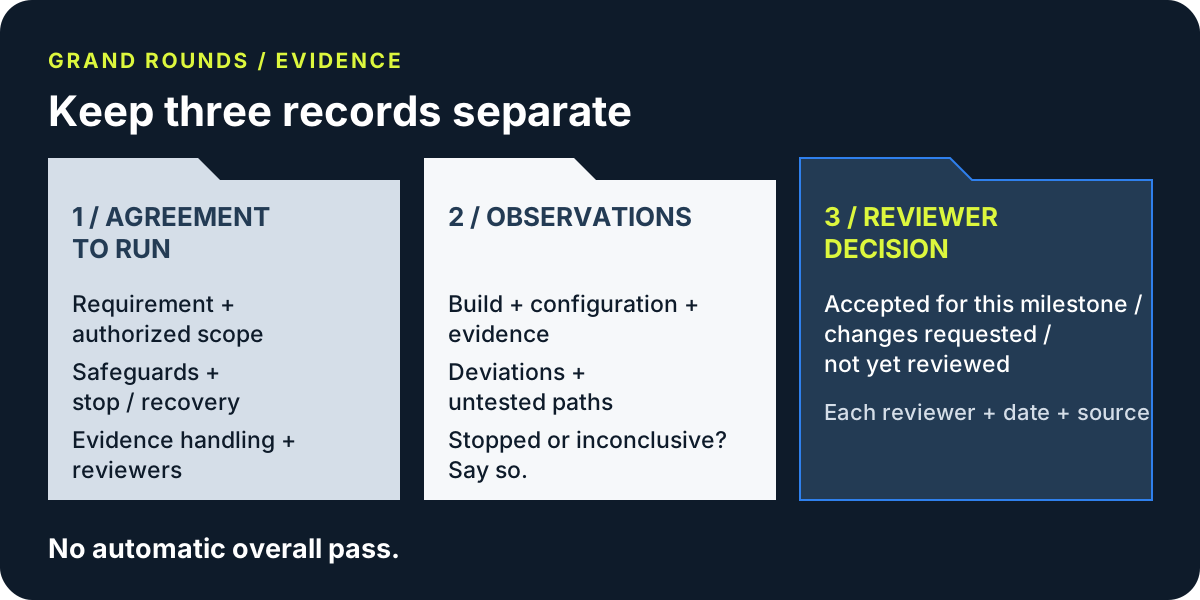
For each requirement, keep the observation separate from the disposition: accepted for this milestone, changes requested, or not yet reviewed, with the reviewer, date, and decision reference. If the test is stopped or inconclusive, say so. Do not turn several successful checks into an automatic overall “pass.”
Agree the bounded readiness plan
Extend the existing blocker record for one opportunity with priority, route, exclusions, and operating ownership. For each must-have, agree the evidence and reviewer against the original requirement. Give every deferral an accepted arrangement and review trigger; give every unresolved question an owner and follow-up date.
Then circulate a short decision for agreement:
For [milestone and scope], we propose [bounded changes and operating procedure] to satisfy [requirement IDs]. We will verify them through [authorized critical flow and evidence], reviewed by [confirmed roles]. We defer [items] until [date/event] under [accepted arrangement]. We cannot commit on [open requirement] until [specific clarification].
The founder or CEO owns commercial priority and budget; product connects the plan to the milestone. The CTO or technical lead defines the solution, criteria, and oversight. The client’s team or a separately selected provider implements it. Finance assesses the cost assumptions, while buyer, security, and domain reviewers retain their respective acceptance decisions. A CTO’s plan does not replace those approvals.
The useful outcome is agreement on what to change, what to defer, and what evidence will support the next decision—not a declaration that the entire product is enterprise-ready. Reopen the plan when the buyer expands the rollout, the test reveals a different constraint, another buyer requires a new capability, or operating cost exceeds the agreed assumptions.
If the team can own the bounded plan and its review decisions, you may not need outside technical leadership. If a cross-functional technical decision lacks an owner with authority to make it, consider outside support; a missing buyer answer such as A4 first needs a buyer clarification, not a CTO search.
To define an outside remit, see how to choose a CTO for an enterprise-readiness milestone. If that is the support you need, ask the Grand Rounds curator about fit. Grand Rounds supports technical decisions; implementation scope and expert availability are confirmed separately.
Boundaries
Grand Rounds is an initiative of Dinarys, and a conversation may lead to cooperation with Dinarys.