
Fix first the verified obstruction to the customer's useful result that you can address with a bounded release. Import comes first when valid, permitted inputs fail; permissions when a legitimate access or administrator handoff is broken; provisioning—the setup that makes an account or workspace usable—when resource setup or processing stalls. Choose by the evidence, dependencies and recovery cost, not a universal backend-first order.
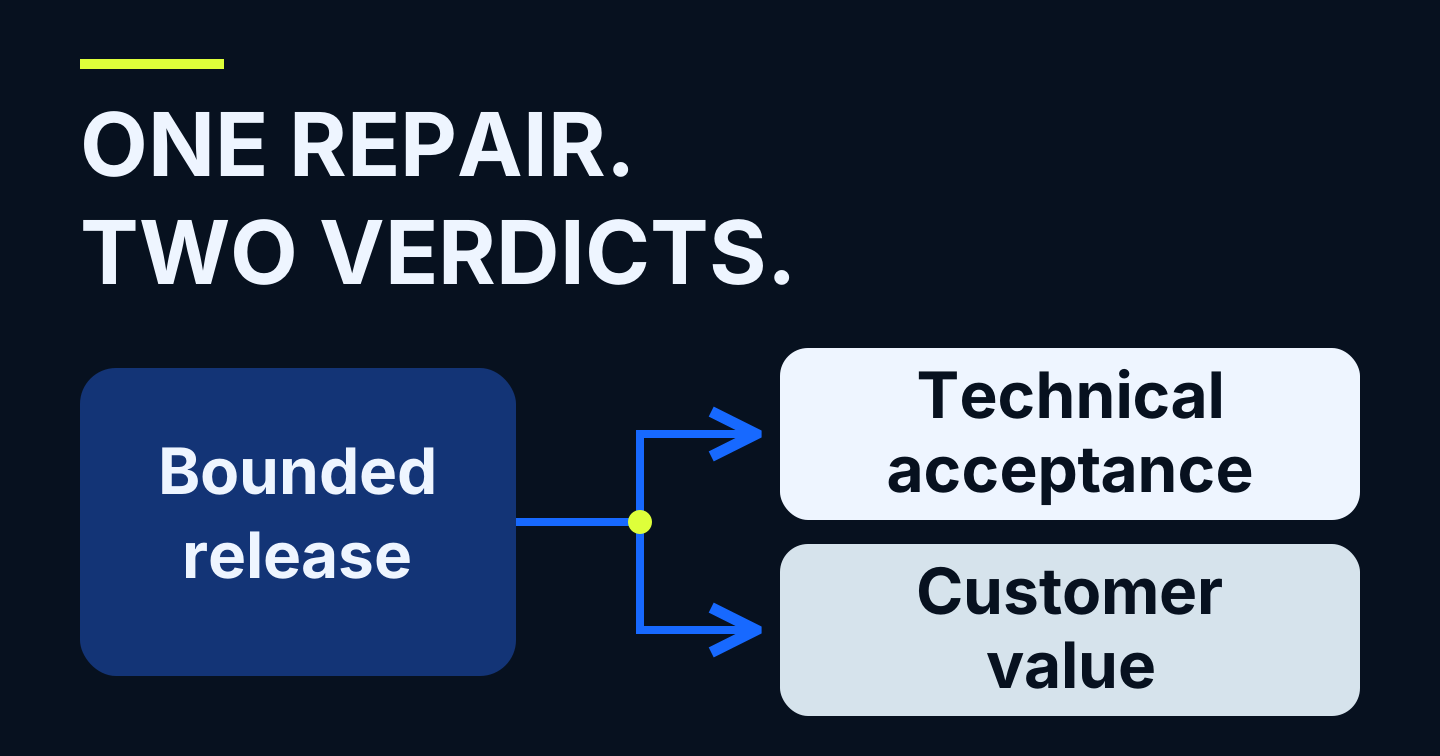
Your team may have several plausible fixes and only one release window. This guide turns an observed barrier into a repair backlog, a selected change and two separate verdicts: technical acceptance and evidence of customer value.
If the barrier is still unclear, use the registration–setup–first-value map first. Use it to locate the barrier; here, turn that evidence into a release choice.
Turn the observed barrier into a repair backlog
Carry forward the agreed segment, customer job, first-value criterion and user/account unit. Product owns the useful-result definition; engineering checks that system state and tracking can evidence it. If a proposed smaller first scenario changes the result, record it as a different product hypothesis rather than an equivalent improvement.
Use one backlog record per candidate change. Link to the existing diagnostic evidence instead of rebuilding the journey map.
| Backlog field | What makes it decision-ready |
|---|---|
| Barrier and evidence | Specific observed behavior or reproducible system state, evidence link and affected path |
| Hypothesis and alternative | Why this repair could unblock the job; what clearer guidance, existing configuration, manual help or no change would leave unresolved |
| Selected scope | Smallest coherent change, dependencies, exclusions and who implements it |
| Activation criterion | The useful result, trustworthy evidence, eligible cohort and observation window |
| Technical acceptance | Expected valid/invalid behavior, legitimate access boundaries, regression and recovery checks |
| Measurement design | Randomized comparison or observational rollout; assignment/exposure records and consistent event definitions |
| Operating control | Product and technical owners, monitoring, stop conditions, rollback/recovery owner and review point |
Prioritize a candidate when its evidence connects to the agreed job, its dependencies can be met and its acceptance and recovery are feasible. A smaller repair is preferable only if it removes the obstruction. A tooltip cannot make failed processing succeed.
Include whole-work cost: implementation, customer effort, support, maintenance, rollback and the existing vendor's responsibilities. Manual assistance is a real alternative when its effort and ownership are visible. Keeping the current path is reasonable if it works adequately or the proposed repair lacks evidence.
Compare implementation trade-offs, not diagnostic labels
Import: a supported-input repair or a larger processing change?
A correction to one documented format can have a narrower compatibility surface than replacing a parser or import pipeline. Expanding accepted formats also expands the behavior the team must maintain. Decide which inputs are supported, what happens to invalid rows and whether partial success leaves customers with usable or misleading data.
Acceptance should cover valid, invalid and previously working inputs, plus retry behavior where records may already have been created. Better error wording can accompany the repair; a clearer rejection alone is sufficient only when rejection is the correct behavior.
Permissions: repair the handoff before changing authority
Sending an existing administrator invitation at the right point may repair a handoff without redesigning roles. Changing the authorization model reaches further: existing accounts, tenant boundaries, revocation and support procedures may all be affected. Choose that larger scope only when the intended permissions themselves are wrong.
Test both the authorized actor's path and the denial of inappropriate access. Keep administrator approval where the workflow requires it. If the invitation and role assignment work but the customer has not yet acted, distinguish a reminder or customer dependency from a software defect.
Provisioning: capacity, retries or a clearer readiness state?
Increasing worker capacity can address demonstrated queue contention, but it adds operating cost and may leave a deterministic job failure untouched. Retrying can help transient failures, but replaying an operation that creates resources or records requires safeguards against duplicate side effects. A job still within its expected window may need truthful progress information rather than more workers.
AWS's Builders' Library explains the trade-off: safe retries can simplify callers while adding service-side complexity. For your backlog, make retry, partial completion and late completion explicit acceptance cases—not an instruction to copy an AWS architecture.
One release choice: send the invitation, or explain it better?
Invented, unperformed example. In a work-planning SaaS product, first value for a team lead means assigning the first task to an invited colleague in a shared workspace. Assume a permitted test fixture reproduces this behavior: the workspace becomes ready, but the existing invitation is sent only after a support agent takes a manual step. The role configuration is otherwise correct.
The team compares clearer invitation instructions with triggering the existing invitation after workspace readiness. It selects the trigger repair: instructions would explain a message that has never been sent. Role redesign and import changes stay outside the release.
The proposed backlog entry makes the choice testable:
- Technical acceptance: the correct pending invitation is triggered when the workspace is ready; repeated readiness signals do not create duplicate invitations; invalid or revoked invitations retain their intended behavior; other roles remain unchanged.
- Activation criterion: eligible team leads can assign the first task to the colleague after the colleague accepts. Invitation dispatch is an intermediate event, not first value.
- Control: the implementation owner can stop the new trigger and account for invitations already sent; support owns any agreed fallback. Previously issued messages cannot be recalled by reverting code.
- Evaluation: record exposure to the new path and compare task completion with equal follow-up, separating technical acceptance from the observed customer result.
If the invitation is already delivered and the colleague is simply awaiting a legitimate administrator decision, this trigger change does not address the dependency. That counter-case would send the team back to the handoff evidence, not toward broader access. The example supplies a decision premise and proposed checks, not executed tests or an uplift result.
Control the release and the before/after comparison
Before launch, agree eligibility, monitoring, stop conditions and who can stop exposure or recover affected data and jobs. Rollback may restore code without undoing side effects. Check whether the existing vendor configuration or feature controls cover the selected path before adding custom infrastructure.
Amplitude's feature-flag documentation describes targeted rollouts and switching features without redeploying code. It also notes that company-level bucketing can keep colleagues in the same experience. Use the controls your current stack supports; tool selection is separate from the repair decision.
Make the comparison inspectable
A before/after rollout is an observational comparison, not a randomized experiment. Acquisition mix, cohort maturity, seasonality and concurrent releases can move the result. Random assignment can support causal estimation with an appropriate design, correct execution and adequate evidence; a feature flag alone establishes none of these.
For a useful before/after report:
- Keep eligibility and definitions consistent. Use the same segment, start, useful result and user/account unit. Record any tracking change; an event added at launch can create an apparent improvement.
- Give cohorts equal follow-up. Compare results at the same elapsed time from registration. Choose a window that fits the customer job before reading the outcome, and allow the later cohort to reach that age.
- Record the experience received. Keep release exposure, version and assistance records. If colleagues share a workspace, consider account-level assignment and shared effects rather than treating them as independent journeys.
- Show the denominator and the unfinished work. Report useful-task completion for the eligible cohort alongside time to value among completers, accounts still waiting and incomplete follow-up. A faster subset of completers can conceal worse completion overall.
- Separate the verdicts. State what technical checks passed, what customer behavior was observed, and which competing explanations remain. Include sample sizes and uncertainty; use the design to limit the claim.
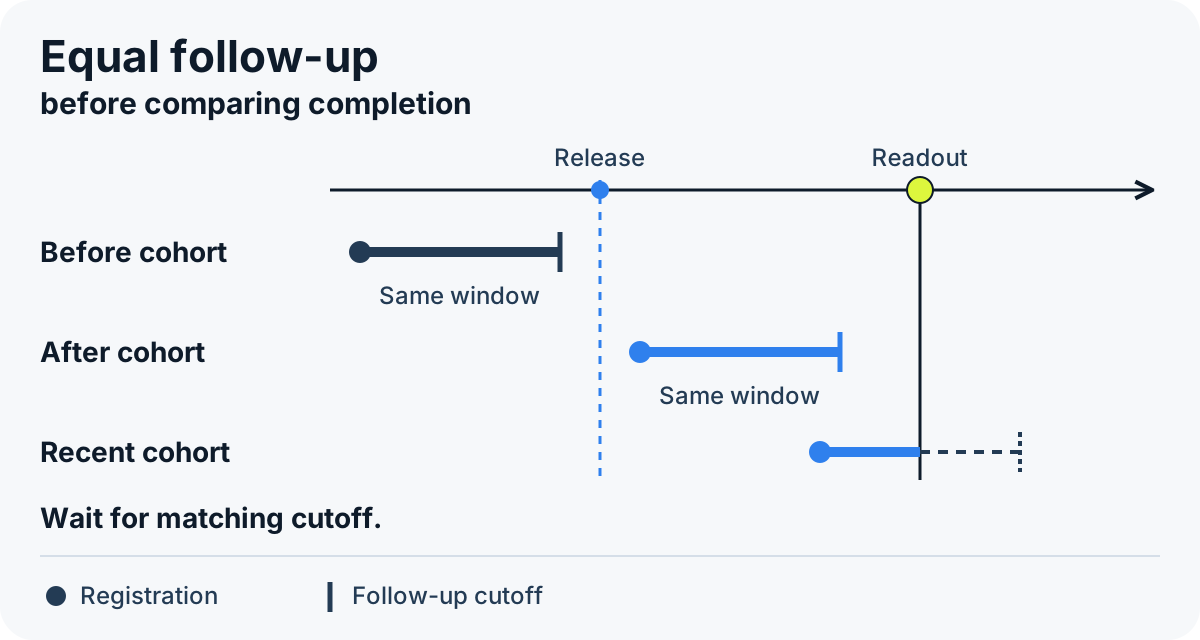
If the technical checks pass but the cohort is too young, the defensible record is “accepted within the tested scope; activation effect not yet established.” If completion improves in a before/after report, describe the observed difference and relevant concurrent changes. Paid conversion and retention need their own follow-up; neither follows automatically from a repaired setup step.
When this needs a technical leader
Bring in technical leadership when product and engineering cannot settle a consequential decision together: a cross-system recovery plan, an authorization-model change or the evidence needed for a release claim. When scope, acceptance and controls are already agreed, the current team or vendor can implement the repair without a new CTO mandate. For the selection decision, see choosing a CTO for an activation milestone.
Next action: take one backlog entry to Product and Engineering and agree its scope, acceptance evidence and release controls—or record why it should wait. If you need an outside technical view on an unresolved trade-off, discuss that record with the Grand Rounds curator. Your team or chosen vendor owns implementation under its agreed scope.
Boundaries
Grand Rounds is an initiative of Dinarys, and a conversation may lead to cooperation with Dinarys.