
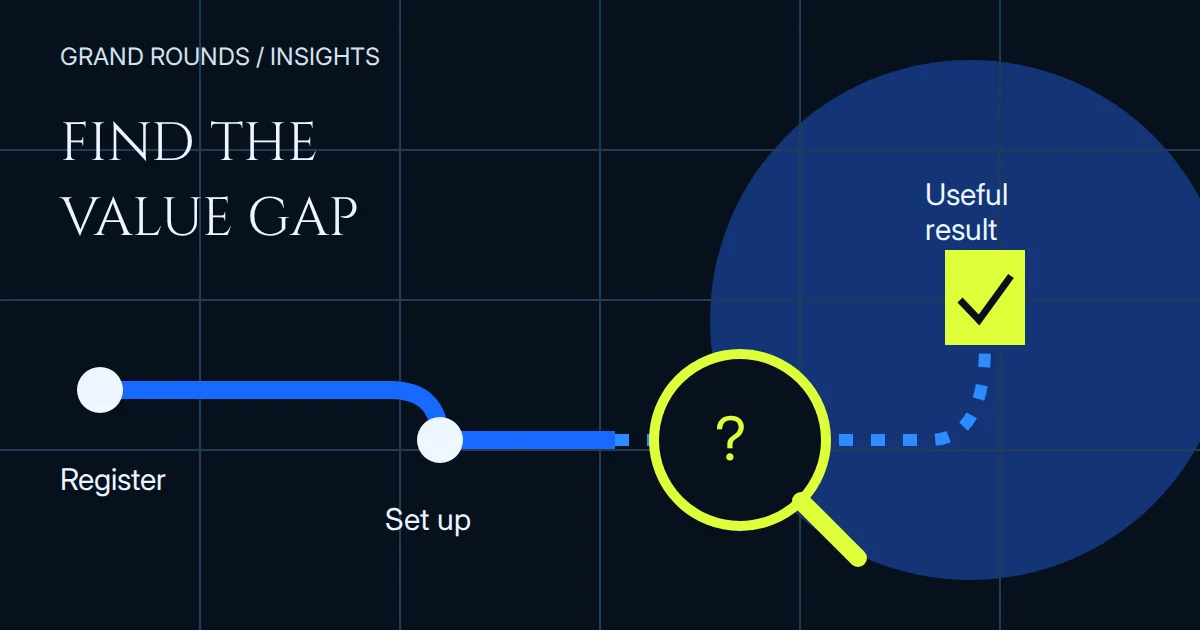
Registrations are arriving. Growth adds emails, customer success runs more demos, and engineering hears that onboarding needs fixing. Yet new customers still need someone to carry them through setup.
Before buying more traffic or commissioning an onboarding redesign, agree what those customers came to accomplish. Then locate one barrier between registration and that result. A missing permission, a confusing import step and a product that solves the wrong job can produce similar-looking funnels, and each needs a different response.
This guide is for SaaS founders, product leaders and growth teams with a working product and users to learn from. Its output is a registration–setup–first-value map for one segment, and it stops short of a verdict on your backend or UX.
First value is a useful customer result
SaaS time to value is the elapsed time between an explicitly chosen starting point and a customer's first useful result. For the activation question here, use registration as the start. Keep any contract-to-value measure separately labeled, since it answers a different question.
Write the end point as a customer action with an observable outcome. “Welcome screen viewed” describes activity. “The operations manager uses an imported account list to identify work requiring follow-up” describes a possible benefit. The product owner must check that this is genuinely useful to that segment, beyond being easy to track.
Use this sentence:
For [segment], first value means [customer completes a job] using [real, permitted inputs], with [observable evidence that the result is useful].
A demo dataset may help someone understand a product, while their own job still needs their own data. Likewise, a successful import is a prerequisite, and value follows only when the customer can use the imported data.
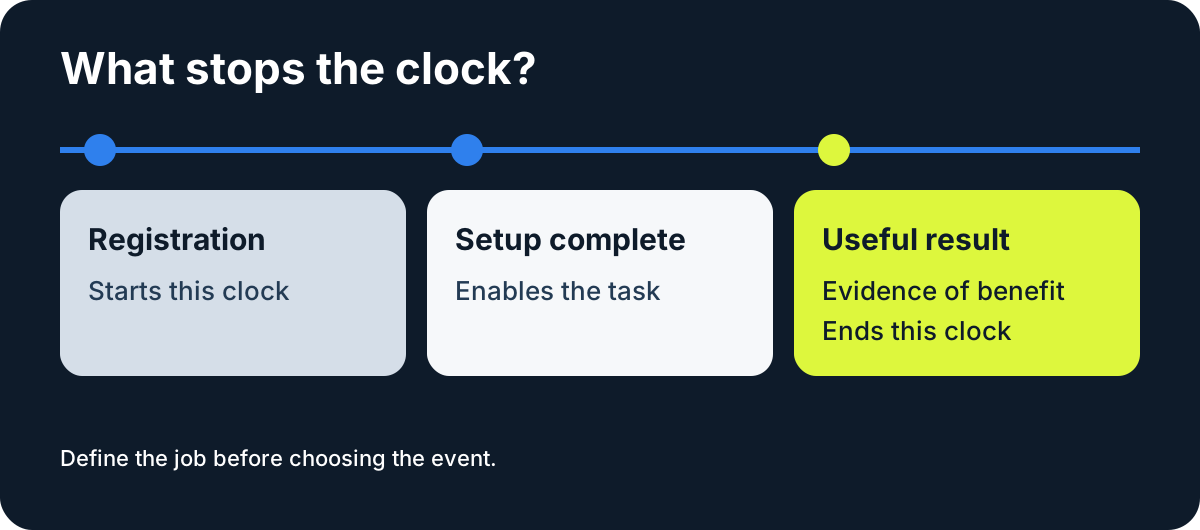
Valuecase's definition also distinguishes a customer’s first real benefit from setup completion, although its starting point is contract signature, where the measure used here starts at registration. Make the clock and milestone explicit before comparing any numbers.
Map one segment before diagnosing the whole product
Choose a segment with a shared job and setup path. A self-serve user importing a file and an invited employee waiting for an account administrator may follow different journeys. Record acquisition promise, role, data source and assisted versus unassisted onboarding where those affect the journey.
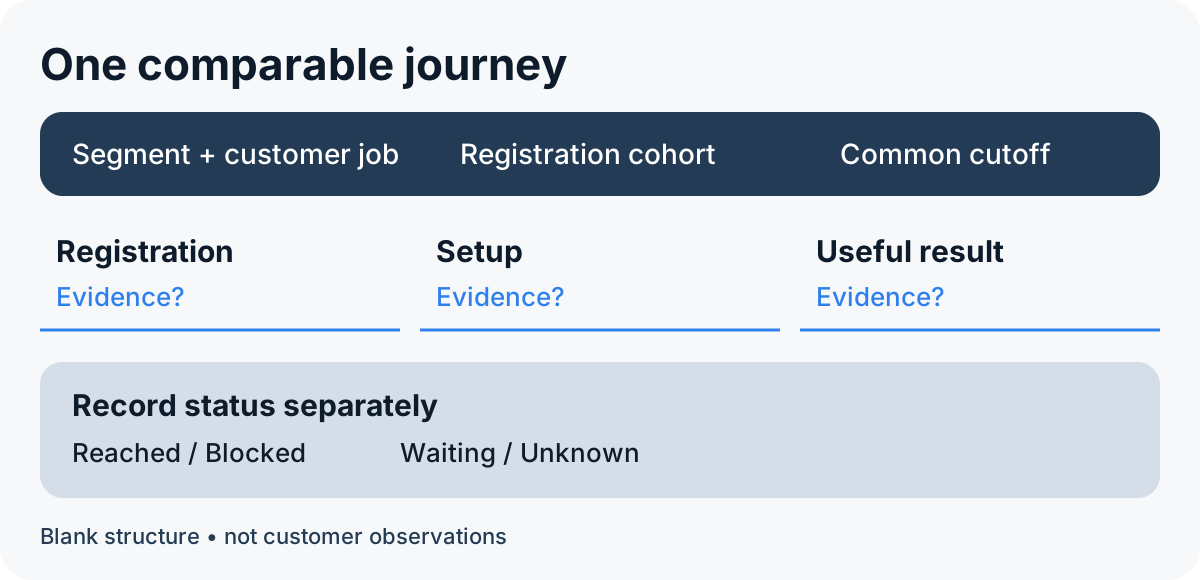
Choose a registration cohort and a common observation window appropriate to the job. A recently registered customer may simply not have had time to reach value. Keep these states separate:
- Reached value: the agreed useful result is evidenced.
- Blocked: a particular obstacle is observed or reproduced.
- Waiting: a known dependency remains outstanding.
- Unknown: evidence is missing or the reason for leaving is not established.
Check identity linking, event delivery and whether the action happened through an assisted or alternative route before calling a missing end event a failed activation.
A reusable registration–setup–first-value map
Copy this record for each meaningful step in the selected journey:
| Field | What to record |
|---|---|
| Segment and cohort | Job, user/account unit, registration period, observation cutoff |
| Step and expected result | What the customer is trying to do; what usable output should exist |
| Evidence | Event definition, system status, permitted session/support evidence |
| Status | Reached, blocked, waiting or unknown; include timestamp |
| Dependency | Customer, administrator, product team, vendor or background job |
| Next check | The narrowest check that could distinguish plausible explanations |
Keep sensitive payloads out of a shared map. Use authorized, minimized evidence rather than copying customer files into an analytics exercise.
Locate the barrier, not just the drop-off
A funnel shows where recorded progress stops, and the reason needs separate evidence. Amplitude's funnel documentation makes an important measurement boundary explicit: conversion means triggering the events you specified in the specified order. A well-built funnel can still measure the wrong definition of value.
Triangulate the map with a permitted walkthrough, job/error status and relevant support evidence. ProductLed's onboarding audit is useful for mapping touchpoints, including manual work and communications outside the product. Look beyond the screens.
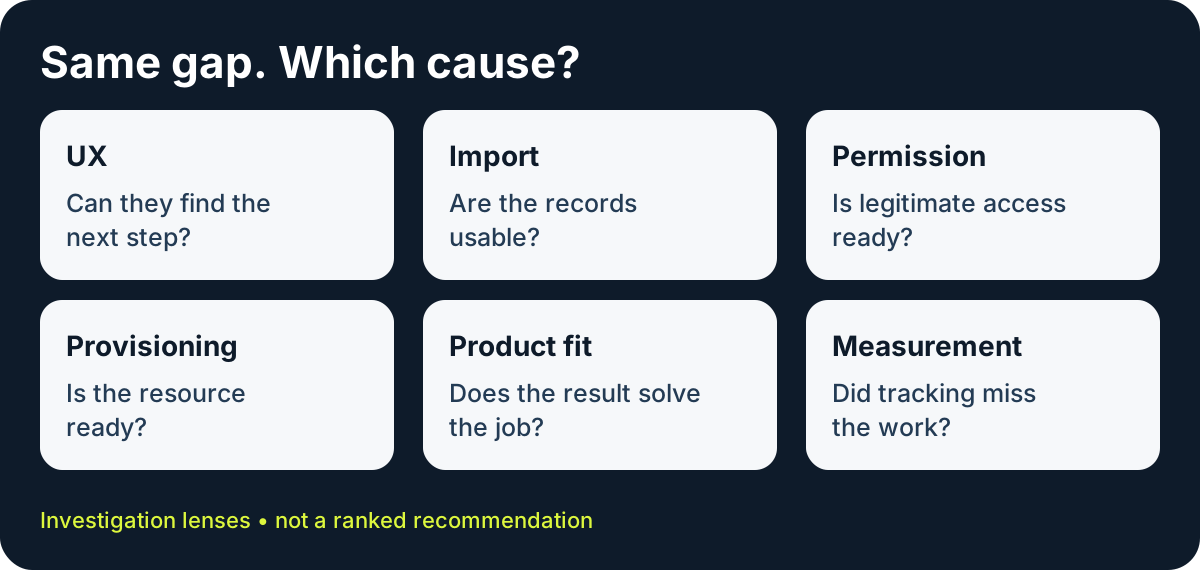
| Hypothesis | Evidence to seek | Inference to avoid |
|---|---|---|
| Setup sequence or UX | A user cannot identify the next necessary step; observed behavior and explanation agree | That every exit means confusion |
| Import | A particular valid input fails, mapping is unclear, or processing does not produce usable records | That clicking upload means the import succeeded |
| Permission | The intended actor lacks a required, legitimate authorization | That broader access is the right fix |
| Provisioning or slow jobs | Account/resource state or job timing prevents the task | That all waiting is a defect |
| Segment or product fit | Users complete the path but the result does not solve their intended job | That more tooltips will create demand |
| Measurement | Known completed work is absent or misattributed in analytics | That missing events prove missing value |
Permissions are especially easy to misdiagnose. An invited user who needs an administrator's approval may be on the correct path. The issue could be an unclear handoff, a broken role assignment, or simply a dependency that has not yet completed. Keep legitimate boundaries in place when shortening a chart.
Worked example: choose the import check, keep other states separate
Invented, unperformed example—not a customer case. A reporting SaaS team selects operations managers who register to create a follow-up list from their own permitted account data. The useful result is a reviewed list that the manager can use, rather than “file uploaded.”
The fictional cohort contains 24 operations-manager accounts, all observed through the same ten-day cutoff. That window is an invented exercise condition, not an activation benchmark. Each account appears in one row:
| State at the cutoff | Accounts | Evidence supplied in the fictional brief | Next decision |
|---|---|---|---|
| Reached first value | 12 | Manager opened the imported list and confirmed the follow-up task was usable | Retain as reached under this definition |
| Blocked on import | 5 | The same permitted input type produces a validation error; the test fixture reproduces it | Engineering checks the validation path before proposing a change |
| Waiting for administrator | 3 | Import is complete; the legitimate account administrator has not granted the required role | Customer success clarifies the handoff; do not widen access to improve the funnel |
| Unknown | 4 | No reliable end-state or explanation | Check instrumentation/contact evidence; hold off on assigning an import cause |
| Total | 24 | Same segment, unit and cutoff | 12 + 5 + 3 + 4 = 24 |
Decision: prioritize the reproducible validation path for one engineering investigation; the product owner retains the first-value definition. Keep the three administrator waits and four unknowns outside the claim. The largest combined unreached group is twelve accounts, and those twelve are three different situations rather than one technical defect.
Counter-case: if the same input validates and the manager can use the resulting records but rejects the follow-up list as irrelevant, the evidence points back to the job or segment, and more import infrastructure would leave that product question open. A later change still needs its own observation; this exercise reports no activation uplift.
Choose one bottleneck and one next check
Select a barrier that is relevant to the agreed first-value job, supported by evidence and narrow enough for an accountable owner to investigate. The largest chart gap is one candidate; the best engineering project is the one the evidence supports.
Write a short decision record:
Observed: [specific behavior/system state]. Hypothesis: [possible cause]. Still unknown: [other exits or dependencies]. Next check: [walkthrough, reproduction or tracking validation]. Owner: [named role/person]. Scope: [one segment and path].
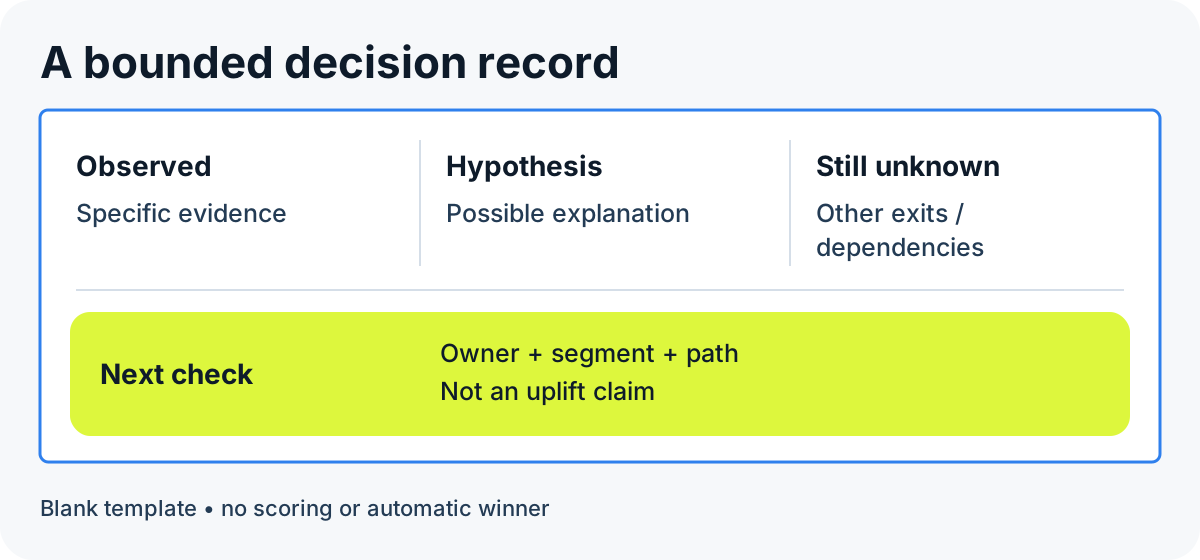
Leave no-change, clearer guidance and continued manual assistance on the table. A customer may need a useful explanation or an existing vendor configuration rather than a new system. If the evidence supports a release, compare the options in Fixing SaaS Activation: Import, Permissions, or Provisioning First?.
Where technical leadership helps
The valuable contribution is joining the product definition, event evidence and system behavior into a decision the team can execute. Product keeps ownership of what counts as customer value; technical leadership tests feasibility and risk; the client team or chosen vendor implements the agreed work.
The Grand Rounds network includes CTOs with product and delivery backgrounds. As stated in the CTO's profile, Carlos Blanco spent 14 years at TransUnion, moving from software developer to DevOps engineer to Product Owner, and built an AI-powered interviewer from scratch including voice, analytics and payments. Those are profile statements about his background; they are separate from any measured activation uplift, and they are not an uplift promise.
Your next action: complete the map for one segment and choose one evidence-backed bottleneck to check. If product and engineering cannot resolve the technical decision, bring that record, in place of a request to “fix growth,” to the Grand Rounds curator to discuss relevant expertise.
Boundaries
Grand Rounds is an initiative of Dinarys, and a conversation may lead to cooperation with Dinarys.