
An investor asks what happens when ten customers need onboarding at once. You show the product working for one. They ask who controls the code and data. You show a roadmap. The demonstration may be genuine; it is answering a different question.
If you are the founder of a product company with actual investor questions, start with those questions rather than a generic due diligence checklist. Your immediate task is to distinguish what you claim, what the available evidence shows, and what remains unknown. That can be a short register maintained with your engineering lead or current vendor, and it can come before any external assessment or full data room.
This is a diagnosis of technical evidence gaps, not a prediction about your round. An unanswered question may call for clarification, an existing record or a narrower claim rather than a product rebuild.
A working demo is evidence with a boundary
A demo can show that a particular flow worked under particular conditions. The repeatability, resource use, operational effort and legal rights behind that flow need their own evidence.
Preserve what the demo genuinely establishes: product version, input, environment, people involved and output. Then compare that boundary with the investor's question. “We processed this prepared document” is different from “we can onboard this customer segment without founder intervention,” and each statement needs its own support.
Ask the investor or their reviewer what decision the question informs. Are they asking whether the next customer can be served, whether costs rise with usage, whether a dependency can be replaced, or whether the company has the relevant rights? Understand the significance of a request before labelling it a deal blocker.
Four questions to separate from the presentation
What a usable evidence reference looks like
A useful answer names the artifact, its version, the conditions under which it was produced and its limit. “We have a data room” falls short of that. For each of the four questions, the reference might be:
- Product control and rights: a release tied to a build record, plus a component and contributor register that points counsel to the relevant agreements. Build access shows control of the build; ownership and license scope go to counsel.
- Own contribution versus external AI: a versioned component map that separates the supplier model or API from your retrieval, workflow rules, integrations and evaluation cases, with one output traced through that path. The map answers a dependency question and leaves customer demand to other evidence.
- Work at greater customer volume: onboarding records that show manual configuration time next to system processing, with the actor and unfinished exceptions visible. A few assisted traces describe those cases and cannot support a capacity claim for concurrent self-service onboarding.
- The next milestone: a dependency record that ties one target customer workflow to its accepting buyer, tests, internal owner and resource assumptions, with open items marked open.
If the investor asks about legal rights, adding performance traces answers the wrong question; route the identified agreements to qualified legal review. For what to put in the technical folder for each of these four questions, see the technical data room guide.
Make one claim–evidence–gap record
Use one row per concrete question. Keep the investor's wording and date so that a broad paraphrase does not replace the request.
| Field | What belongs in it |
|---|---|
| Question and decision | The actual request, who asked it and what they are trying to decide; mark unclear scope |
| Current claim | The precise answer currently in the deck, demo or conversation |
| Existing evidence | A versioned artifact or record, its location, conditions and limits; “none located” if appropriate |
| Gap | What the evidence leaves open: missing fact, untested assumption or question for another discipline |
| Accountable owner | The person who can verify or route the issue, which may differ from the person presenting the deck |
| Current status | What is verified, unverified, disputed or awaiting clarification; leave “closed” for the reviewer to decide |
This register identifies the problem. The reviewer decides whether an answer is sufficient, and any remediation plan comes afterwards.
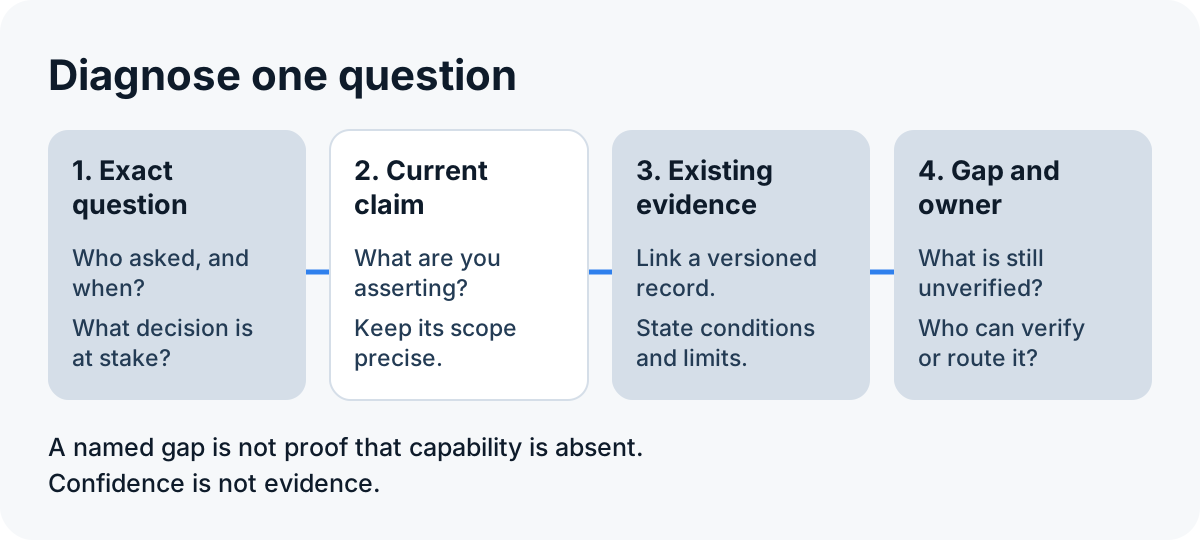
In words: question first, claim second, existing evidence third, then the gap and its owner. Missing evidence leaves the underlying capability unproven, and team confidence is a different thing from verification.
Worked diagnosis: invented and not performed
The following example is wholly invented and unperformed. It is an illustration, with no client case or investment outcome behind it.
Imagine a founder selling an AI document-analysis product. An investor asks: “What evidence shows the next customer can be onboarded without you configuring it personally?” The deck says “self-service onboarding.” The demo shows a prepared account reaching its first output.
One useful register entry would be:
- Claim: the next customer can complete the defined onboarding flow without founder configuration.
- Existing evidence: a recording of the prepared-account demo, tied to its product version. It shows the later user flow, and the account preparation happens off-screen.
- Gap: no located evidence for the preparation and exception steps without founder assistance. The current record supports neither self-service operation nor its impossibility.
- Owner: the engineering lead verifies the actual flow with the implementation vendor; the founder owns correcting the external claim and clarifying the investor's required scope.
- Status: unverified for the stated onboarding claim.
The immediate improvement is honesty about scope, ahead of any new software. Label the demonstrated capability as narrower than self-service onboarding until evidence supports the broader statement. Whether to gather an existing record, run a bounded experiment or change the product comes next.
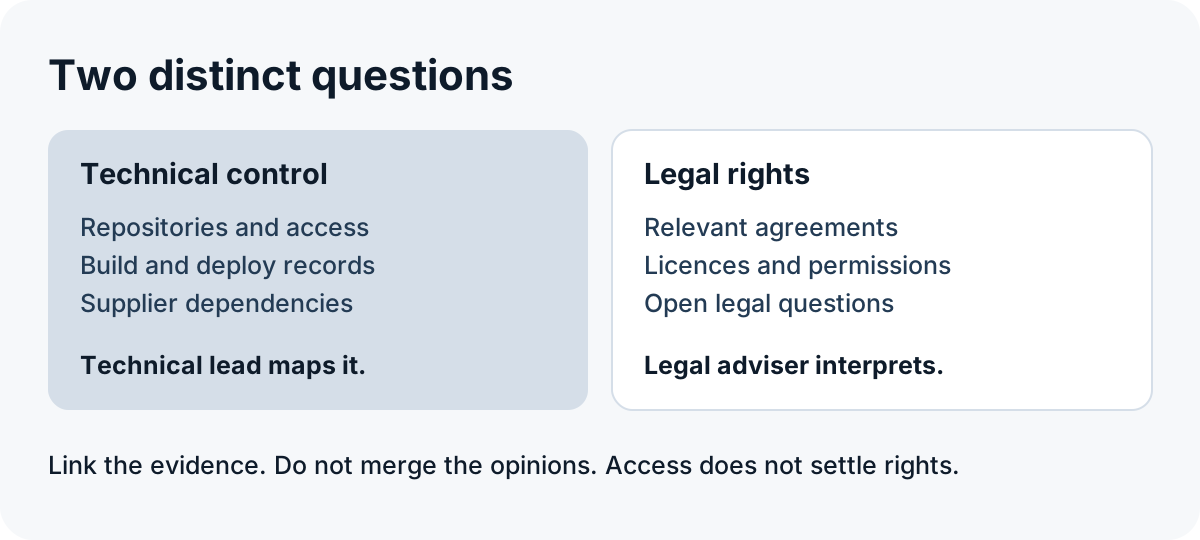
In words: the technical lead maps what exists and who operates it; the appropriate legal adviser assesses the rights. Link their findings and keep their responsibilities separate.
Take one unanswered question to your technical owner
Choose one actual investor request. With your CTO, engineering lead or current vendor, write its claim, existing evidence, gap and accountable owner. Ask for clarification where the decision or expected evidence is unclear. A fundraising adviser stays responsible for transaction preparation if that is their mandate, and a rewritten deck cannot establish technical facts.
Your next useful output is a shared account of what is known and what needs confirmation. It is a working document for the founder team; it is separate from any financing outcome, and the choice of adviser stays with you. Once the gaps are explicit, you can decide which evidence, experiment or remediation deserves priority.
If a bounded technical question would benefit from a senior peer discussion, you can ask the Grand Rounds curator whether an upcoming session fits your challenge. The invitation is to discuss session fit.
Boundaries
Grand Rounds is an initiative of Dinarys, and a conversation may lead to cooperation with Dinarys.