
Put four kinds of technical evidence in the investor data room: product control and rights references; AI contribution and evaluation; scale, manual work and costs; delivery milestones and residual risks. Give each artifact a date, version, owner and stated limit. Where a claim remains unsupported, record that limit and the next evidence-producing action rather than filling the folder with presentation slides.
A data room is the controlled space where an investor's reviewers inspect documents during due diligence. This guide covers its technical folder, not a complete legal or financial checklist. It assumes an equity investor's review; grant applications, procurement and cloud-credit programs have different purposes and requirements. For the grant-specific briefing decision, see choosing a technical adviser for an R&D grant application. The investor or their reviewer determines whether a response is sufficient, and rights questions go to the appropriate legal adviser.
Technical data room checklist: what to put in the folder
Use the actual questions in your claim-evidence-gap register to select relevant records. This is a working preparation checklist, not a universal investor standard.
| Investor asks about | Put in the technical folder | State the limit |
|---|---|---|
| Product control, code and data rights | Current product version tied to repositories, build/deployment records, components, operators, external services and controlled references to agreements or permissions | Inventories and access do not certify legal title; unresolved rights go to counsel |
| AI contribution and evaluation | Supplier model separated from your components/workflow; evaluated versions, input selection, method, criteria, results and failures | A demo or general model benchmark does not establish your application's behavior |
| Scale, manual work and cost | Workload, environment and observed limits; onboarding, checking and support effort; costs labeled measured or modeled | An assisted pilot is not a company-wide unit-cost result; retain forecast assumptions |
| Delivery milestones and residual risk | Observable capability/evidence points, dependencies, accountable owners, available resources and budget assumptions; open risk, consequence, action and next evidence | Proposed hires and vendor capacity are not committed resources; planned work is not a result |
The investor-questions guide explains why those questions matter. Here the job is to assemble the response and choose what to do when evidence is missing. Do not copy a complete legal archive into the technical folder: use authorized references to the records needed for the question.
For AI evaluation, the NIST AI RMF Playbook, MEASURE 2.1 and 2.3, recommends documenting test sets, metrics and tools, and demonstrating performance under conditions similar to deployment. It is AI risk guidance, not an investor's acceptance standard or certification. Keep the evaluation's failures and limits beside its result.
Choose the smallest action that answers the gap
Four routes are useful as a working method; they can be combined and do not exhaust every situation:
- Verify existing evidence. Locate the deployment record, evaluation or source agreement and check that it matches the claimed version and conditions. A traceable original may answer the question without new engineering work.
- Test an unknown. Specify the claim, permitted inputs/environment, method, expected evidence and stopping conditions. Retain the run record; a planned experiment cannot answer as a completed result.
- Fix a demonstrated problem. Name the implementer and required behavior, then verify the change. A shipped fix without a relevant check leaves the evidence question open.
- Disclose a limit and propose a milestone. State the consequence, owner, dependencies and next evidence. This asks the reviewer to consider a bounded response; it does not close their concern unilaterally.
Use existing team and vendor records first. A controlled index can be sufficient; a new data-room product cannot produce a missing evaluation or resolve an agreement. Keep necessary manual work visible rather than automating it just to support a self-service claim.
Worked example: prioritize the gaps
The following is a hypothetical illustration, not a client case or result. An AI document-analysis company is preparing responses about its next customer milestone, using the same four question areas as the investor-questions guide.
| Question | Action and evidence to produce | Owner, dependency and limit |
|---|---|---|
| Can another operator onboard a customer without the founder? | Run a bounded exercise before committing to broader automation. Retain a versioned record of steps, interventions, failures and supported conditions | Engineering lead plus receiving operator; approved test account and permitted sample inputs. No result yet; one exercise would not cover every segment |
| Which code and data can the company use? | Map components and locate records; route unclear rights to counsel. Retain the repository/dependency inventory and controlled agreement/license references | Technical lead and record owners; legal adviser interprets rights. An inventory does not establish legal title |
| What does the company add beyond the external model? | Verify existing component/evaluation records before commissioning a build. Retain the own/external component map, provenance and evaluation limits | Product/engineering owner; vendor supplies its actual boundary. Technical evidence alone does not prove a commercial moat |
| Can the next milestone be delivered with the proposed team? | Reconcile capacity and dependencies; revise scope if needed. Retain the delivery sequence, accountable owners, cost assumptions and open dependencies | Engineering lead and founder/finance; account for vendor commitments and other work. Proposed capacity remains conditional |
In this illustration, clarify the reviewer's onboarding conditions and secure permitted inputs before scheduling the exercise. Map rights references in parallel only if different owners have capacity. Use findings to revise the milestone rather than promising a full onboarding rewrite before the cause is known.
If the exercise revealed one missing permission setting, a narrow configuration fix and repeat check might suffice. If it revealed extensive founder judgment, distinguish the supported assisted service from an unproven self-service claim. These are hypothetical branches, not reported findings.
Prioritize by the pending decision, dependencies and resources
Confirm which questions are material to this review and what evidence the reviewer expects. Then record:
- Decision effect: what milestone, resource commitment or external claim could the answer change?
- Dependency: what must be settled first? An evaluation cannot use a dataset merely because its permission review is still open.
- Resource reality: who has accepted the work, what access or specialist input is needed, and what product work will it displace? Keep unknown estimates visible.
This is a discussion, not a weighted score. If the same engineer appears on every urgent action, the founder, technical owner and finance must resolve the conflict. A polished deck does not turn an assisted process into a demonstrated product capability.
Keep the technical data room traceable and secure
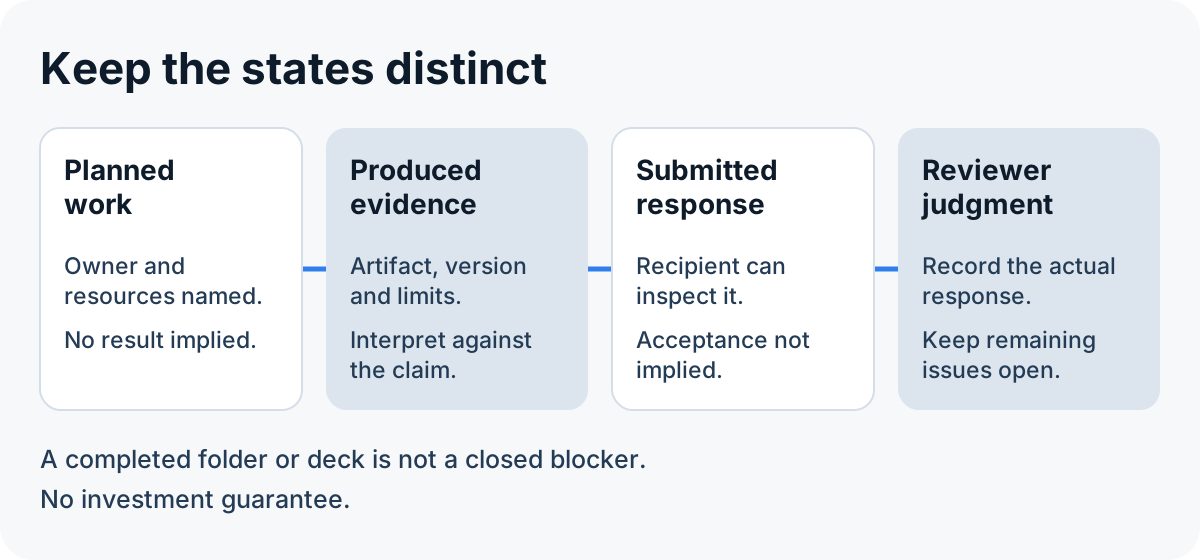
Each response should point to an artifact with a clear title, version/date, owner, source location, scope and known limitations. Use the gap matrix as the index. Distinguish observed results, estimates, planned work and third-party statements; retain the reviewer's response beside the submitted answer.
Agree recipient access before sharing sensitive records. Use permitted extracts, redaction or supervised inspection where appropriate; exclude credentials, unnecessary personal data and unrestricted client documents. Record what the reviewer could inspect and where restrictions limit the conclusion. A link the intended reviewer cannot open is not an adequate handoff.
Agree a feasible next milestone, not an investment promise
Take the matrix to the technical owner and finance. Choose the immediate actions, reserve real capacity and confirm expected evidence with the reviewer. If capacity is insufficient, narrow the proposed milestone or disclose the constraint. The useful output is a prioritized, traceable response with honest residual risk—not an implied investment approval.
For choosing founder-side preparation versus investor-side review, see technical due diligence. If one trade-off would benefit from a senior peer conversation, ask the Grand Rounds curator whether it fits a session. Session fit is not a commissioned diligence report or a remediation commitment; later work needs a separate agreement.
Boundaries
Grand Rounds is an initiative of Dinarys, and a conversation may lead to cooperation with Dinarys.