
The acquisition has closed and both businesses still run, yet the board cannot get one comparable management report. Every question about the combined process returns to two IT teams, and nobody can say who settles a disagreement between them.
Short answer: name one accountable decider for each decision that sits between the two businesses, starting with the decisions behind one critical process, and write down who recommends, who must agree and where a disagreement goes. Then map the systems, data, contracts and people behind that process. A platform decision can follow once both exist.
Specialist decisions stay with their owners: finance owns reporting definitions, legal and procurement own contract questions, security owns its approvals. The missing owner is the one for the decision that sits between the two businesses.
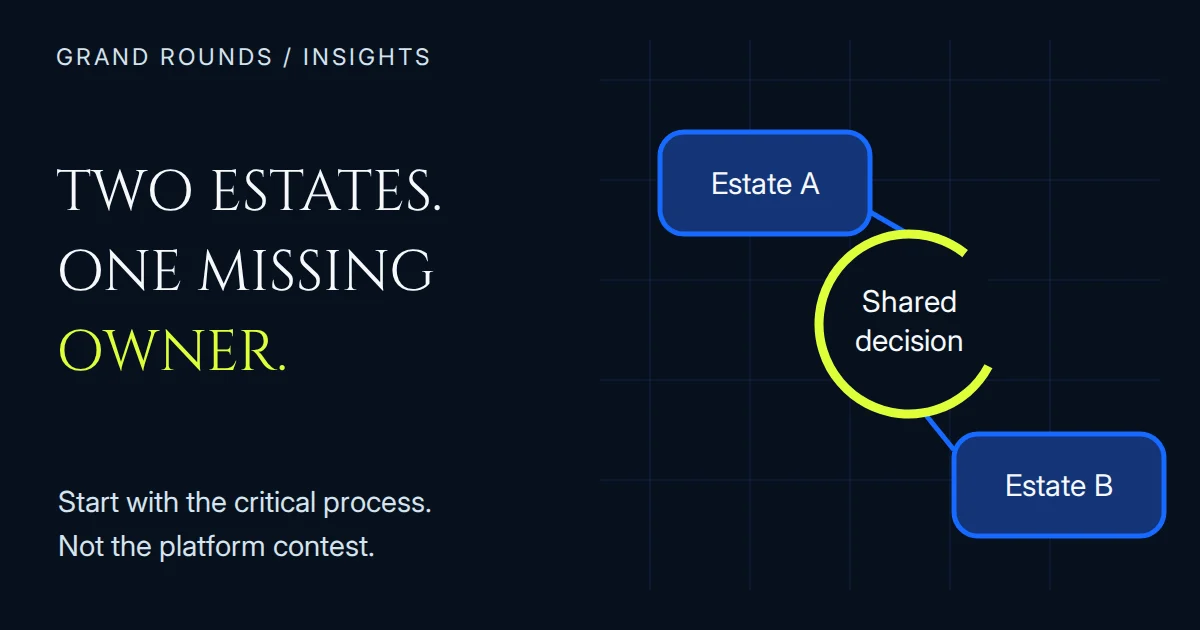
What in IT is actually blocking the integration?
Start from the opening symptom: the board cannot get one comparable management report. Name that output, then the shared decision holding it up, such as which customer identifier the report uses. In the invented example below, the blockers are an identifier nobody has authority to change, a vendor who controls its format and a report definition finance has not fixed. Finance defines the report's meaning, IT explains systems and identifiers, and the sponsor names a decider and escalation route for each cross-business decision.
Build an inventory that can answer a decision
Limit the perimeter — the process and systems in scope — to one process and both businesses' relevant dependencies.
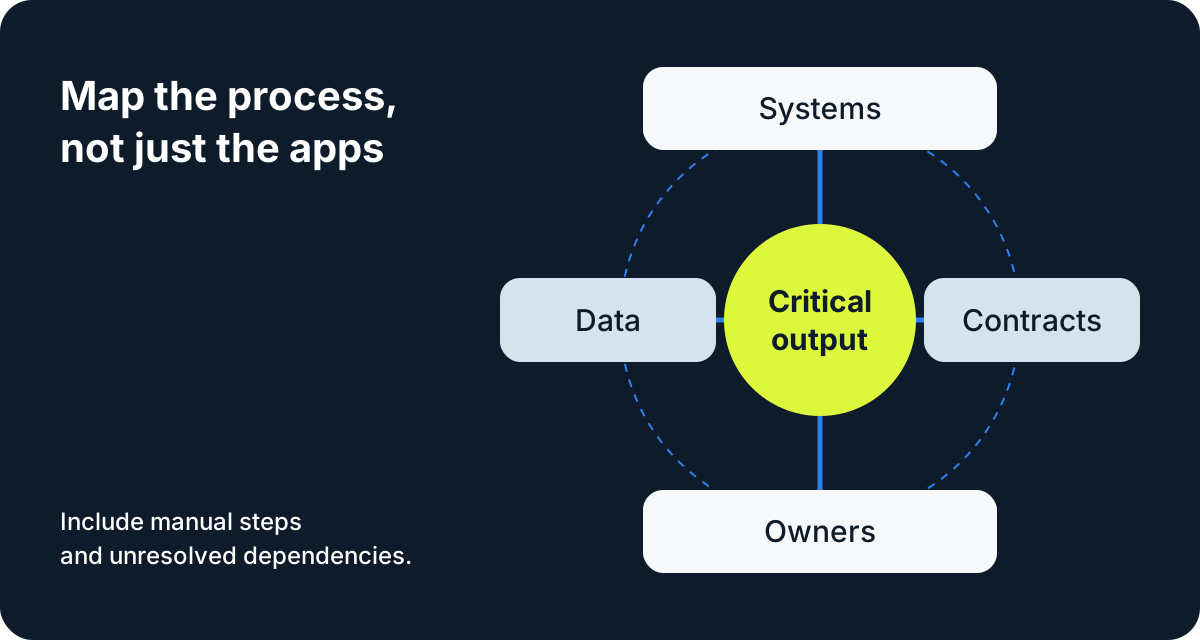
| Record field | Information to agree |
|---|---|
| Output/process | Critical result, receiving owner and fixed perimeter |
| Systems/data | Source systems, definitions, identifiers, interfaces and manual steps |
| Contracts/control | Vendor, qualified contract owner, dates and permitted access |
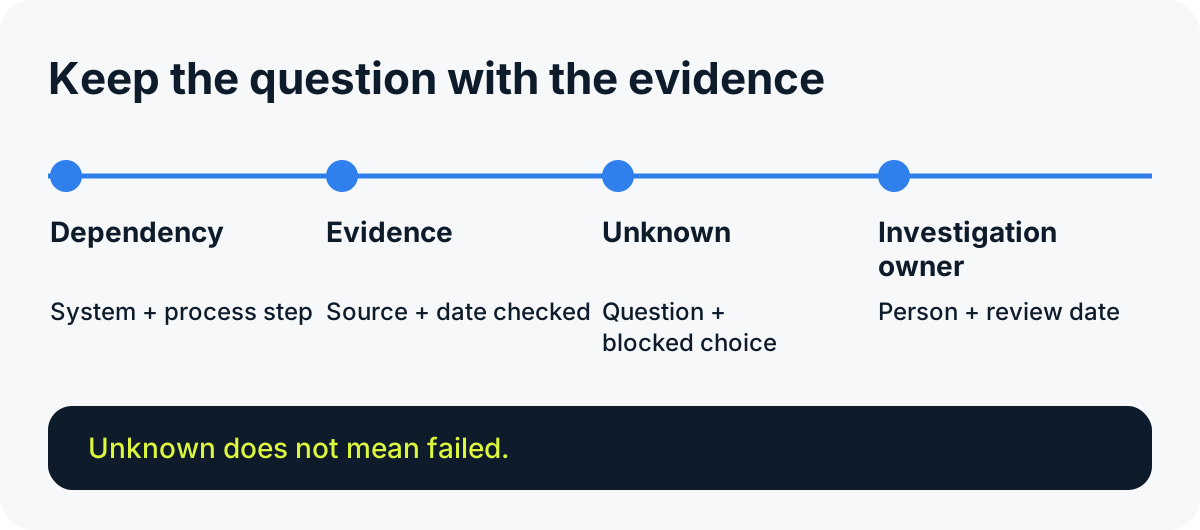
| Evidence/gaps | Source/date, confirmed dependency and open question |
| Decision rights | Recommender, decider, required agreement and escalation |
Use the inventory to answer a decision: which dependency could change the next step, who can supply its evidence and who accepts the resulting output? Give uncertain contracts to the qualified legal/procurement owner.
Record who decides: a decision-rights record, with an invented example
Decision-rights record For each decision that sits between the businesses, record five things: who recommends, who decides, who must be consulted, where a disagreement goes, and what evidence is still missing. One person can hold several roles; the point is that each decision has a named decider.
Invented, unperformed example, fictional teaching material. A group has acquired a services business. Both companies run their own CRM, and the board wants one pipeline report. Group finance wants a shared customer identifier; the acquired business's IT team says its vendor controls the identifier format; the group's technical lead has no authority over the other business's system.
| Decision | Recommends | Decides | Must be consulted | Escalates to | Evidence still missing |
|---|---|---|---|---|---|
| Identifier-mapping rule used in the board report | Group technical lead named by the sponsor | Group finance, on its definition of the report | Acquired business's IT; both business owners | Integration sponsor | Which duplicates the mapping must resolve |
| Change to the acquired business's identifier format | Acquired business's IT with its vendor contact | Acquired business's process owner, after the sponsor sets priority | Group finance, security | Integration sponsor | Vendor terms, reviewed by procurement or legal |
| Pause of the acquired business's export during month-end | Acquired business's IT | Its operations owner | Group finance | Integration sponsor | Month-end calendar |
Reading the table: finance can decide the report's mapping rule without changing the vendor's system; whether the rule handles duplicates remains an evidence question. A format-change recommendation waits for the vendor and contract answers. The record does not choose a platform. If the current CIO, process owners and integrator already hold these decisions, keep them. This record assigns deciders per decision; combining several decisions into one person's temporary mandate is a different step, covered in choosing an interim CTO for post-acquisition integration.
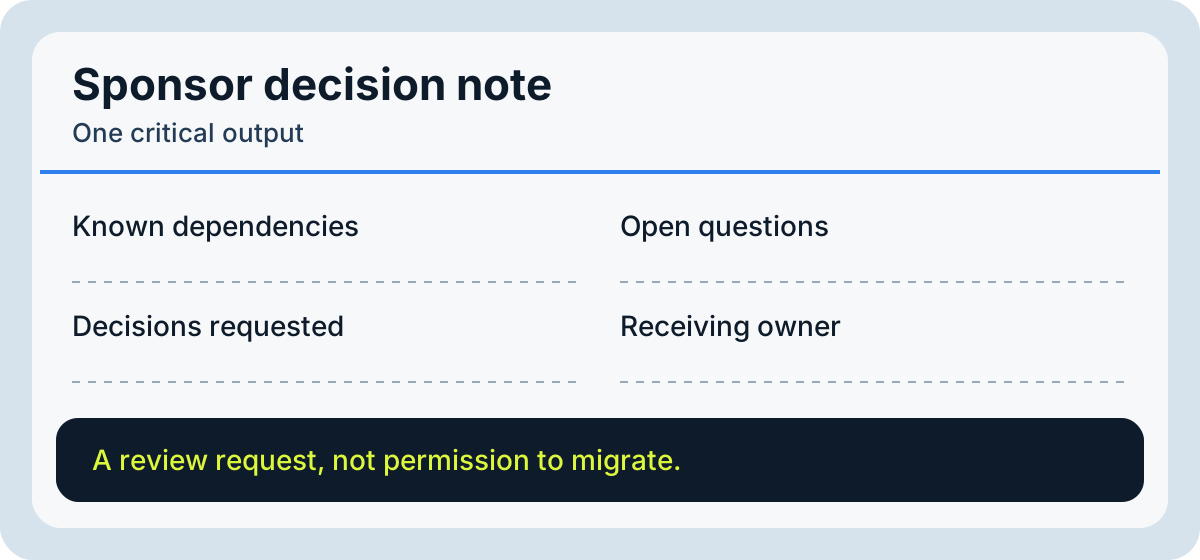
Turn the map into a short sponsor decision list
Turn open items into a short note with three columns, one row per option:
| Option | Evidence needed | Decision requested |
|---|---|---|
| Map identifiers without changing the vendor's format | Which duplicates the mapping must resolve | Group finance decides the mapping rule; both business owners are consulted. |
| Change the acquired business's identifier format | Vendor terms, reviewed by procurement or legal | The acquired business's process owner decides, after the sponsor sets priority. |
Reserved approvals stay with their owners.
What changes the size of the inventory
The number of businesses and processes in scope; the systems and manual steps the critical output touches; whether an agreement with the seller sets services and expiry dates; whether finance has agreed the output's definitions; and what you are permitted to share outside the company. If the agreement is a transition services agreement (TSA), record it by that name for qualified legal review; otherwise record its actual type. Unknown terms remain unknown.
Boundaries
This article frames a decision for the sponsor. Finance, legal, procurement and security keep their own approvals. The inventory records evidence and open questions; it grants no access to systems or data, and a production change follows the organization's own approval route. Implementation stays with your team or a provider you select separately.
Grand Rounds is an initiative of Dinarys, and a conversation may lead to cooperation with Dinarys.
Questions and answers
Next action
Pick one blocked output and name who can accept each decision behind it. Keep the inventory to that process, then compare end states and migration routes. If a decision still lacks someone who can settle it, choosing an interim CTO covers the mandate. To talk it through, ask the curator whether a Grand Rounds session fits the question.