
Your R&D funding plan says what the product will do. Make the unresolved technical claim and the check that could change the plan equally explicit.
Short answer: a feature roadmap lists activities; a feasibility case names one technical claim the evidence leaves unresolved, today's baseline, a check that could contradict the claim, and the decision that follows. Before you commission more technical work, locate that one claim with a one-page card (below), completed with your technical lead, and take it to your grant adviser.
This is written for a founder or grant lead with a prototype, a team or vendor, and resources for the next milestone. It concerns a grant application or a funder that asks for technical feasibility; equity investors and procurement buyers ask for different evidence. The technical lead says what is already known; the grant adviser checks the account against the actual funding opportunity.
Jump to the card or, if a technical decision is still unowned, talk with the Grand Rounds curator.
A new feature is not, by itself, a technical uncertainty
Write one technical statement the existing evidence leaves unresolved. Separate a user-facing feature, known implementation work and the claim requiring an experiment. The specific funding opportunity determines eligibility.
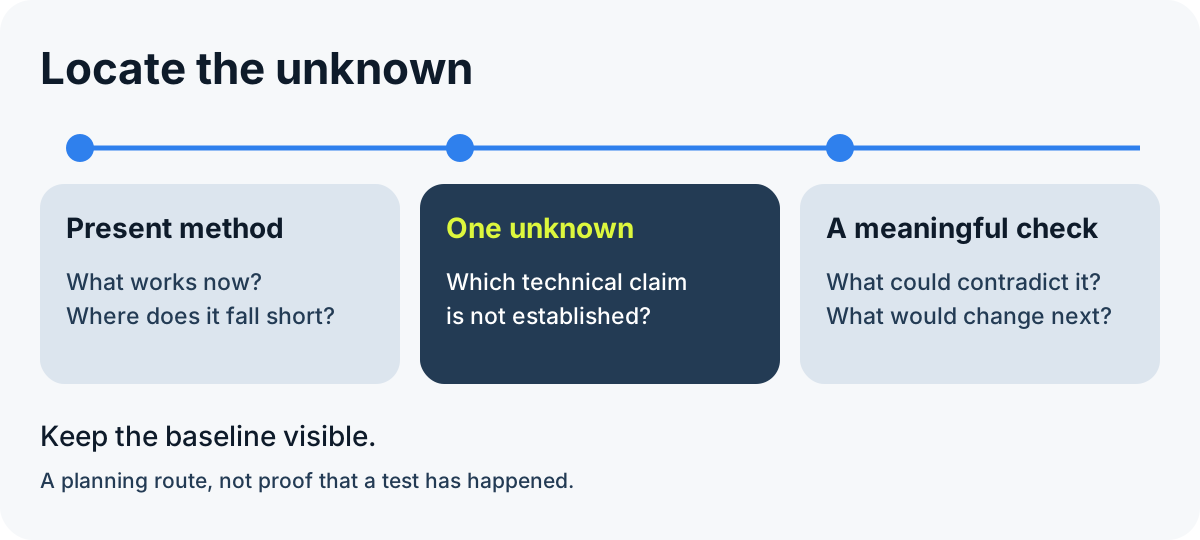
Start with the workaround, not the innovation adjective
Describe the current process, output, operating limits and human effort. A documented workaround gives the proposed method a meaningful baseline and may already serve the next milestone.
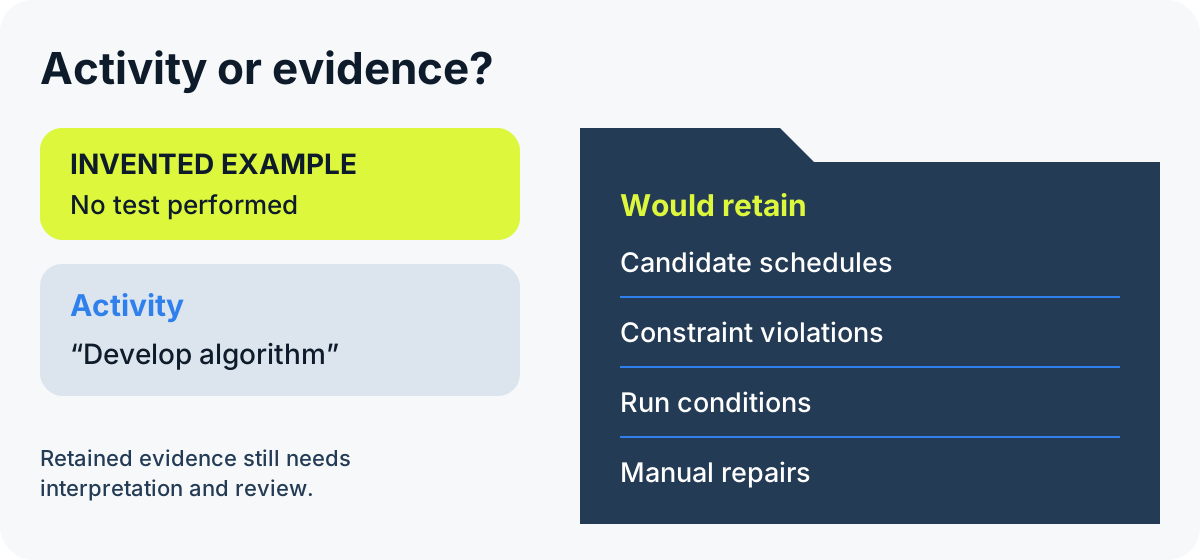
Worked illustration: an automated planning feature
Invented, unperformed example. A company's funding plan lists "automated shift planning" as a feature. Here is the card filled in for that claim:
| Field | Example |
|---|---|
| Task and receiver | A weekly rota the site manager can use. |
| Baseline | A planner builds the rota in a spreadsheet and repairs rule breaks by hand. |
| Unknown | Whether the method produces a rota for one preselected recent week under the site's stated rules without manual repair. |
| Hypothesis | It can do so for that week's recorded demand and staff availability. |
| Check and comparator | Before either run, select and record the week, inputs and rules. Run the method and the spreadsheet process on those same inputs; count rules broken and manual repairs. |
| Evidence and dependency | Candidate schedules, rule violations, run conditions and manual repairs; the site's rules and the week's data, with access awaiting confirmation. |
| Decision | Proceed, narrow the claim or stop, according to conditions agreed before the check. |
A pass would support the claim only for that week's recorded conditions, not establish performance in the hardest week. "Develop algorithm" is an activity; the schedules, rule violations, run conditions and manual repairs are the evidence a later check would retain.
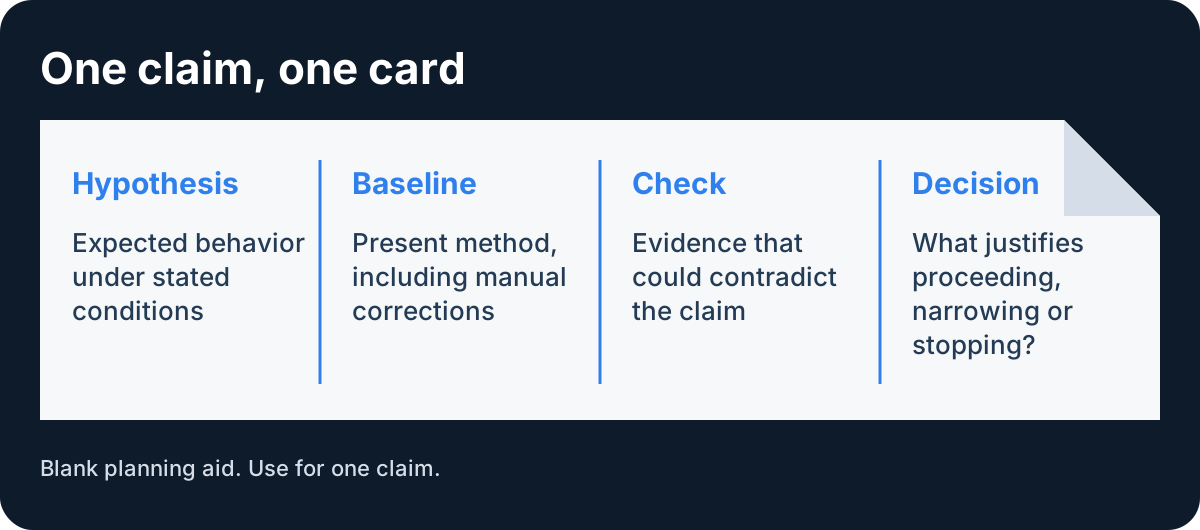
Use a hypothesis, baseline and check card
Use the card to name the claim, baseline, permitted data, proposed check, expected evidence and decision. The technical lead owns the scientific/engineering account; the grant adviser aligns it to the opportunity. The figure below highlights four core fields; the table retains the full record.
| Field | What to write |
|---|---|
| Task and receiver | The decision or activity the result must support, and who will use it. |
| Baseline | The existing method, its output and its observed limitations. |
| Unknown | One claim the available evidence leaves unresolved. |
| Hypothesis | What the proposed approach is expected to do, under stated conditions. |
| Check and comparator | How the team could discover that the hypothesis is wrong, against what alternative. |
| Evidence and dependency | The output to retain and the inputs, people or equipment awaiting confirmation. |
| Decision | What would justify proceeding, narrowing the claim or stopping. |
A work package needs a result, not just an activity
Describe the inspectable result of the package and the decision it enables. Equipment, data access and specialist time need confirmed owners; see what the next R&D stage must prove for that fuller dependency review.
You may need a grant writer, not another technical adviser
If the technical evidence and resources are coherent, focus on explanation and program alignment with the grant adviser. Bring in a domain or senior technical contributor when the unresolved claim or experimental design needs their judgment. If you do not have a grant adviser yet, compare the card with the funder's guidance for your call, such as its technical uncertainty, objective and method fields. Calls differ: use the call's own wording. The card does not decide eligibility. To assess outside help, see choosing a technical adviser.
Your next step: identify one uncertainty
Complete one claim card with the technical lead and, where available, the grant adviser. Discuss CTO support with the curator only when a technical decision remains outside the current team's remit.
What shapes the effort of a feasibility check
The effort depends on how many technical claims the plan makes, whether a documented baseline exists, whether representative data and equipment are confirmed, who holds the existing evidence and what the specific call requires. One claim and one comparator is a smaller task than a work-package-by-work-package review; costs and timing are discussed through the curator.
Boundaries
The card distinguishes an unestablished technical claim from implementation and from missing explanation. Eligibility, reimbursable activity and funder acceptance depend on the actual funding opportunity and the grant adviser’s review. The scheduling example is invented and unperformed.
Grand Rounds is an initiative of Dinarys, and a conversation may lead to cooperation with Dinarys.