
Releases keep slipping, and the team or vendor proposes a refactor, rewrite or new tool. Start with one outcome for the next release, then ask what each route must keep, rebuild and prove.
Short answer—editorial synthesis, not a validated test. Refactor when behavior is worth keeping and you can add checks around the parts changed in steps. Reimplement one boundary when a specific part, data model or interface is the obstacle. Consider a full rewrite when the platform cannot be maintained and required behavior is understood and documented. If behavior is unknown, recover and document it before choosing replacement scope. A smaller business scope or existing product may serve the release better than any of these.
Missed releases justify comparing routes, not choosing a rewrite by default. In Test Double's second report below, replacement of a discontinued framework still exceeded estimates as forgotten quirks, learning, tests and documentation surfaced.
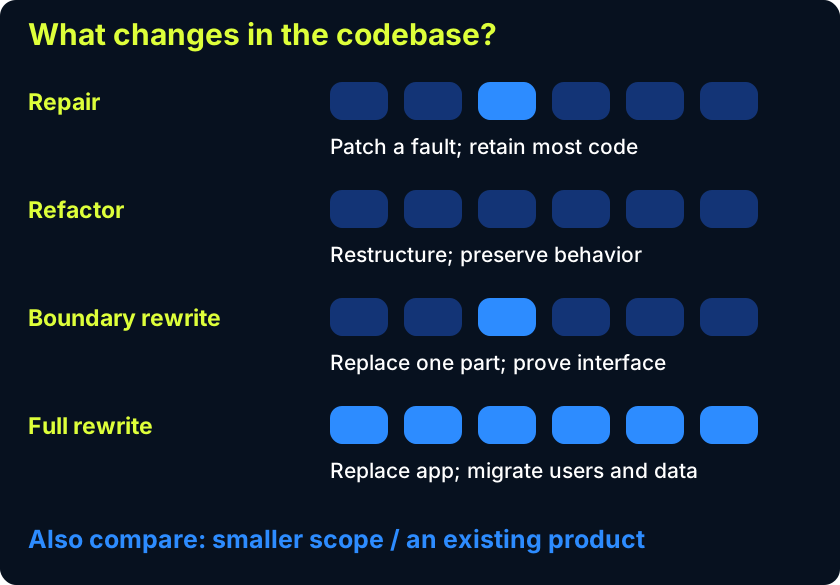
Definitions. Repair corrects faults. Refactoring (rearchitecting, when the change is structural) reorganizes internals while preserving behavior. A rewrite, sometimes called a rebuild, reimplements a selected part or the whole application.
If the promised flow itself remains unverified, start with why the team is busy but the product does not ship. Comparing routes on unverified explanations compares stories.
Copy the record below, hold the outcome constant and expose each route's assumptions. To discuss your situation and relevant CTO experience, talk with the Grand Rounds curator. Specific CTO availability and any later working arrangement require separate confirmation.
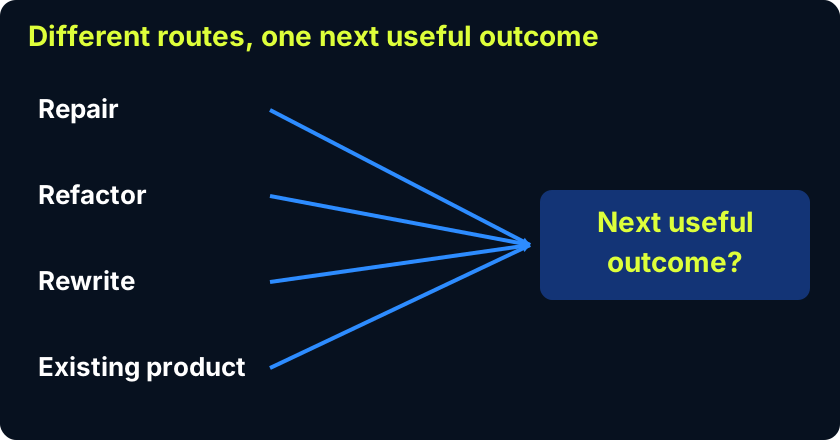
Start with the same useful next-release outcome
Define one next-release user outcome with product, engineering and customer-facing colleagues. Apply that same scope to every route, and record the operating commitments that continue during the change.
| Direction | What stays or changes | Knowledge and transition focus |
|---|---|---|
| Smaller business scope | Keep the product; defer lower priorities. | Agree useful behavior and which operating commitments continue. |
| Repair/stabilization | Keep most code; correct faults or reduce immediate operating risk. | Recover failure context; plan support during changes. |
| Refactor | Restructure internals without changing behavior. | Recover relied-on behavior; check change effects. |
| Boundary rewrite | Reimplement a selected part; retain surrounding code. | Recover interface/data expectations; examine separation and migration. |
| Full rewrite | Reimplement the application. | Recover required behavior and exceptions; plan migration and overlapping operation. |
| Existing product | Configure and integrate software for the required workflow. | Map business meaning; examine integration, export, operations, and exit. |
Compare what each approach must retain and prove
For each route, identify behavior to preserve, knowledge to recover and transition work to estimate. Treat smaller scope and an existing product as genuine alternatives. Refactoring preserves behavior; a replacement must recover the required behavior and move its users and dependencies.
Joel Spolsky’s 2000 essay on rewriting software argues that existing code carries knowledge in accumulated bug fixes. He also describes a project where the team made major architectural changes inside the existing codebase. Use the essay to investigate which accumulated behavior the existing code preserves.
Bill Vivino's discussion of rewrites and stabilization describes requirements distributed across the application, data, jobs, support records, and user practices. It also emphasizes migration alongside construction. Apply these provider investigation prompts to your own evidence.
Reyem Tech's rescue guide includes a commercial product as an alternative and recommends evaluating integration, data export, and exit against actual requirements. Treat this as provider guidance and establish product fit and total cost locally.
Refactor vs rewrite: what tipped two reported decisions
Two sections of Test Double’s provider field reports, dated 17 September 2025, describe different products, rather than a controlled comparison.
| Field Report 1 | Field Report 2 | |
|---|---|---|
| Situation | Original contractors gone; documentation sparse; tests absent; credentials hard-coded | Framework discontinued, security updates ended; fork unrealistic |
| What the team knew | Feature knowledge too incomplete to scope a rewrite | Software well understood and documented |
| Route chosen | Incremental refactor (separated concerns, replaced the authentication layer) | Full rewrite |
| Alternative considered | Full rewrite rejected: the exposure would remain during it; a refactoring spike was tried instead | Timeboxed refactoring spikes tried and discarded: they amounted to a partial rewrite |
| What was underestimated | Unreported | Forgotten quirks, new framework, docs and tests |
In the first report, hard-coded credentials and authentication exposure made leaving the old system in place during a rewrite unacceptable. Incomplete feature knowledge also made replacement scope difficult. The team separated concerns and replaced the authentication layer.
In the second, framework support was ending and the software was understood and documented. Refactoring spikes looked like a partial rewrite, so the team chose replacement; forgotten quirks, learning the framework, tests and documentation expanded the work. These are a consultancy’s attributed accounts.
The second team was also the main user of its software, which helped it understand the behavior. A team building for outside customers may first need to recover that knowledge.
Experience in the Grand Rounds CTO network
As stated in Jerome MacGillivray’s profile, his role covers technology strategy, delivery recovery and engineering leadership, and his focus areas include platform recovery and vendor and technical due diligence. The profile also lists directing Ratio Software Engineering, an ecommerce agency, and delivering the Alpha Programme at NSPCC. These are career statements, not evidence about a rewrite or refactor decision; ask for that evidence separately.
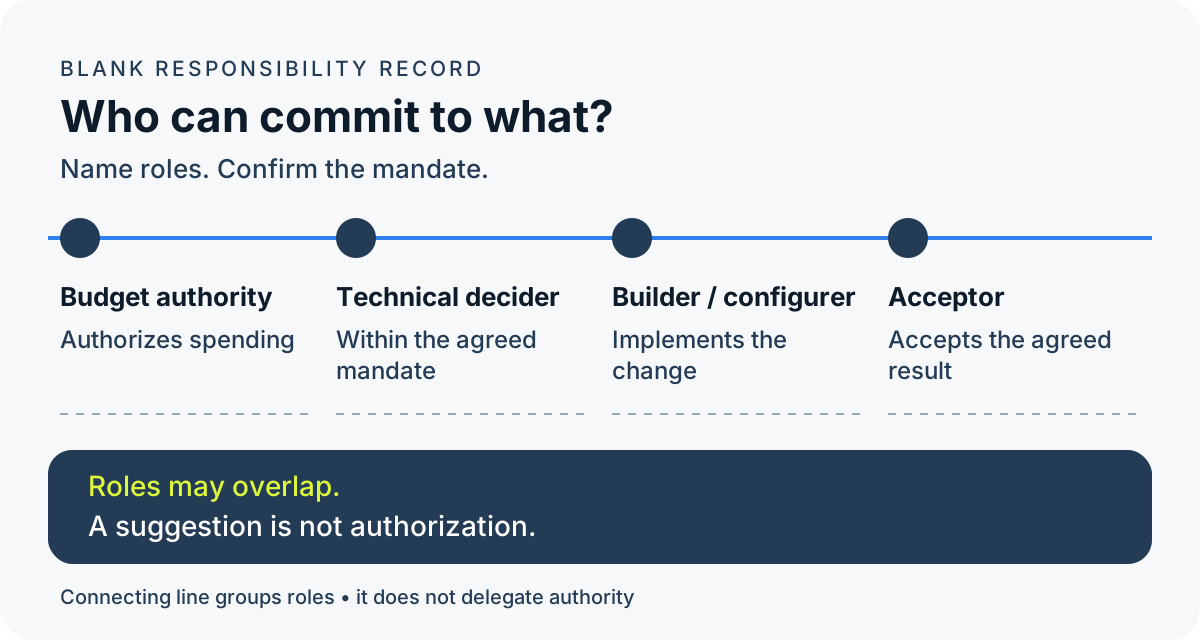
Name four roles before changing vendor, architecture or leadership
Separate four responsibilities: budget authority, technical decider, builder/configurer and acceptor. A team change, architecture change and leadership appointment can be agreed independently. Record lawful knowledge transfer and support responsibilities for any supplier change.
Copy a compact comparison record
Copy the record once per candidate. Keep evidence, attributed reports, assumptions and proposed work distinguishable. An unresolved field defines the next question for the owner.
NEXT-RELEASE OUTCOME: user, useful behavior, target environment.
PROMISED VS OBSERVED: what was promised, what you saw.
FOR EACH ROUTE: what stays and changes; supporting evidence;
behavior only old code or a person knows; migration, overlap,
support and exit; assumptions still to check and their owners.
ROLES: budget authority, technical decider, builder, acceptor.
NEXT STEP: bounded investigation or delivery milestone,
acceptance evidence, environment and review date.
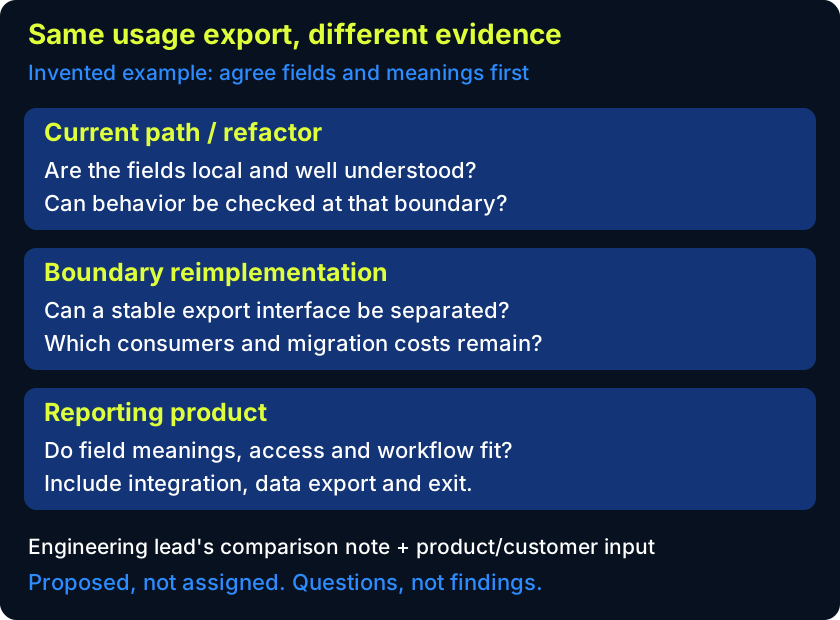
Invented example: one usage export, three routes
This is an invented editorial illustration. A subscription company needs a customer-usage export; the sponsor proposes deferring an unrelated dashboard redesign. Product and customer-facing colleagues first agree the fields and meanings.
| Candidate | Question that changes the decision |
|---|---|
| Current path/refactor | Are the relevant fields held in one well-understood module, and can behavior be checked there? |
| Boundary reimplementation | Can a stable export interface be separated, with consumers and transition costs identified? |
| Reporting product | Can it reproduce the same field meanings, access rules and workflow, including integration, export and exit? |
The proposed engineering-lead comparison note needs an accepted owner and authorized scope. If fields prove local and well understood, the current-path route becomes stronger; if they span many systems, examine a separable boundary or product mapping more closely. Each route still needs its own evidence, estimates and acceptor.
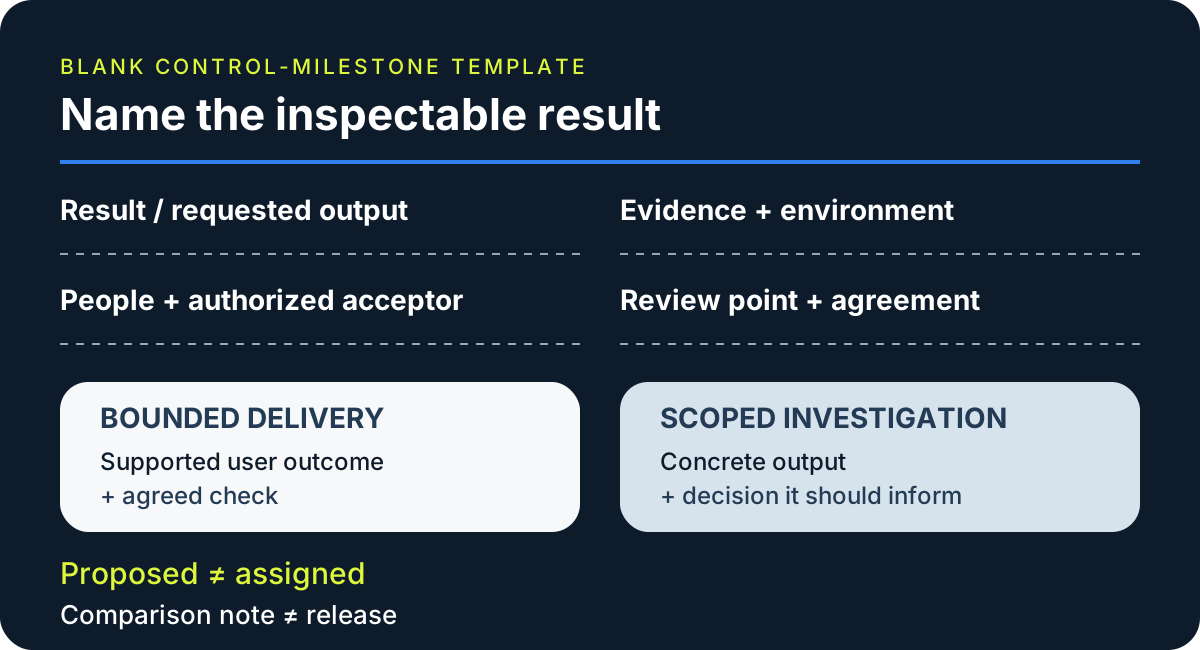
Choose the next verifiable control milestone
Choose an inspectable next result, its evidence and environment, the responsible people and the authorized acceptor. Where uncertainty prevents a delivery commitment, agree a bounded investigation and the decision it will inform.
As an editorial planning check, look for an agreed outcome, evidence behind the chosen route's main assumptions, a check and owner for each remaining uncertainty, and named budget authority, technical decider, builder and acceptor. Otherwise agree an investigation rather than treating the record as readiness proof. Urgent security or data-loss containment follows the authorized incident process; it must not wait for this comparison.
Boundaries
This guide compares routes at decision level and does not replace a code review or architecture assessment of your system. The working rule is an editorial synthesis of the cited sources. The usage-export example is invented for editorial teaching only. A small, well-understood fault is usually faster to repair than to compare. Parts that carry security or regulatory duties need qualified specialists. A CTO's advice supports your decision; who builds is agreed separately.
Grand Rounds is an initiative of Dinarys, and a conversation may lead to cooperation with Dinarys.
Questions and answers
Next step
Copy the comparison record and agree one outcome. To discuss relevant recovery experience, talk with the curator.