
If you are weighing AI for SME lending, the first question is which route gets a complete, source-linked file to your reviewer: your current loan origination system (LOS), an extraction component, or a small integration change. This guide shows how to test all three on the same applications and who should accept the result.
It is written for a product company whose credit platform cannot raise its SME application flow without adding manual handling.
Here, "AI-assisted" means preparing document facts for a reviewer: each value linked to its source page, period and version, with conflicts left visible.
In short
- Write the expected behavior for each file before you look at any output: complete, missing document, conflicting values, unreadable text, repeated event, wrong period.
- Report unresolved, incorrect and correctly source-linked fields separately. A populated field is a coverage count.
- Use the decision matrix below to name who accepts what: the lender's risk function, operations, engineering, sponsor.
- Choose one bounded pilot or the existing-stack fix. Credit approval, policy change and core replacement stay outside it.
The decision is shared. The matrix below proposes an allocation: product sets the boundary, operations owns the operating problem, engineering judges the system path, the lender's risk function owns policy and domain acceptance, and the sponsor (the CEO, CFO or P&L owner) approves the investment. It is a proposal for you to adapt.
For the preceding queue diagnosis, start with Your SME Lending Platform Cannot Scale Without More Manual Review.
Compare three routes to the same reviewer-ready file
Run current LOS configuration, an extraction component and a bounded integration on the same authorized files. Use the reviewer’s expected preparation outcome and preserve source, period and document version beside each value.
| Route | What to ask it to demonstrate | Evidence still required by itself |
|---|---|---|
| Configure or extend the existing LOS/lending stack | Document status, version handling, queue routing, rule references, reviewer display | That every needed feature exists in your edition, configuration, or integration |
| Add extraction to prepare document facts | Field value tied to document, page/location, period and version; uncertainty and conflicts preserved | Credit-policy interpretation, missing evidence supplied, or a complete operating workflow |
| Add a bounded integration layer | Stable application identity, controlled transfer of approved fields, permissions, retry handling, traceable state changes | Correct source facts, valid policy, or domain acceptance |
Use a control set that can expose a bad handoff
Include complete files, missing documents, conflicting values, unreadable text, repeated events and wrong-period material. In the proposed allocation, an authorized domain reviewer (authorized by the lender's risk function) defines expected behavior before comparison and, with the risk function, sets suitable coverage and sample size. Keep acceptance files separate from configuration and tuning files, so the results come from files the setup has not seen.
| File | Condition to include | Expected preparation behavior, subject to approval by the risk function |
|---|---|---|
| A | Complete, internally consistent documents | Prepare source-linked fields for review |
| B | Required document absent | Keep the missing item visible; hold preparation pending the required source |
| C | Two documents contain different values | Show both sources and the unresolved difference |
| D | Relevant text is unreadable | Mark the field unresolved and use the agreed human path |
| E | Same application event delivered twice | Test that retries preserve one application identity |
| F | Document covers a different period | Preserve the period mismatch for authorized review |
Invented comparison: a populated field can still be wrong
The team, files and comparison are fictional. They use the six files above. The counts below describe one run, the extraction route, on those six files; the LOS configuration and the integration change are described but not counted.
The existing LOS configuration already handles missing-document status and reviewer queues, but lacks a source-page display beside the prepared field. The extraction component supplies source pages. File C holds two statements with different values for the same period: the applicant's first upload and a later corrected one. The extraction keeps the value from the earlier upload, so the field points to a superseded version. A small integration change would carry the latest version and keep the earlier value visible in history.
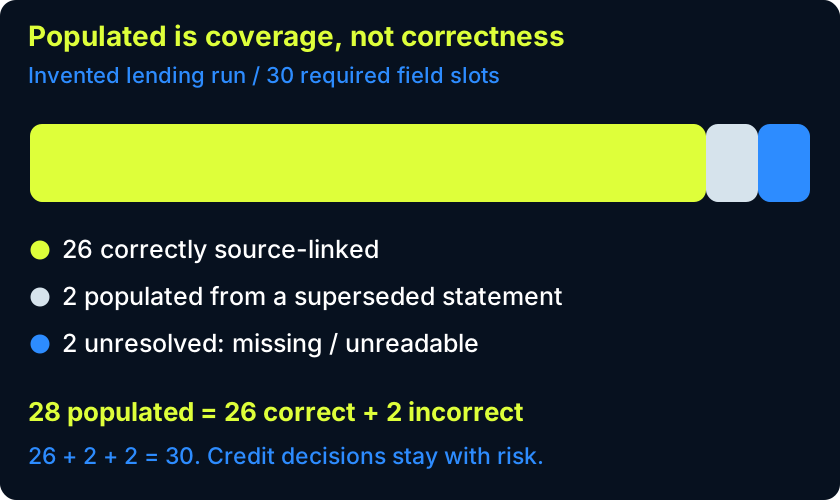
The extraction run fills 28 of 30 required field slots: 28/30 populated is coverage, not correctness. The invented counts are 26 correctly source-linked, 2 populated but incorrect (from the superseded statement in file C), and 2 unresolved (one missing-document slot in B and one unreadable slot in D). Thus 26 + 2 + 2 = 30. Correctly source-linked means matching the reviewer's expected value and the correct document, page and version; a numerically right value with a wrong source link counts as incorrect.
The candidate decision is narrow: keep the LOS queue, test extraction with version handling, and integrate only the latest-version display. If the LOS vendor can supply version display adequately, the integration may be unnecessary.
Make the human-decision matrix explicit
Name separate owners for source-linked preparation, credit-policy interpretation, operating receipt, integration evidence and investment. Record delivered and accepted results separately. The roles below are proposed, not fixed: nothing is accepted until the named person agrees, and the lender decides what validation it requires.
| Decision | Proposed accountable role | Software contribution | Required evidence |
|---|---|---|---|
| Which documents and periods are required? | Lender's risk function (policy owner) | Display the approved requirements | Versioned policy reference |
| What do the control files, coverage and sample size need to be? | Authorized domain reviewer, with the lender's risk function | Provide the files and show results by file | Expected behavior per file, written before comparison |
| Which extracted fact is reliable enough to use? | Authorized domain reviewer: a reviewer authorized by the lender's risk function, working to its criteria | Present value, source, uncertainty and conflicts | Reviewer decision and correction trail |
| How are fields and events moved? | Engineering owner | Transfer, validate schema, handle retries and access | Integration tests and traceable events |
| Is the preparation workflow usable? | Operations owner with product | Queue, review screen and manual fallback | Workload, rework and waiting-time observations |
| May the pilot proceed or expand? | Sponsor, with acceptance from the risk function and technical owners | Summarize evidence for the authorized sponsor | Accepted scope, exceptions and unresolved limits |
Where the rules sit
The lender's credit and document rules live in the lender's policy and in the LOS or rules engine you use. A preparation tool should show the policy version a check refers to and leave the rule itself unchanged. Ask each route to show the applicable policy version and who may override a check. Rule changes are separate work for the risk function and need their own review.
Agree a bounded pilot
Product, operations, the lender's risk function and engineering agree the decision matrix and each acceptance decision. Use an existing-stack fix if it closes the gap. Document types, products, interfaces, permitted test files and review capacity set the pilot's size. Whether outside technical leadership is needed, and how its scope differs from implementation and from validation, is covered in Choosing a CTO for an assisted lending pilot. To discuss the decision matrix, bring it to the Grand Rounds curator.
Boundaries
This is general information, not legal, financial or regulatory advice. Credit decisions, credit policy and any validation the lender requires stay with the lender. Applicant notices, data protection and regulatory questions remain for the lender and qualified specialists to determine. The example is invented.
Grand Rounds is an initiative of Dinarys, and a conversation may lead to cooperation with Dinarys.