
More SME applications arrive, but each one starts another round of document chasing and manual reconciliation. A lending partner calls it growth; your operations team sees a longer queue.
This guide is for a fintech founder or COO who wants to find where manual handling comes from in a credit platform whose SME application flow adds it as the flow grows.
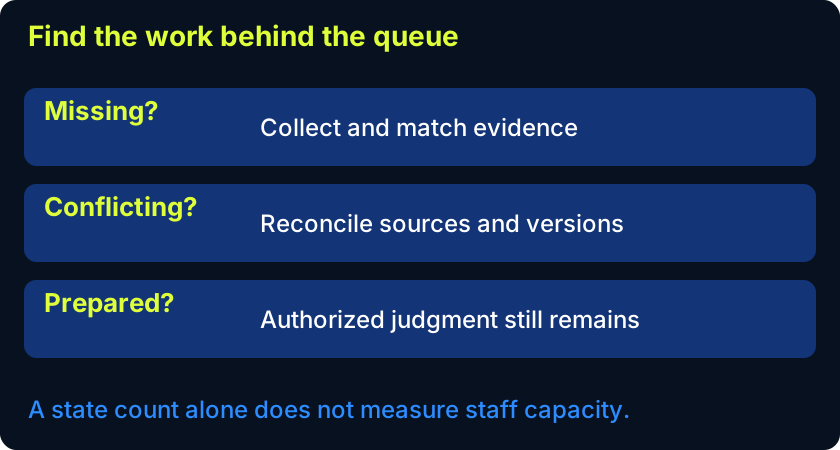
Short answer. Separate three kinds of work hidden in a manual-processing total: preparation (requesting, matching and transferring documents), reconciliation (resolving different values for the same fact across portal, spreadsheet, document and loan origination system, or LOS), and authorized judgment under the lender's credit policy. This is a working diagnostic split, not an established benchmark. Test process or tooling changes against the first two. In the proposed allocation below, judgment sits with the lender's risk function, which decides which checks remain necessary.
Start with one loan product, one intake channel and the path to a reviewer-ready file. The map locates where to investigate each work type; counts alone cannot identify the capacity constraint.
Separate preparation, reconciliation and judgment
Count applications once, then record handling episodes and active staff time separately from elapsed waiting. Preparation might be requesting and matching a bank statement; reconciliation might resolve three turnover values for the same period; judgment applies lender policy to the confirmed evidence.
Build an intake–documents–rules–review map
Map one product and channel from received documents to a reviewer-ready file. For each step record the source, document/version identity, rule version, waiting reason, accepting owner and next evidence check.
| Boundary | Evidence / question | Work-type hypothesis to check |
|---|---|---|
| Intake → application | Identity, channel, product, duplicates and arrival; what starts the workflow? | Preparation |
| Application → documents | Required list, owner, versions, periods and missing items; absent or merely hard to find? | Preparation: requesting and matching |
| Documents → prepared facts | Value, source/page/version, conflict and correction; can a reviewer trace it? | Reconciliation where sources differ |
| Prepared facts → rules | Policy version, inputs and prerequisites; which exceptions go to the lender's risk function? | Mixed; test the actual handling |
| Rules → review | Review queue, reviewer, returned reason, active time and waiting; ready for review is not credit approval | Authorized judgment |
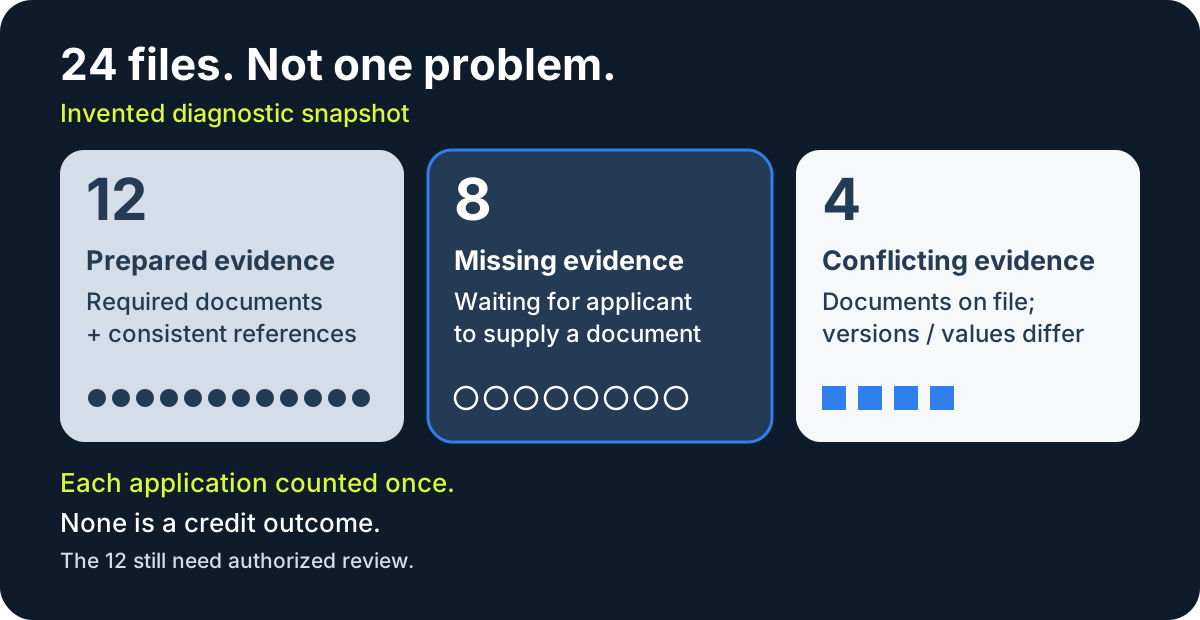
Invented 24-application snapshot: states are not work types
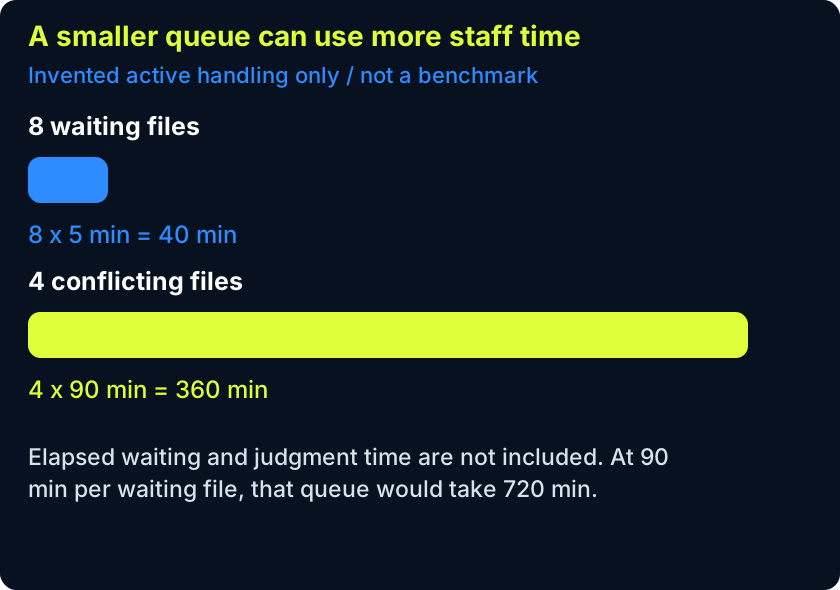
In this invented snapshot, 12 files are prepared, 8 await applicant material and 4 contain conflicting versions. These are states, not work types: preparation, reconciliation and judgment remain hypotheses to investigate. Suppose chasing each of the 8 waiting files takes 5 active minutes, while resolving each of the 4 conflicts takes 90. That is 40 versus 360 active minutes, so the smaller conflict queue uses more handling time. The 12 prepared files still await authorized judgment, whose time is not supplied here.
These times illustrate the method. If chasing each waiting file took 90 minutes, those 8 would require 720 minutes and the comparison would reverse. Measure active handling and elapsed waiting on your own sample; a large waiting inventory can still be a small staff-time cost.
Check what your existing lending stack can already do
Ask the LOS or current vendor to demonstrate supported document states, source links, version history and queue behavior on the same permitted files. Prefer a supported configuration where it resolves the evidenced gap.
Choose one workflow, not a transformation slogan
Name one document-to-review constraint and the smallest test that could change the decision. Assign the roles separately. The proposed allocation below is adapted from the decision matrix in the AI-assisted lending guide linked below: operations, with product, owns the preparation workflow, including receipt of the prepared file and the queues for missing material and conflicts; an authorized domain reviewer, authorized by the lender's risk function, decides which conflicting value is reliable enough to use; the lender's risk function owns judgment under credit policy; engineering owns the integration; and the sponsor owns the investment. Adapt it to your organization; each named person still has to agree before it holds.
Your next step: write one paragraph naming the product and channel, first document to reviewer-ready endpoint, limiting step and evidence, owners and the next test. If work types remain mixed, complete that diagnosis before selecting a tool.
To compare an existing-stack fix, extraction and a small integration on the same files, see AI-assisted SME lending: evidence, rules and human decisions. To choose the person, see Choosing a CTO for an assisted lending pilot. If the unresolved boundary spans product, the lender's risk function, operations and engineering, bring your paragraph to the Grand Rounds curator.
Boundaries
This guide diagnoses preparation, reconciliation and authorized judgment. It is general information, not legal, regulatory, financial or credit advice: qualified advisers own legal, regulatory, financial and credit-risk conclusions, and credit policy and decisions stay with the lender. The lender boundary and the proposed matrix of who accepts what are set out in AI-assisted SME lending: evidence, rules and human decisions. The snapshot figures and handling times are invented.
Grand Rounds is an initiative of Dinarys, and a conversation may lead to cooperation with Dinarys.