
Short answer. Choose against the candidate's personal contribution to the document-to-review workflow, and name who decides the rest. Four checks to run before deciding:
- Contribution. Which decisions in a comparable system were the candidate's own: source linkage for documents, bank and data interfaces, retries, access, recovery?
- Role split. In the proposed mandate table below, technical leadership, implementation and domain or model validation are three roles with three separate owners.
- Acceptance. The lender's risk function and your product, engineering and operations owners each accept their own part of the pilot, in line with the proposed decision matrix of the AI-assisted lending guide (linked below).
- Handover. Your team can run the assisted workflow, stop it and return to the manual path after the CTO's mandate ends.
This guide is for a lender or fintech with a live product, implementation capacity and an authorized budget owner considering one document-to-review workflow. The sponsor, as defined in the AI-assisted lending guide (a CEO, CFO or P&L owner), appoints the technical lead and accepts the remit. Here, LOS means loan origination system, and technical leadership means the CTO or technical-lead role described in the mandate table below.
Not sure which workflow option to test? See AI-assisted SME lending: evidence, rules and human decisions.
Six questions to put to every candidate
Ask each candidate the same questions, and ask for answers in terms of an artifact you may inspect (a redacted record, a permitted reference or a structured account of one decision).
| Question | A strong answer shows | A weak answer shows |
|---|---|---|
| Which decision in a comparable system was yours? | One named decision and who owned the rest | Only team results; no personal decision identified |
| A request is retried after a timeout: what stops a duplicate application? | Application identity, idempotent calls, a recovery path tested in a sandbox | "The integration handles it" |
| Where does the reviewer see the source of a prepared field? | Source location, document period, version and unresolved differences shown beside the value | A summary without provenance |
| Which decisions belong to the lender's risk function rather than engineering? | A boundary map; in the proposed allocation, thresholds, policy changes and model changes sit with the lender's risk function | A promise to "automate underwriting" |
| Who can stop the assisted workflow and return to the manual path? | A named stop authority, a fallback and a log | An operating model that depends on the candidate |
| What can your operating team run without you? | A runbook, an accepted decision record, a change process and a named queue owner | A demo only the candidate operates |
“We” is a prompt to ask which part was theirs. A walkthrough or plausible explanation still needs permitted corroboration.
Then ask the candidate to critique your own boundary map on authorized, de-identified material: what the existing LOS may already do, and which decision belongs to the lender's risk function. If evidence is confidential, ask for a redacted artifact or a permitted reference and mark the rest unknown.
Write a mandate with three separate scopes and an operating acceptance
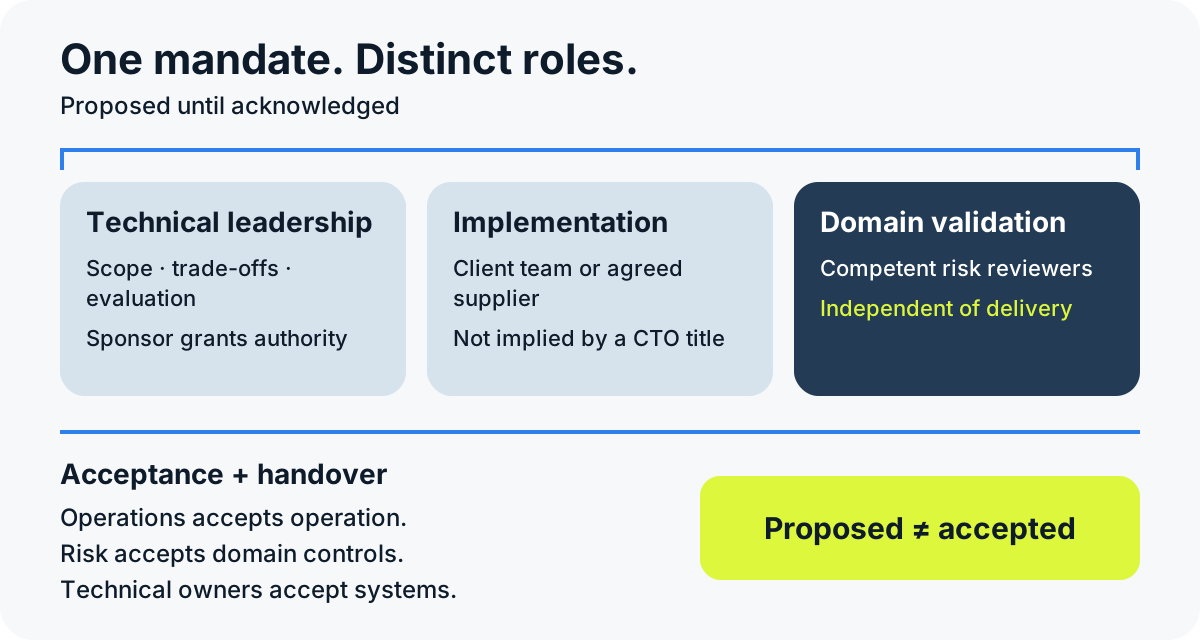
Agree the technical-leadership remit, implementation scope and domain/model validation separately, then add the operating acceptance. Each workstream needs an owner, output, accepting person and evidence. The allocation below is proposed, not fixed: your organization may assign the roles differently, and each person named still has to agree.
| Workstream | Proposed scope | Proposed owner | Accepted by |
|---|---|---|---|
| Technical leadership | Define the boundary, compare native capabilities and additions, record architecture decisions, coordinate evaluation and stop/continue decisions | The technical lead (internal or outside CTO) whom the sponsor appoints and gives authority | The sponsor accepts the remit; product, engineering and the lender's risk function each agree their own boundaries |
| Implementation | Configure or build the agreed components, connect the test environments, implement event handling and reviewer display, document recovery | Named client team or separately selected supplier | Engineering accepts technical delivery |
| Domain/model validation | Review domain evidence and any implications for existing policies or models; recommend what specialist validation is required | Authorized domain reviewers (authorized by the lender's risk function), independent of delivery in this proposal | The lender's risk function accepts the reviewers' work as its domain controls and decides what further validation it requires |
| Operating acceptance | Confirm reviewer visibility, exception ownership, workload baseline, fallback and readiness to run the bounded workflow | Operations owner | Operations accepts service operation; the lender's risk function accepts its domain controls; technical owners accept their systems |
An invented selection exercise: stronger profile, weaker fit
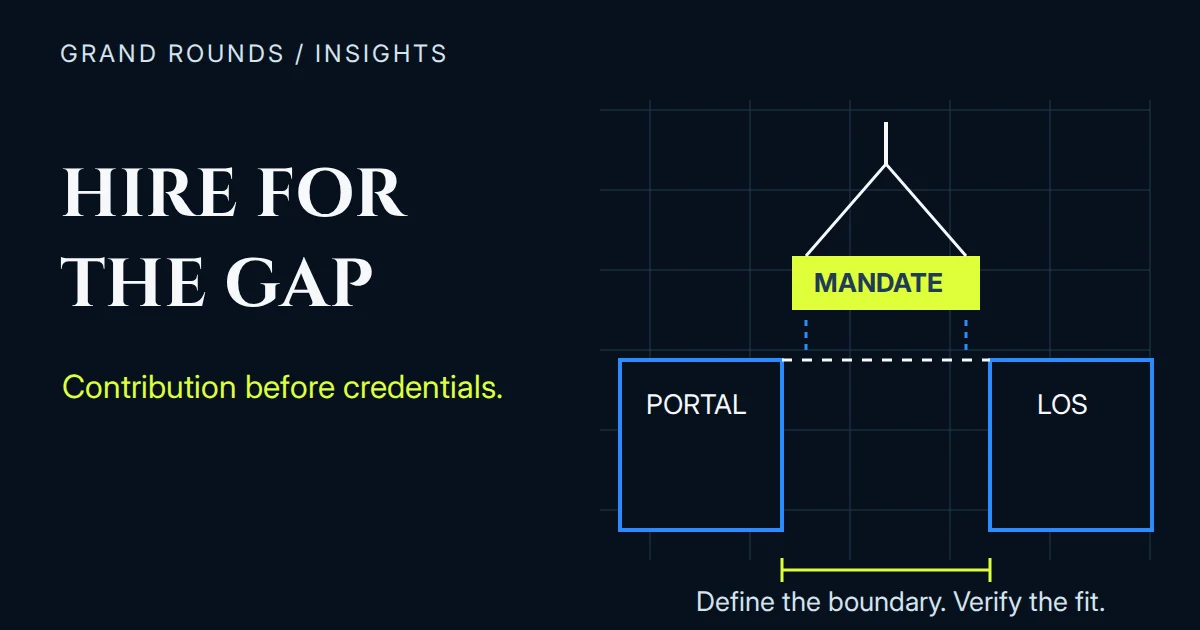
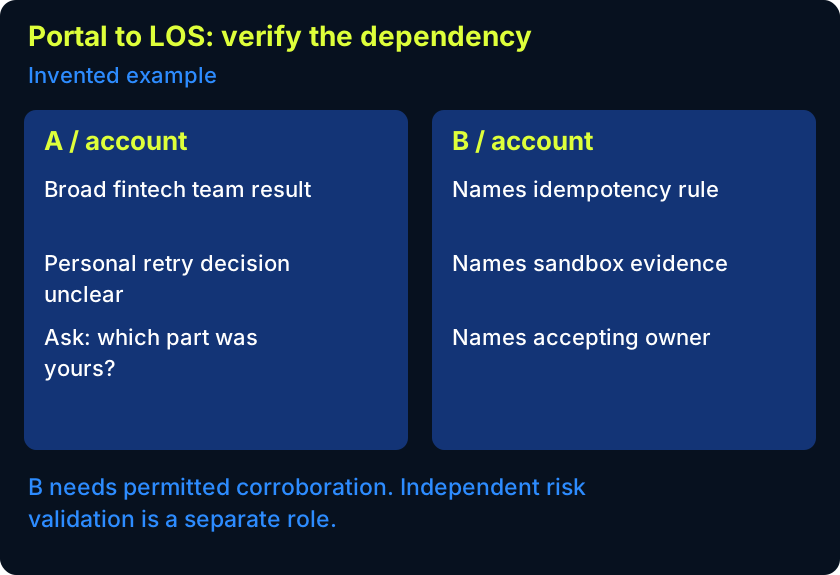
The invented gap is the applicant portal, where documents are uploaded and handed off to the LOS. Candidate A describes a lending-platform launch in team terms but cannot name who owned bank-API retry behavior. Candidate B identifies the submission idempotency rule they set, the sandbox test and its accepting owner. Ask both: after a timeout, what prevents a duplicate application? B goes forward to verification against permitted corroboration; A may fit a different question. Neither answer speaks to risk-model validation, which is a separate role.
Accept the pilot with evidence, then transfer control
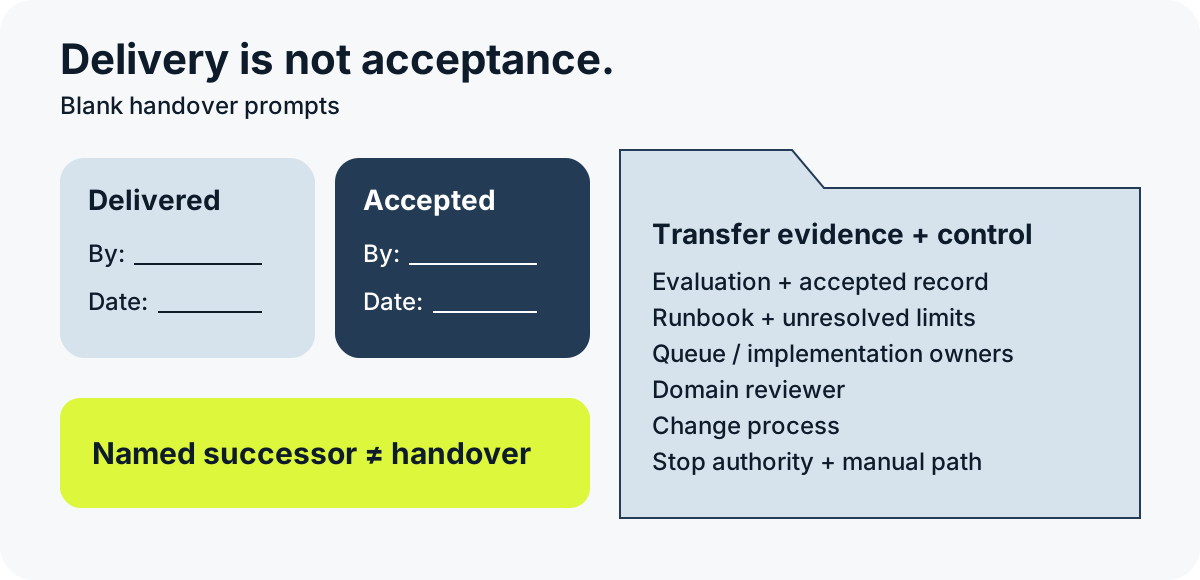
Have the lender's risk function, operations, product and engineering accept their own evidence. Then have the receiving team operate, stop and recover the assisted workflow from the agreed runbook, returning to the manual path when required.
The handover record names the runbook, stop authority, change process and receiving queue owner.
Adjacent financial-technology experience
As stated in Marton Csernai's profile, one example reads: "Built a hybrid RAG pipeline with durable workflow orchestration (Temporal) for a RegTech SaaS, delivering AI responses with 100% citation provenance for regulated document analysis". As stated in Carlos Blanco's profile, he spent 14 years inside TransUnion, moving from software developer to DevOps engineer to Product Owner; the profile carries a Fintech & credit tag. As stated in Berkan Sesen's profile, the headline reads "Applied AI Adviser — Oxford DPhil, ex-J.P. Morgan, UBS, Citi". These attributed statements are adjacent experience. They show neither SME lending nor credit-decisioning competence. Ask for personal document, LOS and bank-interface decisions, plus separate underwriting or loan-origination evidence where required.
Your next step: bring one mandate to the curator
Write a one-page mandate: the workflow boundary, the contribution evidence you still need, the split between leadership, implementation and validation, the acceptance owners and the handover requirements. Add the facts that help the curator understand the case: loan product or partner, document quality, sandbox access, permitted sample, the named owner in the lender's risk function and implementation capacity. Check first whether your internal lead, current supplier or a ready-made LOS feature already covers the gap.
If outside technical leadership is still needed, take the page to the Grand Rounds curator to discuss relevant network experience. Later technical work and development need their own agreed scope and owners.
Boundaries
The lender boundary is set out in the Boundaries of AI-assisted SME lending: evidence, rules and human decisions. Credit decisions, credit policy and any validation the lender requires stay with the lender. Technical criteria are agreed with the sponsor and engineering. Profile summaries are attributed public statements, not availability or fit evidence. This is general guidance, not legal or financial advice.
Grand Rounds is an initiative of Dinarys, and a conversation may lead to cooperation with Dinarys.