
Short answer. In this article, “approved knowledge” means versioned sources a named owner approved for the audience, app version and topic. A “real escalation” means evidence that a named human queue received the case, an accepted owner opened it within the defined response window, and an agreed fallback covers missing receipt or response. Test source applicability, answer boundaries, permitted handoff data and human receipt on one administrative task. The six escalation tests below apply to every handoff request, urgent or not; urgency and clinical criteria are defined by your clinical/content owner.
This guide helps the founder or product director of an existing digital-health product decide how users reach approved information and a person. It names the owners who sign off each part: the clinical/content owner, the service owner, engineering and the privacy and security owners. The sponsor who funds the work authorizes scope.
It is a technical-governance comparison of a knowledge assistant, self-service content and human support on one task: finding appointment-confirmation information. Clinical policy, regulatory classification and deployment approval stay with the specialists who own them.
What counts as approved knowledge?
Approved knowledge is a versioned source that a named owner approved for the audience, app version and topic. Record the owner, the version, the app version, language and market it applies to, a withdrawal route, and the questions it left unanswered. A citation shows where an answer came from; check its applicability to this user and version separately. For the full evaluation scorecard see AI Evidence and RAG Evaluation: What Should a CTO Accept?.
Compare the same task, not three different demos
Compare approved self-service, an assistant and human support on the same administrative task, with the same permitted cases. Use the task chosen in the demand diagnosis.
| Option | Test on the same task | Important limit to expose |
|---|---|---|
| Approved self-service page or in-product instructions | Can users find and follow the current confirmation-navigation instructions? Can they reach the approved human route? | A missing confirmation goes to the service owner's authorized account-investigation route; clearer discoverability may cover navigation |
| Knowledge assistant | Can it handle different wording while preserving the approved meaning, applicable version and boundary? | Review correctness, applicability, completeness and permitted scope separately |
| Human service using approved knowledge | Can staff distinguish navigation help from an account investigation (the service owner's route) and follow the existing policy? | Staffing, access, queue ownership and content gaps still constrain the service |
What makes escalation real? Six tests
These six tests apply to every handoff request, including a symptom or urgent message. For those messages the clinical/content owner defines the response, its timing and the response window, and approves the route; for administrative items the service owner sets the window. The tests check that an owner, receipt, fallback and permitted context exist; they do not judge whether the clinical policy is right.
- Named owner. A person or named role has accepted the queue. A proposed owner counts as unaccepted.
- Receipt. The receiving system shows the item. "Sent to support" on the user's screen is an interface claim; inspect the receiving record.
- Response path. Someone opens the item inside the agreed response window (see the lead-in for who sets it), and the user is told through a defined channel what happens next.
- Fallback. The service knows what happens outside staffed hours or when nobody responds. An unopened item remains open. (The same logic for approvals is in Human-in-the-Loop AI Agents: Who Can Approve External Actions?.)
- A tested route to a person. Test reachability from each agreed feature state, including uncovered questions; record checked states and failures.
- Permitted context only. The handoff carries the context the owners allow, and nothing else.
Measure the full ladder: define the start event, such as the user's handoff request, and record separate endpoints for sent, received, opened by the owner and closed. Report items missing the next transition; a time-to-human average built only from completed handoffs hides them. Measure the receiving workload as well as automated answers.
Build an allowed/forbidden scenario register
| Test request or condition | Proposed boundary for this illustration | Evidence to inspect |
|---|---|---|
| Find the confirmation section, phrased several ways | Candidate allowed navigation help, if locally approved | Instructions match the user's app version and stay within the approved steps |
| User on app version 1 receives version 2 instructions | Applicability failure even with a genuine citation | Answer withheld or corrected; content-gap record opened |
| “I want to talk to a person” | Route to the human path; test every agreed state | Receiving item and next-step message, or recorded failure |
| Administrative handoff request outside staffed hours | Follows the owner-approved fallback | Fallback message; item waits in queue with owner and window visible |
| Request outside the approved scope | Follow the approved out-of-scope human route | Behavior matches the clinical/content owner's policy |
| User describes a symptom or says the matter is urgent | Follow the clinical/content owner's written policy, including its fallback outside staffed hours | Owner-approved response; named owner, receipt and fallback evidence for the human route |
An invented walkthrough: "sent to support" is not receipt
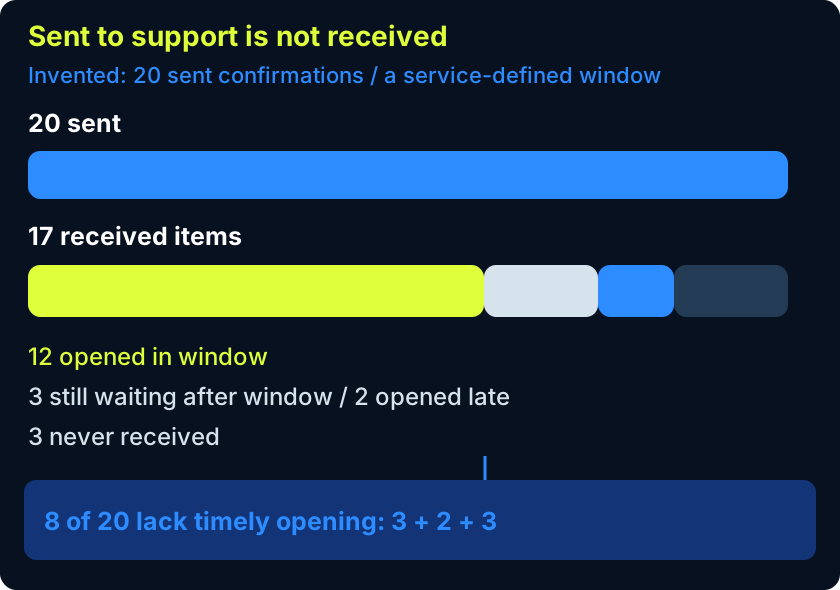
Imagine a fictional product whose assistant shows users a "sent to support" confirmation after a handoff request. The version-mismatch case in the register above is a separate failure; this walkthrough is only about what the receiving queue shows.
Invented, unperformed. The assistant displays “sent to support” 20 times. The receiving queue contains 17 items: 12 were opened within the window, 3 are still waiting after the window has elapsed and 2 were opened after it. The other 3 requests never arrived. So 8 of the 20 sit outside timely opening: 3 never received, 3 waiting, 2 opened late. These are teaching counts; evaluate applicable content and service-state transitions separately.
Draw the data flow through the human handoff
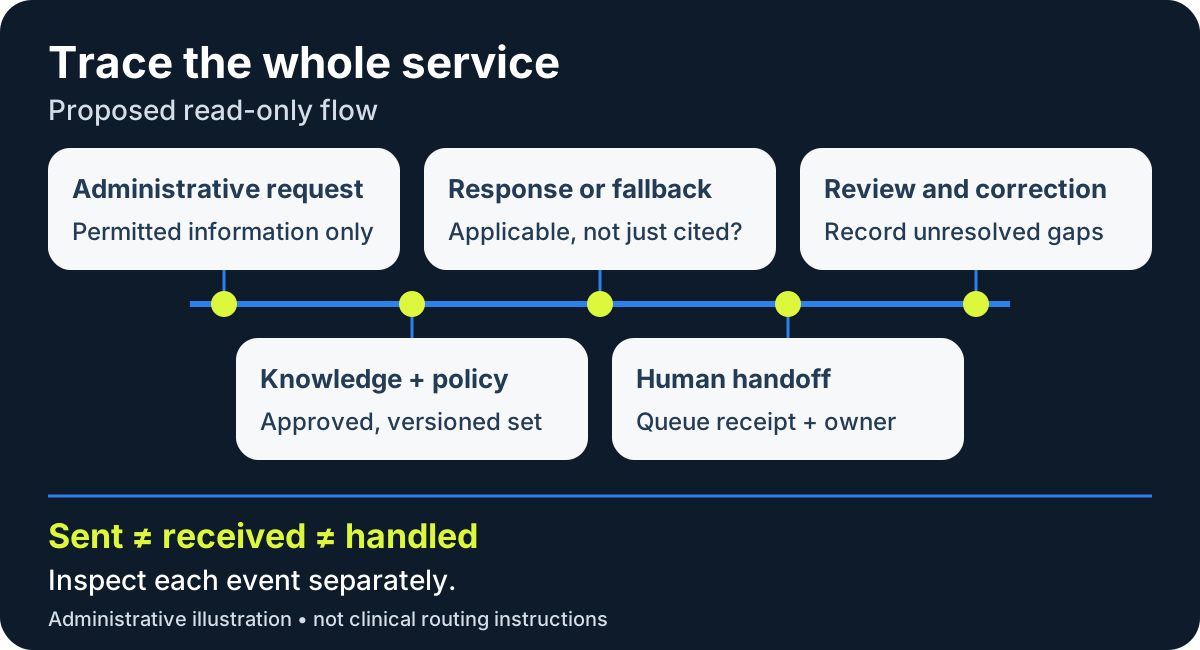
Trace request, identity, permitted context, approved source/version, answer, receiving queue item and fallback. Agree access and retention with the responsible owners; the figure below shows a proposed read-only trace.
List what the assistant can see, including account identifiers, app version and free text that may contain health details, and what may travel with a handoff. The privacy and security owners approve access, minimization, retention and recipients.
Make the comparison decision with the owners
Use this comparison heuristic, not a validated acceptance test: if approved self-service and the existing human route cover the permitted requests, keep them. Consider an assistant for varied wording that self-service does not cover only after the source, boundary and handoff tests meet the owners' conditions. Retain human service outside the approved register. A hard-to-find confirmation section may need clearer instructions; repeated phrasing failures may justify testing an assistant, not deploying it automatically.
Record evidence, unresolved items and stop/change authority. Fill the register with the clinical/content owner and service owner. Clinical/content, service, privacy, security and classification decisions remain separate acceptances by their owners; the governed rollout CTO guide shows how to record the software, clinical/content and service acceptances and who leads technically, while privacy, security and classification stay with their own owners. If the comparison exposes a gap no single owner covers, bring it to the Grand Rounds curator.
Boundaries
This is a technical-governance comparison for one administrative task. Symptom criteria, urgency, diagnosis, treatment and emergency routes belong to the clinical/content owner. Regulatory classification and deployment approval belong to qualified specialists. Technical receipt and a passed test are not clinical or operational clearance.
Grand Rounds is an initiative of Dinarys, and a conversation may lead to cooperation with Dinarys.