
Count unique journeys, not contacts. A journey is one distinct request behind however many contacts it generates; this series uses “task” for the kind of administrative request you choose to test. Sort the journeys by cause (hard-to-find approved information, product defects, account investigations, content-boundary questions) before choosing a fix. Account investigations stay with the service owner's authorized queue. Uncovered questions (not covered by approved content) and requests outside the administrative scope you choose to test stay with people unless the clinical/content owner approves another route. A symptom or urgent message is outside this count and outside any automation question: an assistant only routes it, to the human route that the clinical/content owner defines.
Written for the founder or product director of an existing digital-health product with a service team, a clinical/content owner and a funded next step.
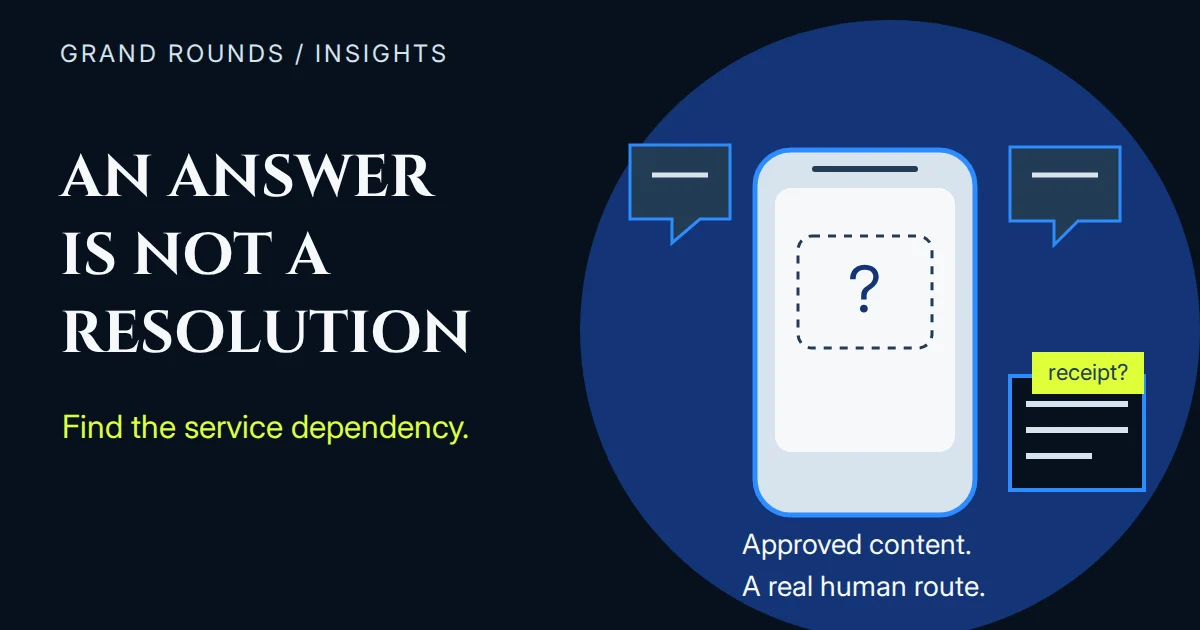
What is really behind repeated support contacts?
| Cause | First move to test | Who decides / assistant boundary |
|---|---|---|
| Approved information is hard to find | Clearer instructions or help page | Service owner and clinical/content owner; consider an assistant only for a remaining approved need |
| Account investigation | Authorized queue with receipt and owner | Service owner; navigation answers do not investigate an account |
| Product defect | Product repair | Engineering/product owner; an assistant does not repair the failed screen |
| Content gap or out-of-scope request | Owner-defined response and human route | Clinical/content owner; no improvised answer |
Count the work the team is actually doing
Agree a working definition with the service owner: contacts concern one journey when they come from the same user, about the same administrative request and within the counting period; the owner-defined resolution closes it. A repeated missing-confirmation message can belong to the same open journey, but a different appointment is a separate journey even for the same user. Treat this as a counting convention to check with the service owner. Contacts that cannot be matched stay visibly uncertain, and any linkage across channels or sessions uses only the identity matching that the privacy and security owners approve.
A symptom or urgent message is never merged into an open administrative journey and is never closed as a duplicate. It goes to the human route the clinical/content owner defines, is logged separately and stays out of the counts below. If that route is not yet defined, take that gap to the clinical/content owner before you count or automate anything.
Invented example: 36 contacts, 30 journeys, 18 navigation questions
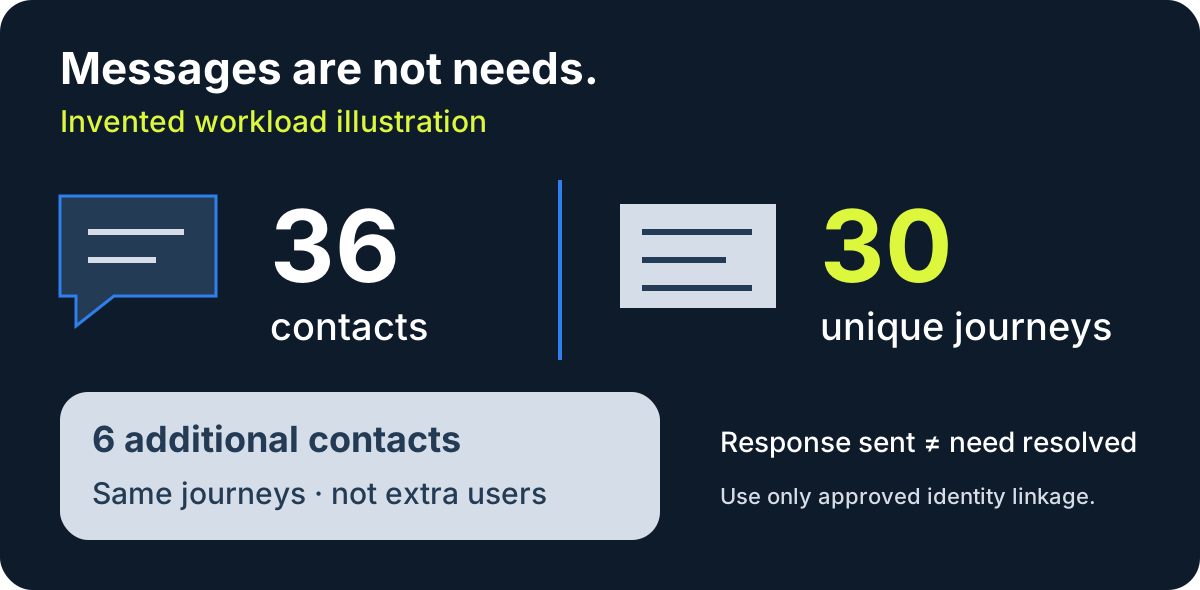
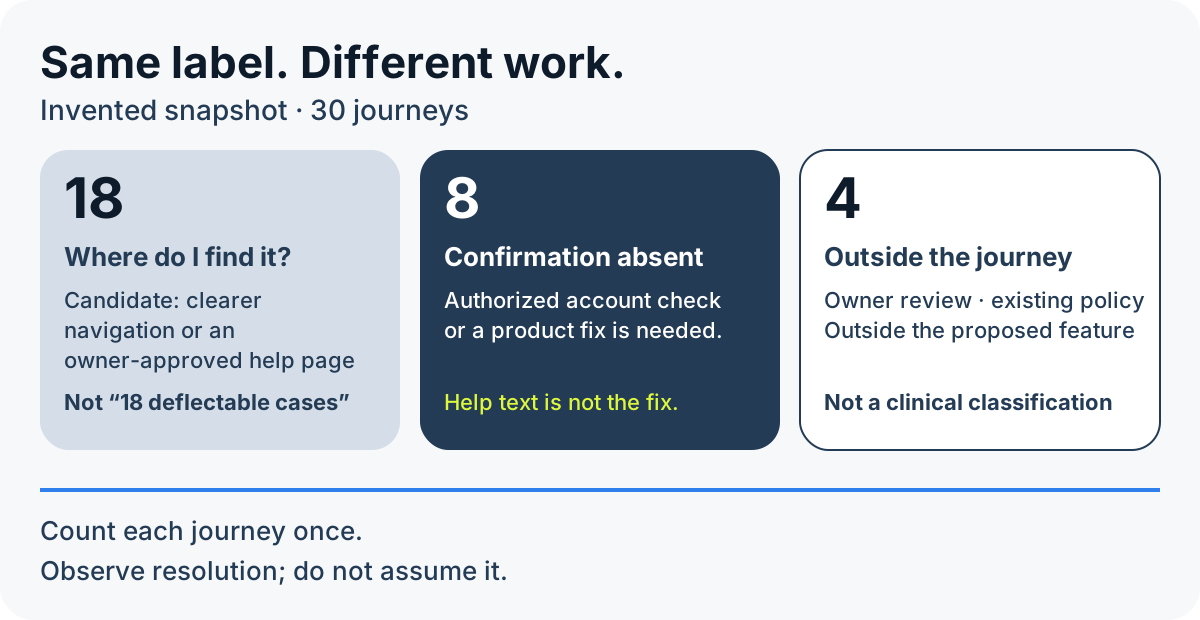
Invented snapshot of administrative contacts only: 36 contacts concern 30 journeys, with 6 additional contacts. The journeys split into 18 navigation questions, 8 missing-confirmation investigations and 4 outside the approved scope. Only the 18 navigation journeys are candidates for clearer instructions or a permitted assistant. The 8 investigations go first to the service owner's authorized account check; if that check finds a defect, engineering repairs it. The 4 outside the approved scope go to the route the clinical/content owner defines. The figure below labels this group “Outside the journey”; read it as outside the approved scope. An automation target set on all 36 contacts would include work an assistant should not take.
Choose one task before choosing AI
From the sorted administrative journeys, pick one task (for example, finding the confirmation section) and record its demand count, approved content, boundary owner, service queue and permitted evidence. “The confirmation is missing from my account” needs an account check; “Where is the confirmation section?” may be covered navigation. For each question on the chosen task, name the approved source, content owner, allowed response and human route. The clinical/content owner sets allowed responses, thresholds and escalation policy; engineering tests the specified behavior; qualified specialists decide clinical policy and software classification.
Next in this series: AI-assisted health support with approved knowledge and real escalation compares self-service, an assistant and human support on that task. Choosing a CTO for a governed digital health support rollout covers who leads technically and who accepts what.
Bring your journey map to the Grand Rounds curator.
Boundaries
This guide counts and sorts the journeys within one administrative task. Clinical guidance, urgency criteria and regulatory classification are outside its scope; the clinical/content owner defines allowed responses and escalation policy, and qualified specialists and operational owners retain deployment approval.
Grand Rounds is an initiative of Dinarys, and a conversation may lead to cooperation with Dinarys.