
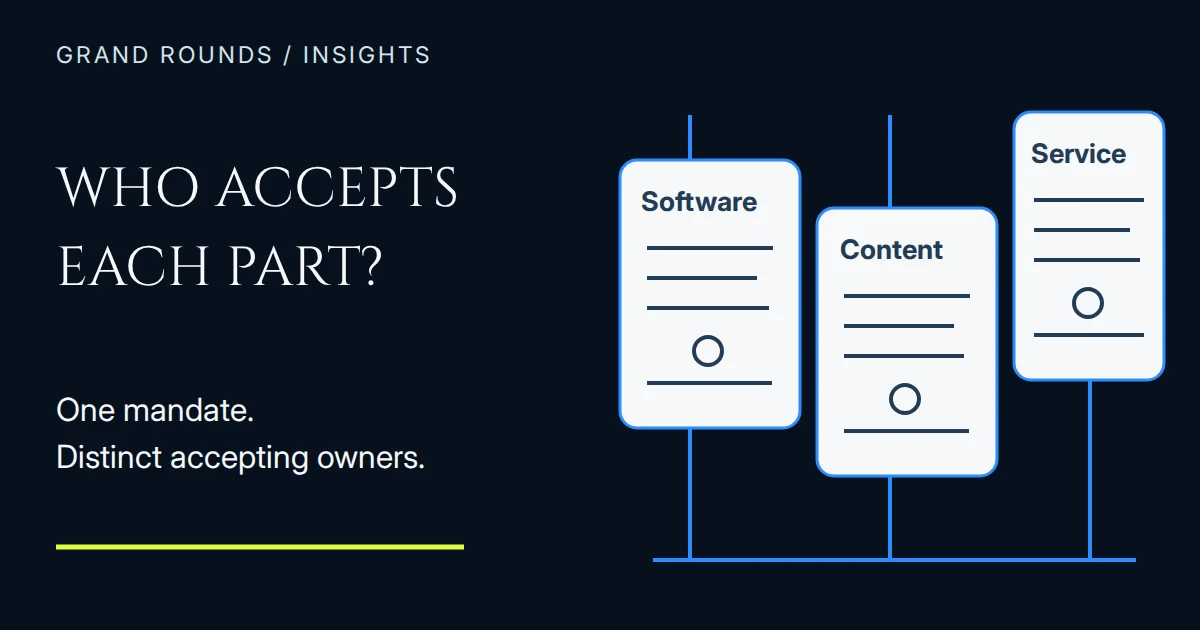
Delivered software is not a ready service: tests can pass while the content owner and the service team have not yet accepted their parts. Choose a CTO who can keep three acceptances separate (software, clinical/content, service) and make the open items actionable by their owners.
Software acceptance checks tested behavior; clinical/content acceptance belongs to its qualified owner; service acceptance confirms that the team operating the human queue has agreed to take it on. These three are the minimum to record. Privacy, security and regulatory-classification decisions stay with their own specialists and are separate again. Before choosing, name the owners and ask what the candidate personally did at the comparable boundary.
The public profiles cited below supply adjacent organizational-technology and AI-evaluation context, not proof of support-assistant delivery or escalation-queue ownership. If your existing lead covers the bounded change, an outside CTO may be unnecessary; otherwise verify personal contribution to the unresolved cross-team decision.
This guide is for the founder or product director who champions the work and the CEO, CFO or P&L owner who approves the mandate (the sponsor below). Keep the first mandate to one administrative task in one language and channel.
Grand Rounds connects you with experienced CTOs; each profile states that CTO's own experience.
Your next step: complete the acceptance record below, then ask the curator whether relevant network experience exists. Participation and any later scope are separate agreements.
Adjacent experience to examine
Experience in the Grand Rounds CTO network that is adjacent to this mandate (as stated in each CTO's public profile):
- Amer Murad: as stated in the CTO's profile, he led product development, technology innovation and DevOps for global HCM and payroll platforms at Ceridian. This is adjacent organizational-technology experience, not health-support delivery or a clinical qualification.
- Berkan Sesen: as stated in the CTO's profile, he has published on AI since 2009, “most recently on the evaluation of retrieval-augmented LLMs in clinical use”. The profile also states a particularly strong fit for “health, clinical, finance or other regulated and sensitive-data settings”. That is a statement of fit, not a described delivery or a clinical qualification. Verify the contribution your rollout needs separately.
Ask each candidate about personal decisions in a comparable service, and what a former client or employer would confirm within what they may disclose.
Ask about personal contribution and operating acceptance
| Claim to examine | Useful verification question | What it still leaves open |
|---|---|---|
| Led a health-support product | Which decisions did you make, which did you inherit, and which belonged to clinical or content specialists? | Who authored the existing logic and content |
| Improved a knowledge workflow | How were approved versions, withdrawals, conflicts and corrections handled? | Whether answers were correct for the user's situation |
| Delivered an escalation integration | Who accepted the receiving queue, and who could stop it? | Whether the service had the capacity to staff it |
| Managed rollout and handover | What remained unresolved, and who took ongoing ownership? | Whether operating acceptance was recorded |
Team-level results with no named personal decision prompt another question; treat them as unanswered, not as disqualifying.
Use an acceptance record, not “the chatbot is ready”
Write one line per acceptance: feature/content version, approved task, scenarios, observed behavior, accepting person/date, remaining conditions and failure handling. Specify what happens with uncovered questions, an unstaffed queue and symptom or urgent messages (routed as the clinical/content owner defines). Software, clinical/content and service acceptance each require their own record. For the escalation tests behind the service line, see approved knowledge and real escalation.
Draft a responsibility matrix with named acceptance
Use the matrix as a proposal for local agreement. The sponsor authorizes scope; the CTO leads technical evidence; qualified content/clinical and specialist owners accept their parts; the service owner accepts the staffed human route.
Accountable signs the decision; Responsible does the work. Both assignments below are proposed until accepted.
| Decision or deliverable | Accountable (proposed) | Responsible (proposed) | Consulted | Informed |
|---|---|---|---|---|
| Allowed/forbidden knowledge and specialist escalation policy | Clinical/content owner | Authorized content/domain reviewers | Service owner, CTO | Sponsor, implementation team |
| Technical design and evaluation implementation | Technical owner/CTO | Named client team or agreed supplier | Clinical/content, service, relevant data reviewers | Sponsor |
| Human queue operation and fallback | Service owner | Named support operations team | Clinical/content owner, engineering | Sponsor |
| Clinical/content acceptance decision | Clinical/content owner | Designated competent reviewers | CTO, service owner | Sponsor, implementation team |
| Software acceptance decision | Engineering acceptance owner | Test and implementation team | CTO, relevant specialist reviewers | Sponsor, service owner |
| Scoped rollout decision after required acceptances | Sponsor | Rollout coordinator | All required acceptance owners | Operating and delivery teams |
In this proposed matrix the rollout decision follows the required acceptances: a rejection by a required specialist (clinical/content, privacy, security or classification) is not the sponsor's to overrule. Whether law or contract adds further requirements is for qualified specialists.
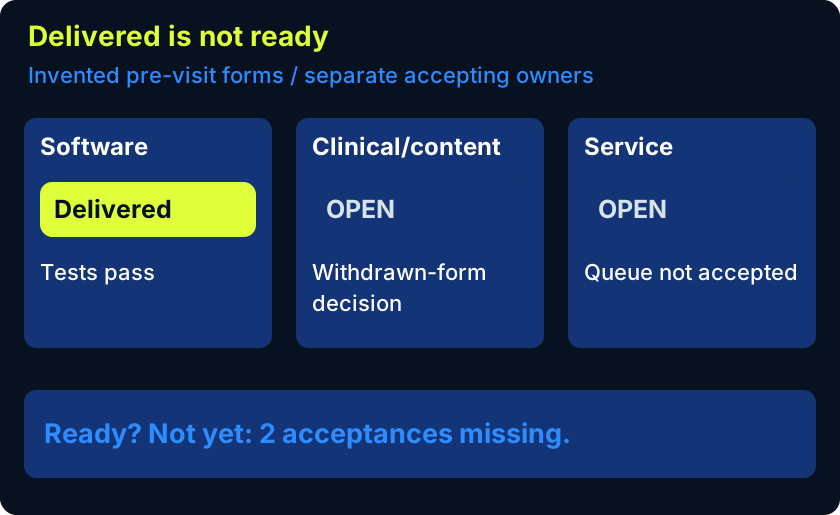
Invented handover: delivered software, two open acceptances
Imagine a fictional product team preparing AI-assisted help for finding pre-visit forms in its app. The approved content is versioned and the engineering tests pass; the engineering acceptance owner has recorded software acceptance and the implementation team has marked its work delivered. At the acceptance meeting, the proposed service owner says the support team was never asked to take on the new queue. The clinical/content owner has not yet accepted what the assistant says when a form has been withdrawn.
Software acceptance is recorded in this example; the other two are open, and the passing tests settle neither. Ask the candidate to name the evidence each owner needs and the condition for keeping rollout on hold. This is an invented case, not a client result.
Appoint for the handover as well as the pilot
Appoint a receiving technical owner and service owner. Hand over source/version controls, correction and withdrawal procedures, monitoring, fallback, stop authority and open issues, then check the team can operate the bounded route.
What changes the scope of a CTO mandate?
The scope of a mandate depends on the number of tasks, languages and channels; whether content is already approved and versioned; whether the service queue exists and has an owner; how many systems the feature touches; how many people must accept; and who takes over afterwards. This page gives no time or cost figures.
Related guides
To size demand first, see counting repeat support contacts.
Boundaries
This guide covers technical leadership for one administrative task. Clinical suitability, classification, privacy, security and law stay with qualified specialists and their accepted decisions. The profile statements above, including the stated fit, are the profiles' own; this guide neither endorses nor tests them and promises no availability.
Grand Rounds is an initiative of Dinarys, and a conversation may lead to cooperation with Dinarys.