
Decide per output, not for AI in general. As a starting point to test, use the simplest route that meets the requirements: process/templates, an already licensed tool, a bought product for a remaining gap, or a small integration with an operating owner. “Partner” names who configures, runs, supports and exits the chosen route—not a fifth technology option. If a known requirement already excludes templates and current tools, evaluate build/buy for that requirement first rather than repeating a ladder.
A faster first draft is not necessarily a cheaper proposal. If experts spend the saved time checking sources, removing confidential material and rebuilding the argument, the work has moved rather than disappeared.
For a CTO or technical lead helping a COO or practice lead with a baseline for one recurring output, the decision is narrower than “What is our AI strategy?” The worked scenario here is research and proposal output for a knowledge-intensive firm: what is the least complicated approach that meets this task's quality, permission and operating requirements?
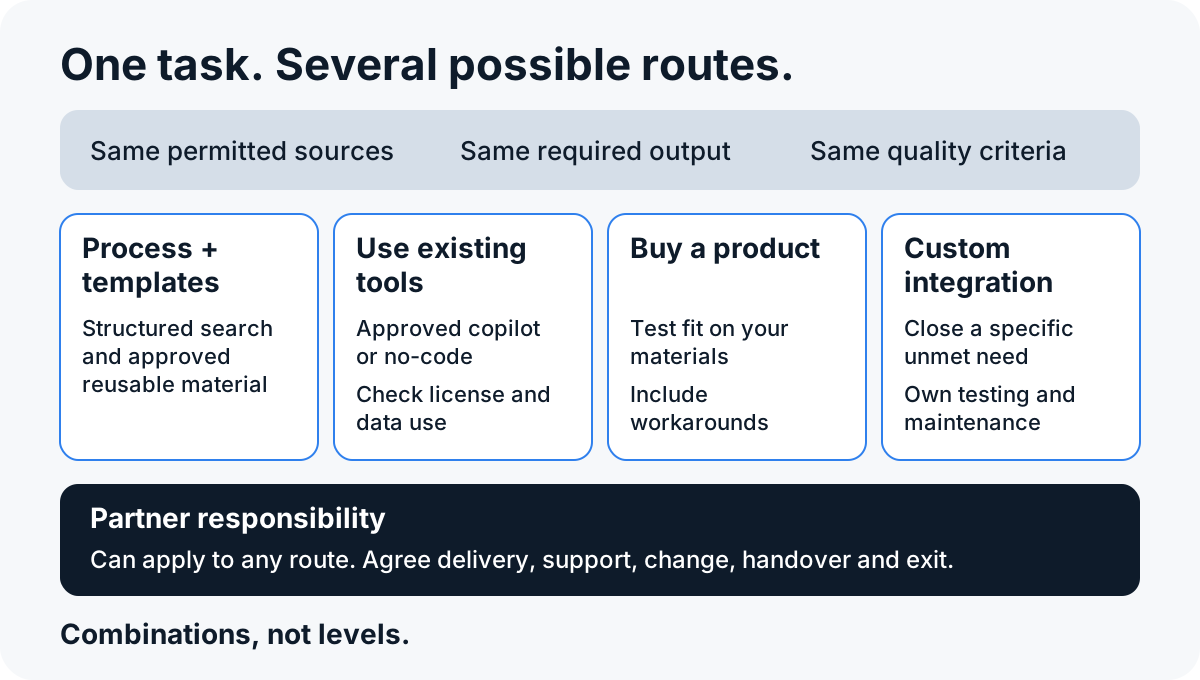
Compare process changes and templates, tools you already license, a bought product and custom integration. Then decide who will operate the chosen combination. Partnering is a responsibility arrangement, not a more advanced technology tier.
Build vs buy vs partner: approaches, not a maturity ladder
Use your existing baseline to shortlist alternatives for the same deliverable. These routes can coexist. The fit conditions are heuristics to test, not validated thresholds:
- Process and templates. Fits repeated assembly from approved material with a source-freshness owner; loses its advantage when difficult retrieval or review rework remains. Use maintained sources, structured search and approved sections.
- Existing licensed copilot or no-code workflow. Fits when terms, configuration and permissions cover the materials and complete active effort falls. Falls short when checking absorbs the drafting gain or terms exclude client documents; an existing subscription alone is not permission.
- Bought specialist product. Fits a requirement the first two cannot meet on your material, with support and exit specified. Loses its case if drafting speed is the only gain or exceptions stay manual. Include configuration, exports and unusual cases in the comparison.
- Custom integration or build. Fits a specific unmet access, version, handoff or review requirement with an owner for testing, maintenance and support. Falls short when operating cost/ownership is unestimated or a bought component closes the gap. Build can be a small integration, not model training.
For each route, separate capability fit from operating fit: can it do the task, and can your team safely run, change and leave it?
If the baseline and eligible-task counts are missing, start with AI Adoption Roadmap.
UK government purchasing-strategy guidance explicitly considers combined build/buy approaches, full costs and the product lifecycle through retirement. Its public-sector contracting rules are not rules for every consultancy, but the lifecycle questions are useful here.
Automate handling; preserve expert judgment
Split the output into work that can be assisted and decisions that remain with a qualified reviewer.
When research takes too long to gather sources, compare structured search with assisted retrieval. Check whether the route finds relevant permitted material, preserves source locations and versions, and makes unsupported claims visible. Keep the expert responsible for relevance, conflicting evidence and interpretation. A citation is a route back to evidence, not acceptance of the claim.
When proposals are rebuilt from previous work, compare an approved section library and template with assisted assembly. Define which material is reusable, which client details must never cross accounts, and who approves scope and commitments. A proposal can be fluent while promising something the practice cannot deliver.
When staff use AI inconsistently, test shared instructions, approved inputs, coaching and an explicit review handoff before assuming another platform is needed. Observe whether people use the process and whether accepted outputs improve; license counts do not answer either question.
NIST’s AI RMF Playbook, MAP 1.1, recommends considering non-AI alternatives and documenting human-oversight roles. In this framework, AI outputs remain drafts. Autonomous legal, medical or investment conclusions are outside scope; a tool choice does not transfer professional accountability to software.
Run a comparison on the same task
Freeze a permitted input pack, source versions, client brief and output specification. Give each shortlisted route the same task and quality criteria. For example: a proposal draft with traceable supporting claims, required sections, explicit uncertainties, no excluded client information and a reviewer able to approve its commitments.
Include representative routine work and known awkward cases from your baseline. Record configuration and instructions so a successful run can be repeated. If a route requires extra input cleaning or human searching, count that work rather than giving it a cleaner starting point for free.
Use comparable staff experience and the same review rubric. Where practical, vary run order and avoid letting a reviewer’s corrections from one route become an undocumented advantage for another. Have ordinary users repeat the workflow: a demonstration run by its builder does not establish everyday usability.
A descriptive pilot scorecard
Create one record per route and task. The scorecard below is an evidence log, not a weighted score, ranking formula or automatic winner.
| Record | What to capture |
|---|---|
| Task and capability | Input/output versions; functions covered; manual workarounds; cases the route cannot handle. |
| Active work | Person-minutes by role for preparation, search, drafting, review, correction and handover, including retries. |
| Elapsed time | Time from the agreed request point to approval; distinguish processing, queues and reviewer availability. |
| Quality | Reviewer decision against the same criteria; missing evidence, citation problems, exclusions and corrections; retain before/after outputs. |
| Cost | Labor by role; incremental licenses and usage; setup, integration, training, support, changes and exit, with assumptions. |
| Data and IP | Permitted sources/users; access isolation; retention/deletion; supplier data-use terms; rights to inputs, outputs and custom work. |
| Ownership and open evidence | Named acceptance/support/change owners; unresolved terms or tests; who will resolve each and what decision remains open. |
Do not convert unknowns into zero cost or good quality. A one-off setup estimate belongs beside, not hidden inside, a recurring cost observation. For total cost of ownership, compare the same time horizon and workload assumptions; show existing committed spend separately from genuinely avoidable or incremental spend.
Worked comparison: invented and not performed
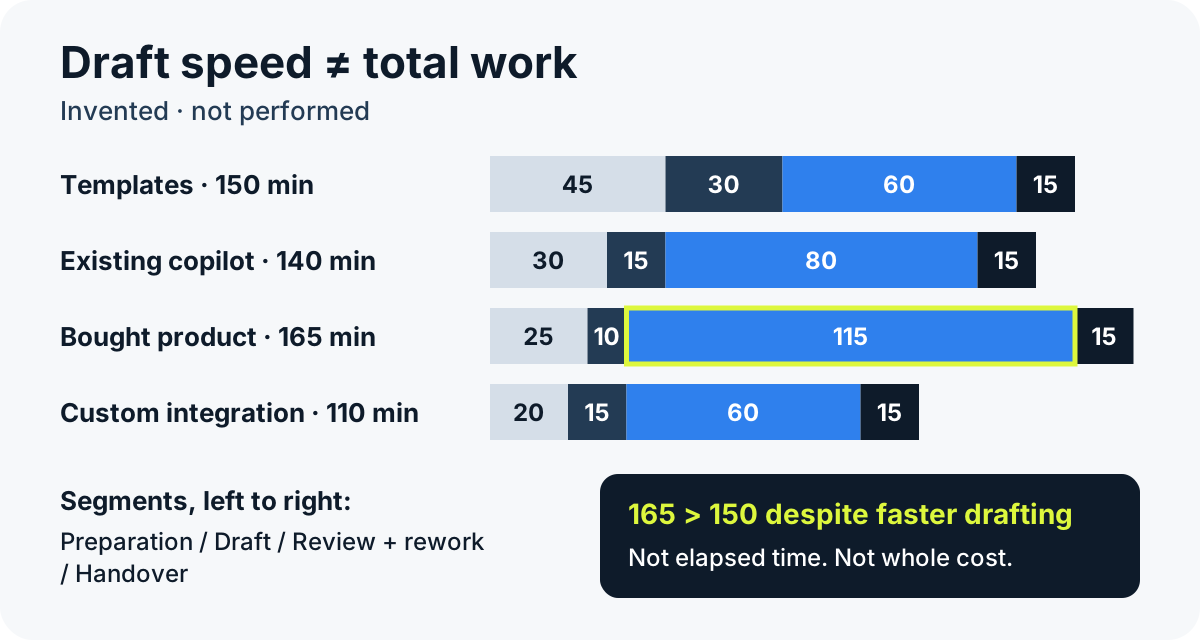
The following is a wholly invented, unperformed comparison—not a client case, benchmark or forecast. Imagine one recurring proposal draft assembled from an approved research pack and reusable sections. All four routes receive identical inputs and acceptance requirements. Every output requires corrections before an expert could accept it.
The assumed times below are active person-minutes, not elapsed turnaround. Preparation includes source handling and search. Review includes fact-checking and all rework; handover includes final assembly. No activity is counted in two categories.
- Template-led manual route: preparation 45 + drafting 30 + review/rework 60 + handover 15 = 150 minutes. The invented review notes flag an outdated reusable section, corrected before acceptance.
- Existing approved copilot: preparation 30 + drafting 15 + review/rework 80 + handover 15 = 140 minutes. The invented notes require checking weak claim-to-source links. Staff time falls slightly, but review effort rises.
- Bought product: preparation 25 + drafting 10 + review/rework 115 + handover 15 = 165 minutes. The invented notes flag unsupported synthesis and unsuitable reused commitments. Drafting alone is fastest here, but total work is highest.
- Custom integration: preparation 20 + drafting 15 + review/rework 60 + handover 15 = 110 minutes. The invented notes require an expert to resolve an evidence conflict. This assumption says nothing about the cost or reliability of building and operating it.
For a limited labor-cost illustration, assume preparation, drafting and handover are done by a practitioner at $80/hour, and review/rework by an expert at $120/hour. These invented rates include no supplier or software charges. Practitioner/reviewer minutes are respectively 90/60, 60/80, 50/115 and 50/60. Multiplying role hours by these assumed rates gives labor costs of $240, $240, $297 and $187, respectively, rounded to whole dollars.
These are not total per-output costs. Setup, integration, licenses, usage, training, support, change and exit costs are not estimated in this illustration. Elapsed approval times are also not observed or assumed: summing person-minutes cannot tell you whether a reviewer’s queue delays approval until tomorrow. Nor does this illustration establish repeatability on other tasks.
What the comparison would—and would not—justify
The bought-product route is the counterexample to buying on draft speed. The existing copilot's lower total time produces no labor-cost advantage under these assumed role rates. Custom integration has the lowest invented active time. That number most needs the missing build, run and exit costs; it should not be read as a result.
If templates meet quality requirements and handle the expected workload, keeping them is a valid choice. If a purchased capability closes the actual gap, there is no requirement to commission a build. If permission-aware source access remains an essential unmet requirement, test that requirement specifically rather than funding a broad platform rebuild.
In a real pilot, the practice lead, domain reviewer and IT/security owner must interpret the evidence together. Agree task-specific acceptance and cost constraints; there is no universal saving percentage or score that authorizes rollout.
Partner: who operates, supports and exits the chosen route?
“Partner” needs a more precise definition than “someone will handle the AI”. Assign these responsibilities whether delivery is internal, external or mixed:
- Acceptance: the practice lead owns the process; the domain reviewer can reject unsupported outputs and retains final professional judgment.
- Permissions and IP: IT/security and the appropriate rights owner approve data use. Document access boundaries, storage, supplier use of submitted material, retention and ownership or licenses for code, configurations and outputs. Verify terms for the actual product and contract.
- Delivery and support: name who configures or builds, monitors failures, fixes broken connections, answers users and maintains a manual fallback. Specify support hours and escalation rather than assuming them.
- Change: assign authority to approve source, template, model, product and workflow changes. Keep representative test cases and rerun relevant checks after changes; record who accepts the revised behavior.
- Exit: establish what can be exported—sources, outputs, review records, configurations and custom code—and in what usable form. Allocate migration work, access removal, deletion confirmation and continuity during handover.
A CTO’s contribution is to make the technical choice, dependencies and control responsibilities explicit alongside the process owner and domain expert. Implementation belongs to the client team or a separately chosen supplier; advice is not an implementation commitment.
For selecting the person who helps the receiving team take over, see Choosing a CTO Adviser for AI Workflow Adoption.
Finish with a short decision record: the sufficient approach for this output, supporting observations, unresolved evidence, responsible owners and conditions that would prompt reconsideration. That is a defensible build vs buy analysis: an operational choice you can explain and maintain, not a vote for the most sophisticated tool.
If the comparison crosses source permissions, review and several tools, ask the Grand Rounds curator about the relevant next conversation. It does not replace your pilot or legal/procurement review, offer implementation or promise a CTO's availability.
Boundaries
Grand Rounds is an initiative of Dinarys, and a conversation may lead to cooperation with Dinarys.