
Choose the personal contribution that matches your adoption gap, not the most impressive AI biography. Ask what the adviser changed, what happened when ordinary staff took over and who could reject weak output. Check whether an internal owner or current vendor can close the gap instead. A useful handover test is a receiving user running the process—including a failure case—without the adviser quietly stepping in; it is evidence of bounded capability, not a universal adoption threshold.
Your practice has measured a recurring research or proposal workflow and compared plausible ways to improve it. Now a different question matters: who will help your team run the chosen process after the pilot stops receiving special attention?
For a COO or practice lead, selecting an adviser is not another tool comparison. It is a decision about a person's contribution to adoption, acceptance and transfer of control. A convincing demonstration does not establish that ordinary staff can use the process, that reviewers can reject weak work, or that IT can support it.
Bring the existing baseline and comparison forward. Do not pay to rediscover them unless something material has changed. The next agreement should name what the adviser will decide, what your team or supplier will implement, and what your process owner must be able to operate independently.
If those inputs are missing, start with the AI Adoption Roadmap and Build vs Buy vs Partner for AI Workflows. This page is the interview and handover script, not another tool comparison.
Select personal adoption experience, not an AI biography
Ask a prospective CTO adviser to describe a relevant workflow they personally helped put into use. Similarity means more than the same model or industry label. Look for repeated expert work, confidential inputs, source checking, a busy reviewer and staff who must change their habits.
Use five questions to distinguish a useful contribution from an impressive career summary:
- What did you personally change? Ask for decisions, configuration, coaching or troubleshooting attributable to the person. “Our firm adopted AI” leaves their contribution unknown.
- What happened when normal users took over? Ask about awkward inputs, skipped steps and manual fallback. A builder-only demo leaves ordinary use unestablished.
- Who could reject an output? Look for an actual quality owner and a returned draft. “Everyone liked it” does not explain acceptance.
- How was ongoing use checked? Ask for eligible-task use and avoidance reasons. License activations and workshop attendance are inputs, not evidence of adoption.
- What remained after you left? Ask what the receiving team could operate and change, with instructions, access, tests and support ownership. A prompt folder alone does not answer this.
A candidate may be unable to share client material. Ask for a permission-safe explanation or a synthetic walkthrough, clearly distinguished from case evidence. Confidentiality is not a reason to demand private records; neither is it a substitute for explaining the person's own contribution. Do not treat employment at an AI company as proof of hands-on workflow adoption.
Agree the responsibility boundary before the pilot
The COO can sponsor the change without becoming its daily operator. The subject specialist can accept the research without owning integrations. Make those distinctions explicit.
| Role | Responsibility to agree | Boundary to retain |
|---|---|---|
| COO or practice lead | Scope, operating resources and the decision to continue, change or stop | Does not replace subject-matter or IT approval |
| Process owner | Eligible tasks, daily workflow, user feedback, exceptions and adoption evidence | Cannot approve new data use alone |
| Domain reviewer | Evidence quality, interpretation, permitted commitments and final professional judgment | Does not inherit platform support by default |
| IT/security and relevant data owner | Approved environment, access, data handling, technical support and incident route | Technical permission is not acceptance of research quality |
| CTO adviser | Technical decisions, dependencies, evaluation design and agreed adoption/handover contribution | Advice is not an implementation or support commitment |
| Client team or chosen supplier | Agreed configuration/build work, fixes and operating documentation | Delivery scope must be separately explicit |
One person may hold several roles. Record each responsibility anyway, including who covers absence and who can resolve a disagreement.
Accept a usable process, not a successful demonstration
Use the baseline's quality requirements and the already compared approach. Agree task-specific acceptance before the next pilot. Do not substitute a universal saving target or number of training attendees.
Quality and full effort. Keep source traceability, uncertainty, confidential exclusions and proposal commitments in the review. Compare complete effort, including checking and rework, against the manual process. Explain differences in task difficulty and missing observations rather than declaring a win from draft speed.
Use in ordinary work. Define which tasks are eligible and record whether staff use the agreed process for them. Retain reasons for manual fallback: unsuitable source, access problem, urgent exception or unclear instruction. License activation and workshop attendance cannot establish that a usable operating process exists.
Control and continuity. Ask a receiving user to run the workflow from the instructions while the adviser observes. Include an awkward case, an unsupported claim and a failed step. Can the user find the source, return the draft, recover or escalate without quiet intervention?
Acceptance may be conditional. A team might accept a narrow task while excluding a document type it cannot reliably review. Record that limit instead of presenting a small pilot as approval for every practice or client.
Worked adoption decision: invented and not performed
Imagine a research consultancy that has already selected an approved document tool for one recurring proposal draft. Its earlier comparison supports assisted assembly from permitted sections; it does not support autonomous research conclusions. This scenario is wholly invented and unperformed. It contains no observed savings or client result.
Weaker invented answer: “We ran workshops for the whole firm and everyone liked them.” It identifies no personal change, failure, reviewer or operating record left behind.
Stronger invented answer: “I changed exception routing after reviewers kept receiving out-of-date sections. Staff returned one task type to the manual route until the process owner could change the rule without me.” It identifies a contribution and a limit worth examining, not proof of past work. Both answers are invented; a real candidate's account still needs permission-safe corroboration.
The proposed acceptance exercise uses an approved proposal section that looks relevant but is out of date. A practitioner should identify its status, avoid silently reusing the commitment and route the uncertainty to the reviewer. If the adviser has to intervene, record the missing instruction or control and retest after repair. Do not count the assisted run as independent use.
Suppose the current tool vendor can supply the missing configuration guidance and your process owner can run the exercise. You may not need a separate CTO adviser. If the difficulty crosses source permissions, review and several tools, personal experience joining those responsibilities becomes more relevant. Retaining the current manual route for excluded work is also a valid operating decision.
Make handover an observable part of the scope
A useful handover is more than a folder of prompts. Agree a compact operating pack:
- The supported task, exclusions, approved inputs and output specification.
- Instructions for preparation, source checks, review, corrections and exceptions.
- Access/configuration ownership and where controlled records are kept.
- Representative test cases, known limitations and the latest acceptance decision.
- Support contacts, escalation, change authority and a usable manual fallback.
- Export and exit arrangements for relevant configurations, source references and review records, subject to rights and agreed terms.
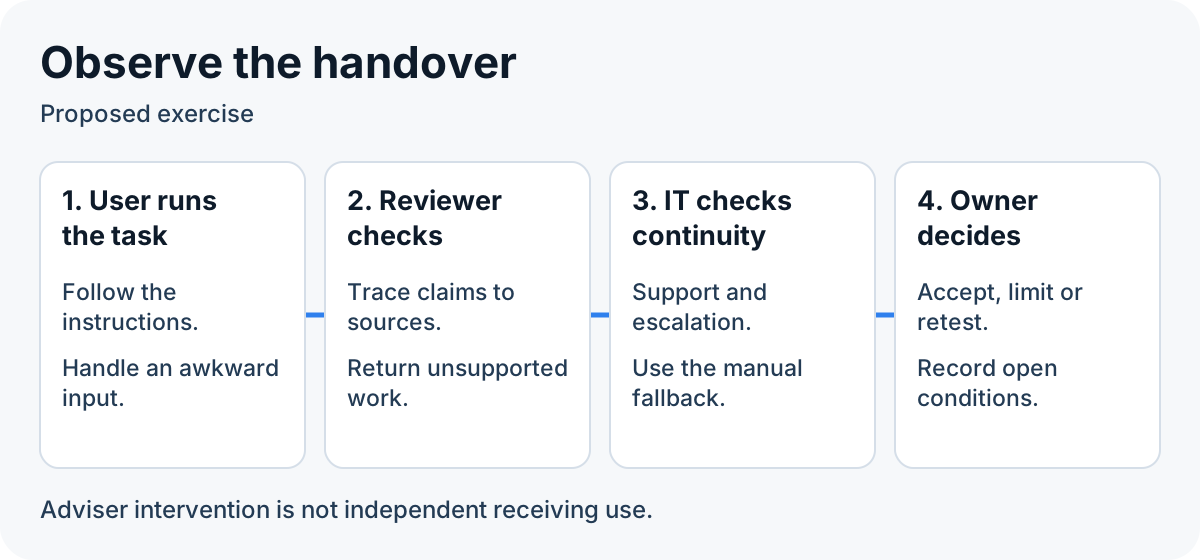
If access, a source set or tool behavior changes, assign who decides which checks need repeating.
Choose the contribution and agree the adoption scope
Before appointing anyone, complete one short agreement with your process owner, reviewer and IT owner: the adoption gap, the adviser's personal contribution, the implementer, evidence of usable operation, handover responsibilities and the decision after the pilot. Name who can accept and who can stop the process.
Choose internal ownership, current-vendor help or an external adviser according to that gap. Do not replace a working team arrangement with an open-ended AI program.
To explore the relevant next conversation for your adoption question, talk with the Grand Rounds curator. It is not a booking for implementation, a promise of CTO availability or a commitment to later work; any later work needs its own agreement.
Boundaries
Grand Rounds is an initiative of Dinarys, and a conversation may lead to cooperation with Dinarys.