Our network includes CTOs, engineering leaders,
and technical advisers with experience at and around companies such as:
Which operation is backing up?
Service intake and booking are backing up with incomplete requests. Or new field-service contracts mean more retyping, rescheduling and late work confirmations. Which handoff needs to change?
Intake queues behind operators
Rising inbound volume creates a queue while operators chase required details.
A transcript is not a booking
A transcript alone leaves the operational task unfinished.
Dispatchers chase work packs
New contracts or geography increase dispatcher work: incomplete work packs, manual rescheduling and chasing proof.
Scheduled is not completed
A scheduled visit and an uploaded report are earlier states than accepted completion evidence.
Choose the lane
Choose the lane first, then compare a process fix with tools and integration.
01
Service intake and booking
Start with one service line, language/channel, CRM or booking destination and receiving team. Done means a correct, verified request or booking with an acknowledged destination state—or a handoff accepted by the responsible person. Count a handoff separately from a booking.
02
Field-service coordination
Start with one job type, region and dispatch team. Check current tools, including any field service management (FSM) system, before proposing a replacement. Done means the job's required completion evidence has been accepted by the authorized reviewer. Finance/ERP then checks its own invoice-readiness prerequisites; readiness is distinct from issuing an invoice or receiving payment.
Choose the smallest adequate change
A routine fix stays with the current owner or vendor. CTO judgment becomes useful for unresolved cross-system choices, unusual rules or technical accountability.
01
Better form, process or human support
Choose it first when clearer fields or operator handoffs can remove the queue. The service/operations owner decides; current staff or vendor changes the process.
02
Configure the current intake platform or FSM
Choose it first when supported capabilities appear sufficient; demonstrate the configured path. Operations and IT accept coverage; the current team or vendor configures.
03
Deterministic integration
Choose it first when structured data and agreed rules exist, but re-entry or state transfer fails. Operations owns rules; IT accepts interfaces; team or supplier implements.
04
Checked voice AI or language-model step
Choose it first when variable speech or documents create a specific preparation gap. Operations and IT evaluate with data reviewers; team or supplier configures and tests.
05
Adopt a ready-made platform
Choose it first when the present setup has a demonstrated gap a supported product may cover. Operations, IT and finance compare; the authorized sponsor approves; the selected supplier delivers.
06
Custom build
Choose it first when a material gap remains after testing process, configuration, integration and ready-made options. The sponsor approves the justified scope with operations and IT; the selected team builds and maintains.
What must stay with people?
Privacy, security, legal and safety reviewers retain the applicable decisions in their areas. The operational owner authorizes expansion only after reviewing the result.
1
Intake: service operations
Service Operations/COO owns service rules and acceptance. Intake staff and the receiving escalation owner handle requests outside those rules.
2
Intake: sponsor and IT
Growth/marketing can identify lost demand; the actual sponsor approves spend and change. IT owns integration decisions.
3
Field: operations and reviewers
Operations and domain reviewers own skills, service-level agreement (SLA) and safety constraints. The authorized completion reviewer accepts work evidence.
4
Field: finance, IT and investment
Finance/ERP owns invoice readiness. IT accepts technical transfers; the CEO, CFO or P&L owner approves investment.
What stays with people
Intake operations
Sponsor & IT
Field reviewers
Finance & investment
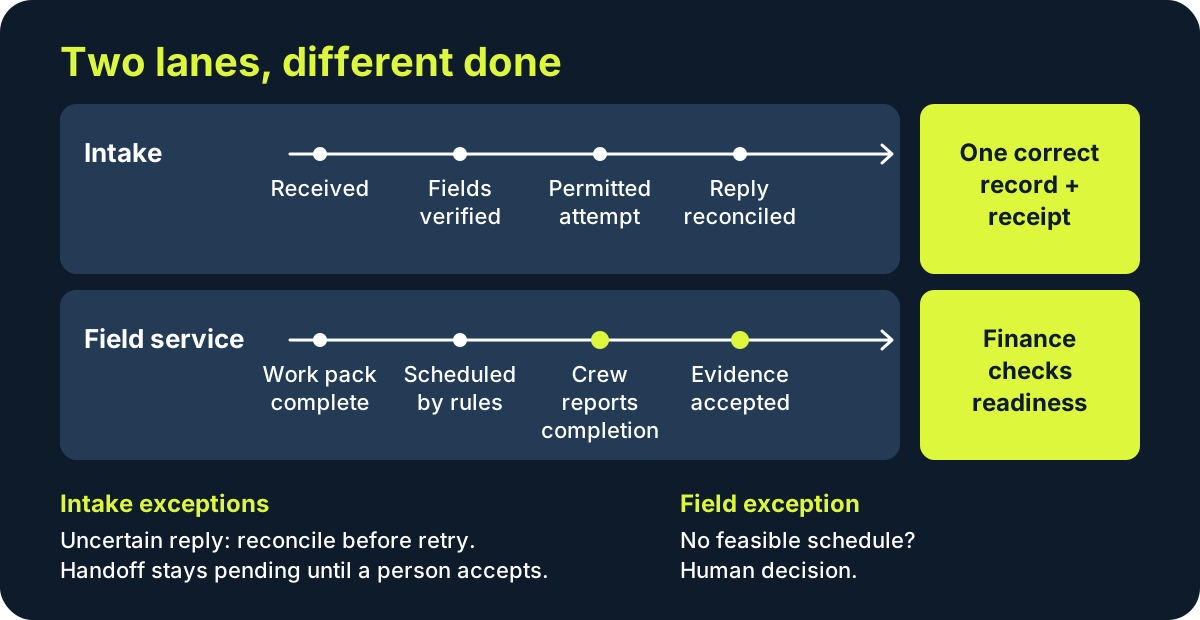
Two lanes, different accepted states
An uncertain booking reply requires reconciliation of the original action before retry; an unacknowledged handoff stays pending.
Dispatch resolves a lack of feasible assignments rather than asking a model to relax the rules.
Proposed checkpoints, not an autonomous workflow. Intake acknowledgment, accepted field completion and finance-owned readiness are different endpoints; pending cases remain visible.
Agree a trial before live actions
A later, separately agreed readiness review could produce a fit-gap assessment and proposed trial decision. The curator conversation checks the situation and possible fit; it supplies neither a completed evaluation nor authorization for live actions. Agree these items with the lane's owners.
01Boundary and baseline
One channel or job type, permitted examples and actions, accepted endpoint, waiting, corrections and full operating effort—including review and tool costs.
02Intake acceptance cases
Missing or corrected details, unavailable recipients, uncertain replies and duplicate attempts.
03Voice consent and retention
Declined or withdrawn recording consent, a permitted alternative path, an identified owner for retention rules and their implementation, and privacy/legal review.
04Field acceptance cases
Incomplete work packs, constraint conflicts, repeated uploads, rejected proof and ERP rejection. Keep completion acceptance and finance readiness separately observable.
05Control and stop authority
Monitor, manual fallback, maintenance owner and who may stop the trial or disable downstream actions.
06Permitted reconciliation and rollback
Defined before rollout; disabling automation cannot undo a completed visit or an existing booking—such states need the approved human correction or cancellation process.
Grand Rounds provides assessment and, where agreed, technical leadership; your team or selected supplier implements and operates the workflow. A proposed plan ends with a decision about the next evaluation. Only observed, reviewed evidence can support acceptance and a separately authorized expansion.
Related cases
Success stories and business challenges from our CTOs’ own work before Grand Rounds.
Name the lane, where work waits, the affected systems and who can accept a changed process. Share nonconfidential context first; permitted examples and access belong in a separately agreed scope.
We work best with founders who believe in what they are building
Every founder brings a different challenge. What stays the same is how we approach it.
David CarrollFounder of EuryanDavid came to Grand Rounds with two open questions he wanted pressure-tested before taking them to investors: how Euryan should handle LLM and cloud strategy across different client environments, and whether the core product wedge, dynamic FMEA/8D automation, was the right foundation to build the rest of the roadmap on.
Susie WilliamsFounder of LinkEDtohomeSusie came to Grand Rounds with two questions she wanted pressure-tested before LinkEDtohome moved beyond its first school: how to scale the team and technology without building too far ahead of real demand, and what needed to be in place around AI liability, training and governance before broader adoption.
Alexander GorrieFounderAlex came to CTO Grand Rounds with several important technical decisions already being actively worked through. One question from the panel reframed the discussion: “How will you know that the result is actually good?” It sharpened the conversation around how those decisions should be sequenced and prioritised.
Tomas JankauskasFounder of Neural DEEPTomas came to Grand Rounds with a question he'd been wrestling with while bringing AI-driven innovation into Toyota: which ideas to pursue, and how much to build before anything was approved, in an organisation where every new idea needs to pass through many hands.
Dr. Lars ZimmermannFounder of Ahead Care GmbHLars came to Grand Rounds looking for an experienced second opinion on the hardware challenges facing MOIO, Ahead Care's wearable care technology. He wanted to explore practical options for the product's development and gain a fresh perspective from someone who had navigated similar challenges in medical wearables.
1 / 5
Products with a purpose
Technology that delivers a real outcome for people, not technology for its own sake.
Energy and enthusiasm
Founders and teams with the passion and drive to address a problem they have seen for themselves.
The story before the numbers
The first question is what you are trying to do and why: what you saw and why you started.
Listening more than talking
Nobody walks in to say “I know better.” We ask what drives a decision and what has not been considered, then work through the options together.
Understanding before fixing
First the people, the business and the why, and what has and has not worked, so the first problem found does not start constant firefighting.
Experience, not just knowledge
Modern and AI tools assist. Architecture, security, recovery and user experience still need people who have built and run real systems.
Test CTO fit by lane
Experience in one lane does not establish fit for the other.
Ask by lane:
Intake: ask which dialogue, field-validation and booking-state decisions the expert personally owned. Request a permitted walkthrough of a correction, uncertain reply and accepted human handoff.
Field service: ask which FSM/API architecture and work-order or completion-handoff decisions the expert personally owned. Who set the operational constraints and accepted the result? What did another team implement?
The CTO profiles below are a starting point; the curator must check specific contribution, domain fit, conflicts and availability. Field-service matching remains to be verified for your workflow.
40+ yearsof experience
Andrew Frith
Fractional CTO/CIO — Health & Care, Government, Commercial | ex-NHS, ex-InHealth
With a career spanning founding and co-founding technology businesses, consultancy, interim executive, and non-executive board roles across the NHS, government, charity, and commercial sectors, Andrew has spent close to four decades helping organisations use information and technology to drive meaningful change.
Brisbane, AustraliaUK & AustraliaDigital transformationHealth & care sectorBoard advisory (NED/Interim)
Fractional CTO & Board Adviser — Applied AI, WealthTech and High-Performance Teams in Regulated Markets
Neil Taggart has spent his career leading technology and product functions across financial services, wealth management and, more recently, applied AI. His experience includes two CTO roles in regulated financial markets, nearly nine years leading technology for a global strategy-execution consultancy through its acquisition by a Fortune 1000 firm, and building the technology function for a Family Office wealth management business, alongside hands-on AI coaching and product work with Tribe AI and Anthropic.
London, UKApplied AI & enterprise adoptionWealthTech & family office technologyHigh-performance team coaching
Fractional CTO/CIO & Board Adviser — Enterprise Modernization, Security & Compliance and Large-Scale Operations in Regulated Industries
Amer Murad has spent 27+ years leading technology, product and operations functions across healthcare, human capital management, education, telecom and banking. His experience includes CTO and CIO roles spanning organizations from a 300-person SaaS communications platform to a 10,000-employee not-for-profit healthcare provider, 16 years at Ceridian leading product development, technology innovation and DevOps for global HCM and payroll platforms, and building a compliance and governance function from scratch for a 45-year-old software company through its growth by acquisition. He is TOGAF 9 certified in enterprise architecture.
Hamilton, Ontario, CanadaEnterprise technology & data modernizationSecurity, risk & compliance (SOC 2, GDPR, HIPAA)Large-scale program & operations leadership
Gabriel began his career as a technical systems analyst and test engineer in the Israeli Air Force, reaching the rank of Major and taking part in several satellite launches, before leading system engineering and testing on large multidisciplinary programmes at Israel Aerospace Industries. He went on to senior system engineering and technical product roles at Orbotech and OSR Enterprises, then moved into regulated medical devices in Sydney as Technology Development Lead at Nanosonics and Principal Engineer for robotics and automation across Cochlear's global manufacturing operations.
Sydney, AustraliaScale-ups, pivots & health servicesMedical devices, AI, robotics, aerospaceSingle-owner projects to 400-person global teams
Neil began his career writing code for the nuclear industry and has since held CTO, Chief Architect, and Director roles at BT, Wipro, Fujitsu, Sopra Steria, and Capita - including a strategic Google (GCP) partnership at BT, the architecture of a country-wide health service in India at Wipro, and a five-year strategic roadmap for UK Government Home Affairs at Fujitsu.
Fractional CTO — technology strategy, delivery recovery and engineering leadership
Jerome MacGillivray has spent more than twenty-five years leading global technology teams and delivering digital platforms across regulated, customer-facing and operationally complex environments. His experience spans fintech, retail, travel, cybersecurity, robotics and AI, with roles covering CTO leadership, engineering scale-up, vendor management, platform delivery and technical recovery. He works with founders, boards and leadership teams to make technology decisions clearer, delivery more predictable, and engineering more closely aligned with business priorities.
Gloucester, UKPlatform recoveryProduct and engineering strategyVendor and technical due diligence
Applied AI Adviser — Oxford DPhil, ex-J.P. Morgan, UBS, Citi
Berkan has worked on AI in high-stakes settings since 2009, starting with an Oxford DPhil in AI and Medical Informatics, where he built clinical decision support systems that predicted patient outcomes and recommended treatment, published in leading medical and interdisciplinary journals. He has published on AI continuously since, most recently on the evaluation of retrieval-augmented LLMs in clinical use, and writes for industry on AI transformation and clinical AI.
Fractional CTO — Precision Biology, Drug Discovery & Translational Science in Regulated Industries
Elad Katz has spent over two decades working at the intersection of deep biological science and commercial reality, leading translational research and venture creation across oncology, kidney, liver, cardiac, bone and women's health. His experience spans founding and leading Navigate Precision Biology, where he built the NaviPlate organoid platform from academic concept through customer discovery to commercial validation, alongside senior scientific and R&D leadership roles at Sartorius Stedim BioOutsource, amsbio, and the Universities of Edinburgh, Manchester and Pennsylvania. He holds a PhD in Immunology from the University of Glasgow and a BSc in Chemistry and Physics from the Hebrew University of Jerusalem.
Greater Dundee Area, UKPrecision medicine & drug discoveryOrganoid biology, disease modelling & assay developmentCommercial translation for biotech & pharma
Carlos spent 14 years inside TransUnion, moving from software developer to DevOps engineer to Product Owner, learning exactly how large financial institutions think, what slows them down, and where the cracks are. Then he left to help founders build things faster than those institutions ever could.
CanadaAI agentsFintech & creditEarly-stage MVPsFull-stack architectureStartup to enterprise
Fractional CTO & AI Engineer — AI for High-Compliance B2B SaaS
Márton began his career in research, completing a PhD in computer systems and networking at the Budapest University of Technology and Economics, with a research internship at Deutsche Telekom's T-Labs in Berlin, followed by four years as a postdoctoral research fellow at the Hungarian Academy of Sciences, where he published peer-reviewed research in neuroscience and distributed systems. He moved to Berlin to join KILT Protocol as Research Lead, Product Owner and Full Stack Developer, designing its self-sovereign digital identity protocol and token economics, authoring its white paper, and leading delivery from research through to mainnet, including a Deloitte-partnered KYC integration.
Ryan is an electrical and electronic engineer who began his career as a semiconductor market analyst at IMS Research, later IHS, where over a decade he built one of the industry’s leading wireless-power research practices and led international analyst teams to around 64% year-on-year revenue growth. He has worked with Aircharge for eleven years, progressing from commercial development to CTO and Managing Director, and now serves on its board as a Non-Executive Director. There he helped lead the evolution of a wireless-charging hardware business into an international physical-digital platform spanning hardware, SaaS, IoT and data, deployed across 4,500+ venues in 45+ countries with major global hospitality, QSR and technology brands.
London Area, United KingdomFounders, CEOs & leadership teamsConnected hardware, IoT, SaaS/data & AI-enabled productsProduct launch to international scale
Reon began his career as an electronic engineer at TEGEMA, a high-tech engineering company in the Eindhoven Brainport region, designing electronics and electrical systems for machines and products in semiconductor, life science and automotive markets, including his first medical products.
Fractional CTO — Scientific Computing, AI & Data for Life Sciences
Arno is a mathematician who has spent more than 25 years building software that applies algorithms and machine learning to life science questions, long before “AI” became the word for it. He joined Definiens as a software developer in 1998 and spent over two decades there, progressing through Director of Platform Development, Chief Architect, VP Product Development and VP & Chief Architect to VP Product & Innovation at Definiens, The Tissue Phenomics Company. Along the way he took the company’s image analysis technology from an early prototype to its core product, was responsible for that product for many years, and later brought up and matured new products and technologies in digital and computational pathology. Since 2020 he has been CTO of Noselab, a Munich biotech company, where he built the entire digital side of the business, from software and IT to data, along with the team behind it, working hands-on throughout. He is a named inventor on multiple patents in image analysis, has co-authored publications on tissue phenomics and cancer research, and serves as a panel CTO with CTO Grand Rounds. He holds a Diplom in Mathematics from Ludwig-Maximilians-Universität München.
Munich Area, GermanyBiotech, pharma & digital pathologyFrom research to productEarly prototype to early scaling
Rodion is a product strategist and the founder of Curiosity Office™, his practice for product vision and strategy. Over fifteen years he has shipped products and advised founders, banks and government offices. He comes in, sees what the team can no longer see, and leaves behind a product that looks like it was always meant to exist.
I've spent 12 years building partnerships between founders, technical teams, and the people
who fund them. Somewhere along the way I noticed the same pattern over and over:
brilliant fractional CTOs, and founders who had no idea they existed, let alone how
to reach them.
Grand Rounds is my answer to that gap. The name comes from medicine, when a case is hard,
doctors don't decide alone, they bring senior specialists around the table together.
I built the same thing for technology.
"People need people. Nothing else works."
I'm the one who listens to your problem, asks the questions you didn't think to ask
yourself, and explores which experience in the network is relevant to it.
Jane has been working across the industry since 2014, connecting
startups, retailers, B2B companies, manufacturers, and expert teams around meaningful
partnership opportunities.
Her experience includes building bridges between companies and ecosystems, ready-made
technology solutions, manufacturing-focused initiatives, and sustainability-driven
projects. Over the years, she has helped create practical collaboration models between
businesses, technology providers, and industry experts.
For Jane, partnership strategy is not just part of the work - it is the DNA of her
professional experience. Her focus is on identifying where teams, platforms, products,
and industries can strengthen each other and turning those connections into real
opportunities.
What founders say after their Grand Rounds session
It's like a hackathon for your real business problems. You bring your
challenges and bright minds work on them - with no obligation, no pressure. I walked away
with perspectives on investors, encryption solutions, and a connection that could directly
benefit my product. Honestly, why rely on one mind, when you can have many?
Saif AlamCEO at Keepsta
It was an incredibly welcoming space to connect with senior technical minds
I wouldn't normally have access to as a non-technical founder. A fantastic opportunity to get
real, honest answers to the challenges I was facing - and to walk away with meaningful
connections who continue to support me.
Audrey LeeFounder of Lumi
CTO Grand Rounds was the best event by far. This is where the founder world
and the tech world actually merge, with real introductions instead of leaving people to stay
siloed. I was deep in a conversation about cybersecurity and feedback loops - practical
advice I could act on immediately.
Hélène Le RouxCEO at Trippin'
What I valued most was the mix of CTO styles at the table - some all-in on
AI, others more measured. As a founder, you don't want someone else's answer, you want enough
perspectives to make your own call. I walked away with two strong contacts - people who hit
the mark on build support, strategic fit, and investor credibility. The relaxed format made
room for real technical conversation, not just quick decisions. Worth coming back for.
We use Google Analytics cookies to see how visitors use this site. They are set only if you accept, and you can change your mind with Cookie settings at the foot of every page.