
Your clinician copies the AI draft into the EHR by hand. Has the product failed to fit? Manual transfer can be a sound route. The more useful question is where one documentation action becomes hard, and what evidence would show it.
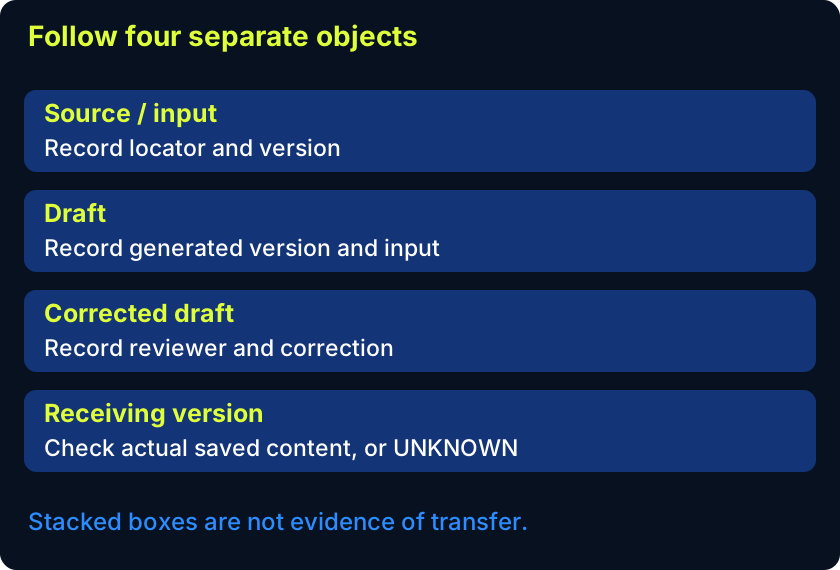
If you build clinical AI documentation, whether an AI scribe, a note generator or a summary tool, start with one action: one draft, its correction and its saved version in the receiving note. Trace the source, the draft, the corrected draft and the receiving version separately, then decide whether the fix is a model change, a connector, a workflow change or no change.
A source-to-draft change points to capture, input handling or generation; a corrected-draft-to-saved-note change points to export, the interface or EHR-side handling. These are investigation hypotheses, not established causes.
Next step: bring the map to your clinical partner: agree the action, permitted material and who can check the saved version. To discuss a technical second opinion, talk with the Grand Rounds curator.
Where does one documentation action stop fitting?
Choose one documentation action and destination with the clinical partner. Record the source, draft, correction and saved receiving version. Observe where extra work arises through permitted evidence, then identify the owner who can clarify that boundary.
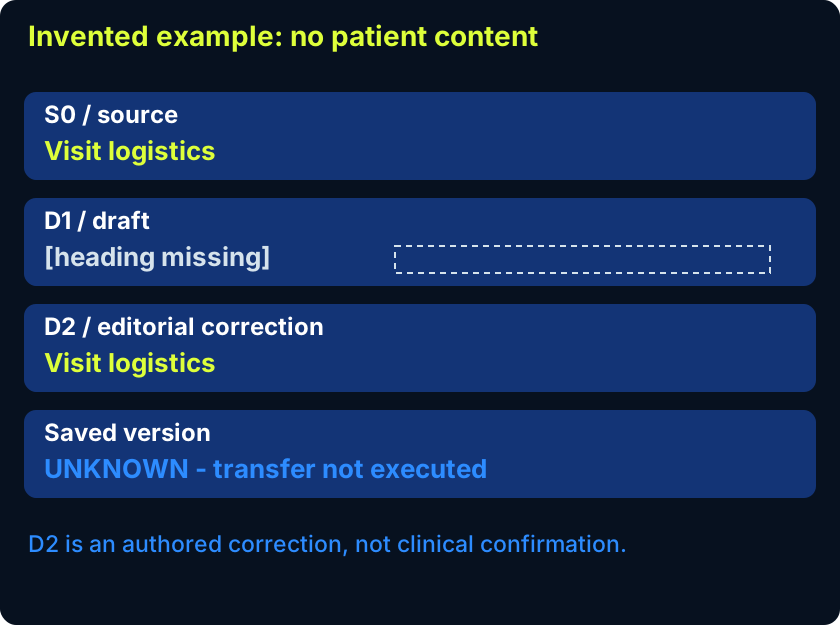
| Step | Version | Evidence status | Owner / open question |
|---|---|---|---|
| Define input | S0: “Visit logistics” present | Invented source | Partner confirms permitted source and authority |
| Produce draft | D1: heading missing | Authored omission; interface unobserved | Compare source and draft |
| Correct draft | D2: heading restored | Editorial correction; qualified review pending | Identify reviewer and version |
| Save | D2 proposed; saved version UNKNOWN | Not executed; destination unobserved | Identify receiving owner and evidence |
Model omission or handoff problem?
Compare source to draft, draft to correction, and correction to saved result. A source-to-draft change points to capture, input handling or generation: dropped audio or truncated input can precede generation. A corrected-draft-to-saved-note change points to export, interface, a person editing in the EHR or the EHR itself. Check which before blaming a connector. This is a diagnostic starting point, not a validated method; a manual route remains a valid comparator.
What is unknown, and who can clarify it?
Name the clinical owner for intended use and saved-content checking, the interface owner for operation/access/destination and the product owner for the decision. Keep each unknown with its next permitted observation rather than presupposing a model or integration change.
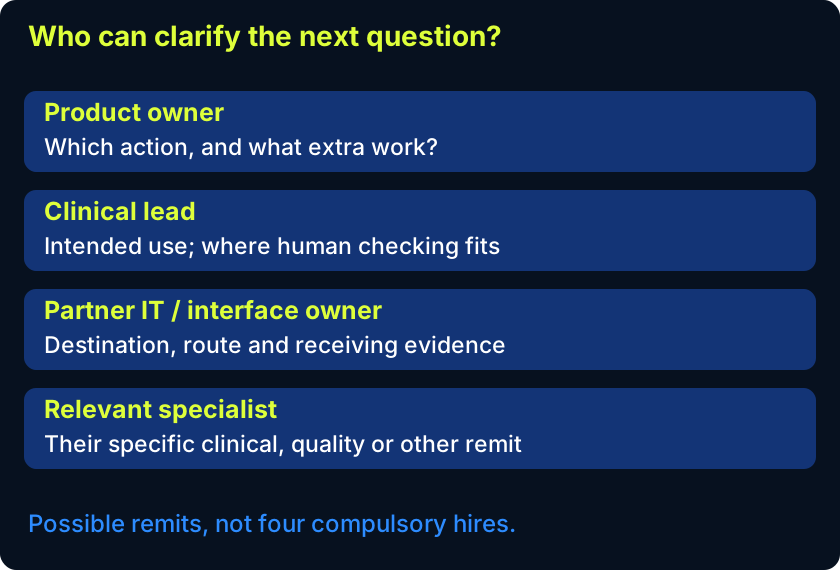
The chosen action, current route, partner owners and permitted observations determine what a technical discussion can resolve. Any subsequent work needs its own agreed scope.
Boundaries
This article describes a technical evidence map for one documentation action. It works with permitted observations and records agreed with your clinical partner; the example headings here are invented. Clinical suitability and the check of saved content belong to your clinical owner, and questions about regulation, quality or security belong to the relevant specialists. A manual route or an existing EHR vendor connector can be the right answer; a model or integration change is warranted only when the evidence points there. A CTO in the Grand Rounds network can help scope the question and the acceptance criteria. Delivery sits with your team or the supplier you choose.
Grand Rounds is an initiative of Dinarys, and a conversation may lead to cooperation with Dinarys.
Compare next-stage EHR integration routes and receiving evidence. For later selection, see choosing a CTO for a clinical AI pilot.