
A clinical AI pilot needs a technical lead who has personally owned the kind of work it depends on: the interface, the data route or the regulated-product decision. General "healthcare AI" experience tells you little about that.
A CTO's technical contribution alone does not make a pilot “compliant.” A CTO can own and evidence technical decisions; authorized clinical, privacy and quality/regulatory owners decide their respective matters.
Before you choose, ask three things. What did this person personally design, build or decide? Which operation, version and installation does that map to, and what is still unknown? Who accepts the clinical, IT/security and quality/regulatory decisions that sit outside the CTO's remit?
To discuss relevant experience in the Grand Rounds CTO network, bring your pilot and the decision you need help with to the Grand Rounds curator.
Relevant experience and the operation to verify
As stated in Gabriel Wainmann's profile, his work includes a clinical-documentation program designed to be air-gapped and gated on clinician acceptance, and an edge clinical-handover system with de-identification and FHIR export. As stated in Berkan Sesen's profile, his work includes evaluation of retrieval-augmented language models in clinical use.
The first describes design and engineering contexts, not evidence that the proposed clinical-documentation program was deployed; the second describes evaluation experience. Access to your partner's installation requires its own agreement. Ask what each person designed, built or decided, for which operation and environment, and what the clinical and IT owners accepted. Fit for your pilot is something to discuss with the curator.
Do you need another CTO, or a narrower contribution?
A supported vendor configuration may cover an interface; a narrow specialist may cover one component or qualified review. Use the existing lead where authority and capacity fit. A CTO contribution addresses the cross-team technical decision still open.
Has the candidate done the operation you need—not just used the EHR name?
Ask for the exact personally owned operation: reading, document transfer or structured write. Confirm the version, installation, access type, destination and permitted corroboration. A product name is context; deployed behavior needs its own evidence.
The HL7 FHIR R4 CapabilityStatement distinguishes a deployed implementation (instance), generic software capability and desired requirements. “Supports FHIR” needs the installation behind it.
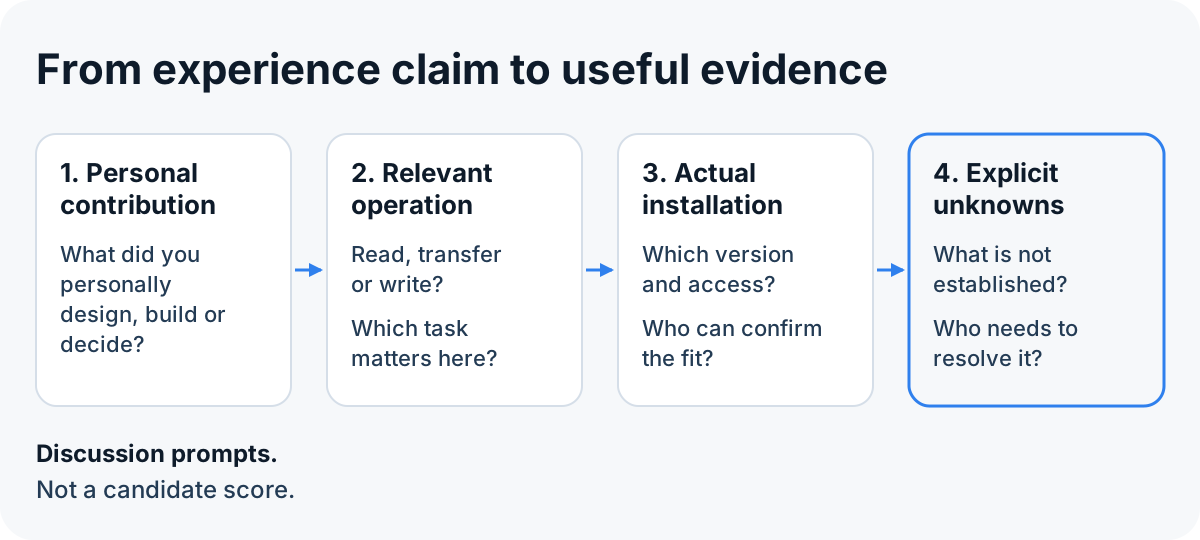
Can the candidate explain what “accepted” means without saying “compliant”?
Turn an acceptance claim into its scope, version, setting, evidence and authorized owner. Record the technical conclusion separately from clinical, institutional, privacy/security and quality/regulatory decisions.
Invented example. A candidate says, “Our pilot is HIPAA-ready.” Ask which product version and setting that covers, which access-control, audit-log or data-flow decisions were theirs, what permitted evidence exists, who accepted it and what remains undecided. A usable answer names those limits rather than declaring the pilot compliant. Whether HIPAA applies and is met belongs to the privacy or legal owner.
Warning signs: an EHR name without an operation/version/installation; “compliant” without a setting, evidence and authorized owner; a technical receipt presented as clinical or regulatory acceptance; or no distinction between personal and team decisions. These prompts guide further verification, not an automatic selection score.
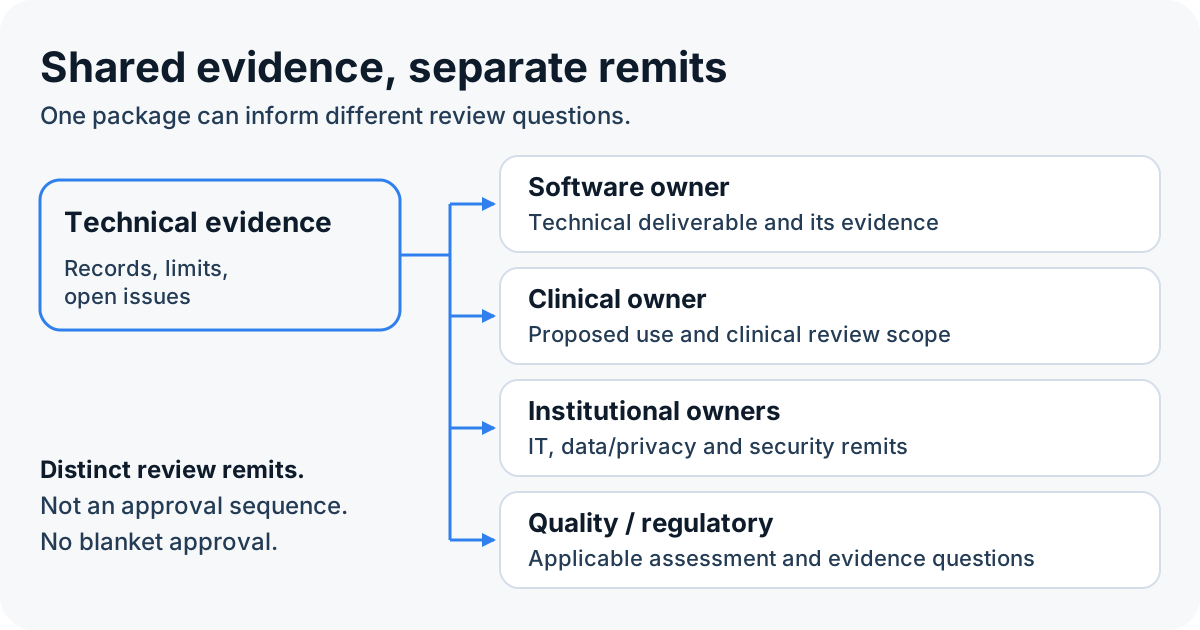
Who owns software, clinical, IT and quality/regulatory acceptance?
Use the matrix to agree local responsibilities. The CTO coordinates technical evidence; engineering/vendor implements; clinical, IT and quality/regulatory owners decide their own conditions. Each accepting decision has a name, date and open items.
| Area | Question to resolve before agreeing the contribution | Record to identify |
|---|---|---|
| Software decisions | Which technical decisions would the CTO own, and which remain with your existing lead? | The bounded decision, its assumptions and the person accepting the technical deliverable. |
| Implementation | Who will build, configure and support the work—the existing team, vendor or another separately agreed provider? | Named delivery owner, dependencies and handover recipient. |
| Clinical use and intended-use constraints | Which designated qualified clinical owner reviews the proposed use, and who supplies the manufacturer's agreed intended-use constraints? | Relevant review scope, unresolved conditions and decisions still needed from authorized owners. |
| Partner IT, data and security | Which institutional IT, information-governance/privacy and security owners review their respective parts? | Their applicable requirements, evidence requests and acceptance boundaries—not a CTO's blanket assurance. |
| Quality/regulatory | Who has the qualified remit to assess applicability and supporting evidence in this setting? | Responsible function, scope of assessment and outstanding decisions. Record those specialist decisions separately. |
What to bring to the curator
Bring the operation, enabled interface information, permitted evidence, accepting owners and missing decision. State what your team must control after handover: versions, configuration, monitoring, review, stop/recovery and the open-issue register. Keep restricted records behind an agreed access arrangement.
Boundaries
This guide supports selecting a CTO and agreeing a technical remit. Clinical suitability, medical-device status, legal compliance and security controls for your product are decided by the qualified owners at your organization and your clinical partner. The matrix above is a starting point for that conversation, not an allocation of legal duties.
Grand Rounds is an initiative of Dinarys, and a conversation may lead to cooperation with Dinarys.
If still comparing routes before choosing a CTO, start with clinical AI integration routes.