
Choose the CTO whose proposed contribution you can state in one sentence, whose relevant personal work you can distinguish from team implementation, and whose limits you can explain to the next owner. Keep three decisions separate: reviewing evidence, accepting technical work and authorizing financial use. Your existing technical lead, vendor, ready-made tools or manual process may still be the right option.
For a financial or professional-service operations owner, the goal is more casework capacity without proportionally increasing expert review hours. If you have no prior evaluation, start with Financial Casework Cannot Scale on AI Answers Nobody Can Verify and bring one permitted case to the first conversation. To compare approaches before choosing a CTO, see Designing Financial AI Casework With Evidence and Expert Sign-Off.
Which experience matches the financial work—not just the sector?
A banking background can be relevant without answering your particular question. Building a trading model, integrating a finance platform and leading source-grounded document review are different work. Ask how the candidate's experience relates to the point where your workflow needs judgment: locating evidence, handling changed sources, supporting a reviewer or passing unresolved questions to another owner.
Bring one finding from your prior evaluation, if available. For example: “We could trace the answer to a report, but had not established whether it was the relevant version.” Ask the candidate to discuss comparable work: the decision they were responsible for, the evidence they could inspect, the limitation they encountered and the people who handled the financial judgment. Separate their contribution from the team's implementation. Request only material they are permitted to share; a confidential client file is not a prerequisite.
Then ask which part of your problem falls outside that experience. A clear limit may point to a narrower advisory contribution, work for your current provider or a separate domain specialist. It does not automatically justify another engagement. Keep an unsupported experience claim unresolved rather than filling the gap with an employer name or technology list.
Separate three decisions before assigning a CTO remit
Reviewing evidence, accepting technical work and authorizing financial use are different decisions. Finding the cited passage does not settle its financial interpretation. Accepting a technical recommendation does not authorize use of an AI-assisted conclusion.
Start with the contribution being considered: advice on existing findings, leadership of technical decisions or separately scoped implementation. Rational Partners' fintech service page distinguishes advisory, investor-side technology audit and embedded leadership services. This illustrates why a CTO label alone leaves the work ambiguous.
There is a useful contextual warning in the UK Financial Conduct Authority's October 2026 observations on AI in financial services, §3.4: effective oversight means people have the right authority, information, capability and escalation routes to challenge or intervene. These are illustrative, non-exhaustive observations in a UK regulated-firm context, not new requirements or universal duties for every financial workflow.
For your discussion, ask what the proposed reviewer would actually be able to inspect and challenge. A role entered in a table does not establish that the person is competent, available or has agreed to it.
Compare candidates on one changed-source case
Use the same bounded case and existing findings for each candidate, rather than commissioning a fresh diagnosis by default. Revisit an uncertainty only when it changes the work being considered. A permission question may need an answer from the data owner, not another model demonstration.
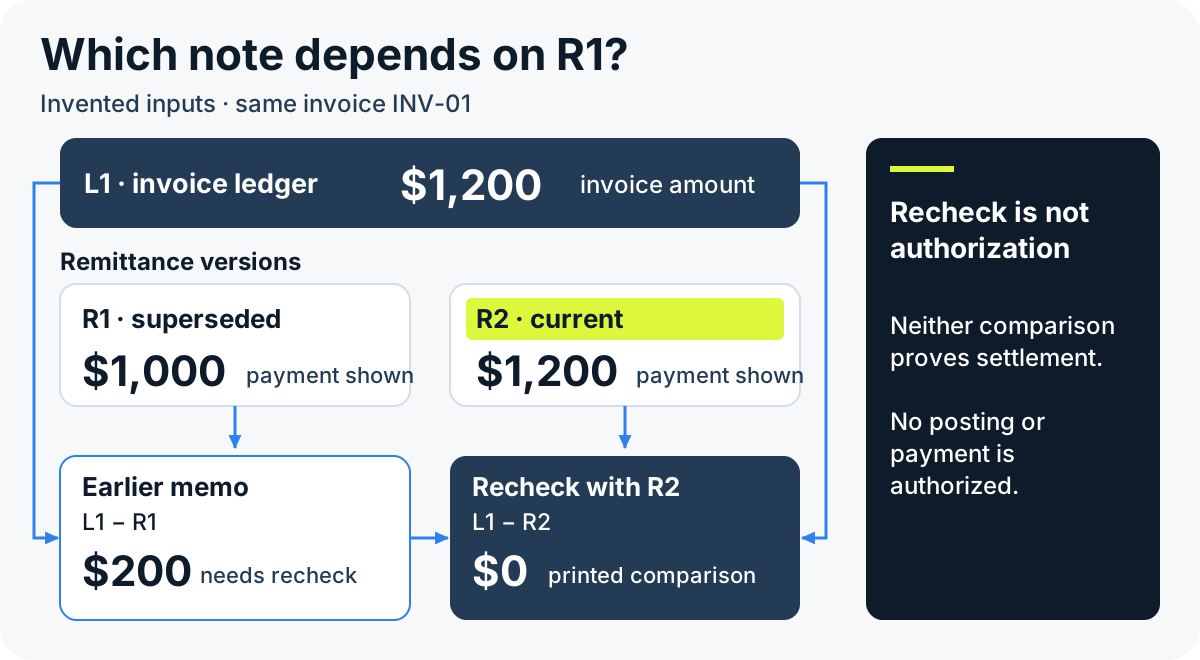
Discussion illustration only—all inputs, roles and answers below are invented. The printed packet concerns one fictional invoice and an internal month-end receivables-comparison note. It is not a client case, a tool run or a completed financial review. Nothing in the exercise authorizes an accounting entry, payment or external action.
| Synthetic input | Version and row | Printed value |
|---|---|---|
| Invoice ledger | L1, invoice INV-01 | Invoice amount: $1,200 |
| Earlier remittance report | R1, INV-01; explicitly superseded by R2 | Payment shown: $1,000 |
| Current remittance report | R2, INV-01; the mock brief labels R2 current for this comparison | Payment shown: $1,200 |
An invented candidate memo says “$200 difference” and cites R1. The arithmetic is $1,200 − $1,000 = $200 with R1, but $1,200 − $1,200 = $0 with R2. This establishes a dependency in the printed example, not whether money actually moved or an account is settled.
What does a strong answer sound like?
These contrasts are illustrative advice, not a validated candidate test. Naming a page or version is only a start: ask what the cited material supports. Then ask for permitted evidence of comparable personal work; fluent answers to a paper exercise do not verify experience.
1. Source support: “Which fragment supports the memo?”
- Strong: “The INV-01 row in L1 prints $1,200; the INV-01 row in R1 prints $1,000. They explain the memo's $200 arithmetic, but R1 is superseded in this brief. Neither row proves settlement.”
- Weak: “The model cited the remittance report; I've worked in banking.” A document citation and a sector credential leave both the specific support and the person's relevant contribution unexplained.
2. Source change: “What would you do with that memo after R2 arrives?”
- Strong: “Identify the comparison that depends on R1 and show the reviewer the R2 row for the same invoice. The printed comparison becomes $0. I would separately establish how the real system tracks affected notes; the data and process owners decide how to handle notes already shared or sources later removed or restricted.”
- Weak: “The index refreshes automatically, so all earlier answers are fixed.” That skips the affected memo and supplies no evidence about saved answers, permission changes or the candidate's own work.
3. Action boundary: “May the revised note now be posted to the case system?”
- Strong: “That is separate scope. A technical check of these rows is not financial acceptance or permission to post. Any later posting proposal needs a named authorizer, an action-attempt record and agreed recovery arrangements, including uncertain or repeated attempts.”
- Weak: “The reviewer approved the memo, so it can be sent; I'll handle the diagnosis, build and sign-off.” The exercise establishes no such approval. Bundling the work conceals who would judge the conclusion and who could authorize the action.
Counter-case: a newer report for a different invoice would not replace R1 for INV-01. A strong candidate checks identity, scope and source status together, rather than adopting “newest wins” as a rule.
Keep one selection record—not another evidence log
Use one shared note to compare proposed contributions and preserve what the receiving owner needs. Link to the existing evaluation instead of rebuilding its claim-by-claim evidence record. The filled column below belongs only to the invented case; it is neither a candidate score nor an acceptance test.
| Entry | What to retain | Filled illustration |
|---|---|---|
| Case and intended use | Case type, supported question and excluded uses. | INV-01 internal comparison note; no accounting entry, payment or external action. |
| Evidence reference and existing finding | Evaluation location, relevant source/version/fragment, finding and limits; supplied versus inspected. | Printed L1/R1/R2 rows above. The invented memo uses superseded R1 for $200; R2 gives a $0 comparison. No system behavior has been observed. |
| Proposed CTO contribution | Relevant personal-work evidence; advice, technical leadership or implementation; result and stopping point. | Proposed advice: map the memo's source dependency and specify the evidence needed to check source changes. Personal-work evidence remains to be requested; no build is included. |
| Permission context | Permitted users/use and the owner confirming them; questions for data, IT or security. | This discussion uses only the printed synthetic values. Access to any real case files would need separate confirmation from their data owner. |
| Review and authority | Who accepts technical work, who judges the financial conclusion and who authorizes the intended use; proposed versus agreed. | Mock proposal: technical lead assesses the dependency explanation; financial reviewer judges interpretation; process authorizer decides any later use. These are assigned functions in the illustration, not actual participants or approvals. |
| Receiving owner and implementation | Who receives the work, who implements changes and who commits reviewer time, resources and budget. | Mock operations lead receives the dependency note and open questions. Existing team is the proposed implementer only if a build is separately agreed; sponsor would confirm resources. |
| Open decision | The unresolved question, who can resolve it and the escalation route if that person is unavailable. | Existing technical lead to establish how supersession affects saved notes; data/process owners to settle handling of earlier copies. Sponsor to name an alternate contact before affected work is agreed. |
Keep status attached to the individual entry. Supplied is not inspected; proposed is not agreed; technical review is not domain review or authorization to use. An unknown is neither an observed failure nor evidence of success.
If work is later undertaken, ask what record would show the evidence considered, the review that actually happened and unresolved challenges. In the smaller-firms focus of §3.3 of the FCA's publication, one small firm emphasized the need to record whether staff needed to review AI outputs, whether that happened, and whether they approved, overrode or escalated them. This is a contextual UK illustration, not a mandatory audit-log specification for your organization.
For the selection decision, look for a proposal whose contribution and limits you can explain to the next owner. Where a material question remains, identify who can resolve it before agreeing the affected scope. Do not describe the record itself as a completed review or handover.
Take the unresolved question to the Grand Rounds curator
Prepare a non-confidential summary of the workflow, any prior evaluation, the contribution you are considering and open reviewer or receiving-owner questions. Keep financial files, credentials and confidential case details out of public forms.
Talk with the Grand Rounds curator about your financial-workflow challenge; the curator can help you explore whether a Grand Rounds session fits. This is a session-fit conversation, not an implementation mandate or a promise of a particular CTO's availability. Participation and any later engagement are agreed for the actual inquiry.
Boundaries
Grand Rounds is an initiative of Dinarys, and a conversation may lead to cooperation with Dinarys.