
Choose the approach that addresses the missing step in your financial document workflow: finding evidence, extracting fields, drafting from sources, routing review or connecting systems. Start with the existing process and add complexity only for a demonstrated gap.
To keep an output verifiable, retain the source and version, exact passage or cell, headers, period, unit, sign and qualifying notes. Check permissions before retrieval and identify the policy applicable to the case. Compare the full work through domain review, including corrections—not just drafting speed.
Match the approach to the job
These are starting points for evaluation, not validated selection rules. The approaches can work together; they are not successive levels of AI maturity.
| Approach | Consider it when… | Evidence and remaining work |
|---|---|---|
| Manual reading, search and rules | The gap is locating documents or flagging conditions that can be expressed as rules. | Retain source references, queries and rule versions. People still resolve context and missing or duplicate documents. |
| Ready-made extraction | The gap is turning permitted documents into fields and tables. | Retain source text and cell locations where supported. Check headers, periods, units and notes; maintain format/API compatibility. |
| Retrieval-grounded drafting (RAG) | The gap is finding fragments across documents and preparing source-linked text. | Retain retrieved fragments, identities and locators. Check claim support, permissions and versions; maintain the index. |
| Fixed workflow | Preparation, review and exceptions need routing through known steps. | Retain step history and review responses. People handle exceptions; integrations and restart behavior need testing. Routing alone supplies neither evidence nor a reviewer. |
| Custom integration | A specific unmet need remains after checking the existing tools and approaches above. | Retain mappings and traces. Assign ownership of code, dependencies and maintenance. Several documents alone do not justify custom work. |
An accurate April cell cannot answer a May question
In this wholly invented example, an operations lead requests a May document-review status note. Sheet S, v1, page 1, Queue row, April column contains 12 items, excluding reopened items. A supplied candidate sentence says “May: 12.” It is illustrative input, not an observed tool output.
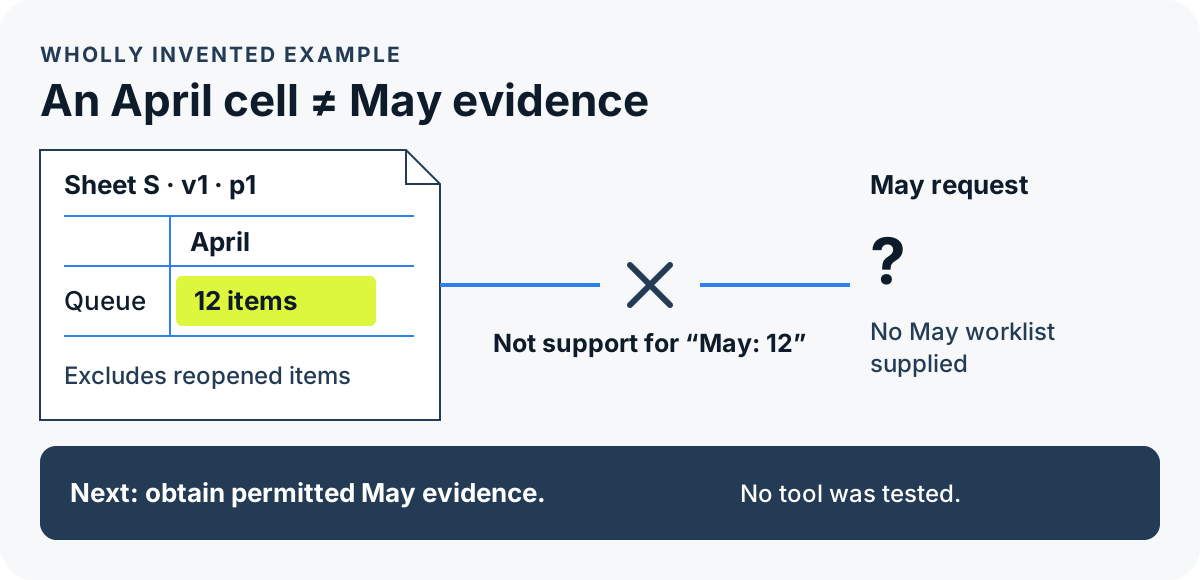
Extraction could preserve the April cell perfectly and still leave May unsupported. Retrieval could help locate a May worklist if one exists and is permitted. With only the supplied packet, none of the five approaches closes the gap. Conversely, one short, permitted May worklist might make manual reading sufficient. No approach has been tested here, and May’s actual count remains unestablished.
Check what extraction preserves around a cell. Azure Document Intelligence’s layout documentation says that for API version 2024-11-30 (GA), bounding regions for tables exclude associated captions and footnotes. A table region may therefore omit a qualifier the reviewer needs.
Take the shortlist through the same review
Use synthetic or explicitly permitted cases in an authorized evaluation environment. Give each candidate the same question, inputs and review standard. Include missing evidence, conflicting periods, changed policies and revoked access. Keep extraction, retrieval, interpretation and access errors separate. Record configuration differences and count preparation, checking, correction, review and exceptions; separate active effort from waiting.
For detailed source checks and review-time accounting, use the casework evidence record. Identify each alternative, configuration and attempt so observations from one are not attributed to another.
If the workflow changes a record or sends a message, also read Human-in-the-Loop AI Agents: Who Can Approve External Actions?. Review, authorization and execution are separate. LangGraph’s interrupt documentation gives a concrete resume caveat: interrupted nodes rerun, so earlier side effects can repeat. A pause/resume feature is not an exactly-once guarantee.
The comparison prepares evidence for a designated domain reviewer; it confers no financial or legal sign-off authority. For candidate questions, see Choosing a CTO for Financial AI Workflows. To discuss the technical contribution your casework needs, talk with the Grand Rounds curator. CTO design and leadership are separate from implementation by your team or chosen provider.
Boundaries
Grand Rounds is an initiative of Dinarys, and a conversation may lead to cooperation with Dinarys.