
A service request still waiting after the customer reached you can be stuck at missing details, verification, retyping or an unowned exception. A missed-call count cannot tell you which of these is yours.
This page is for the Service or Operations lead who owns a repeatable inbound journey. Choose one such journey, give each request a single journey ID, and record its state at a fixed cutoff. The map and invented example below help locate the first fix before adding a channel.
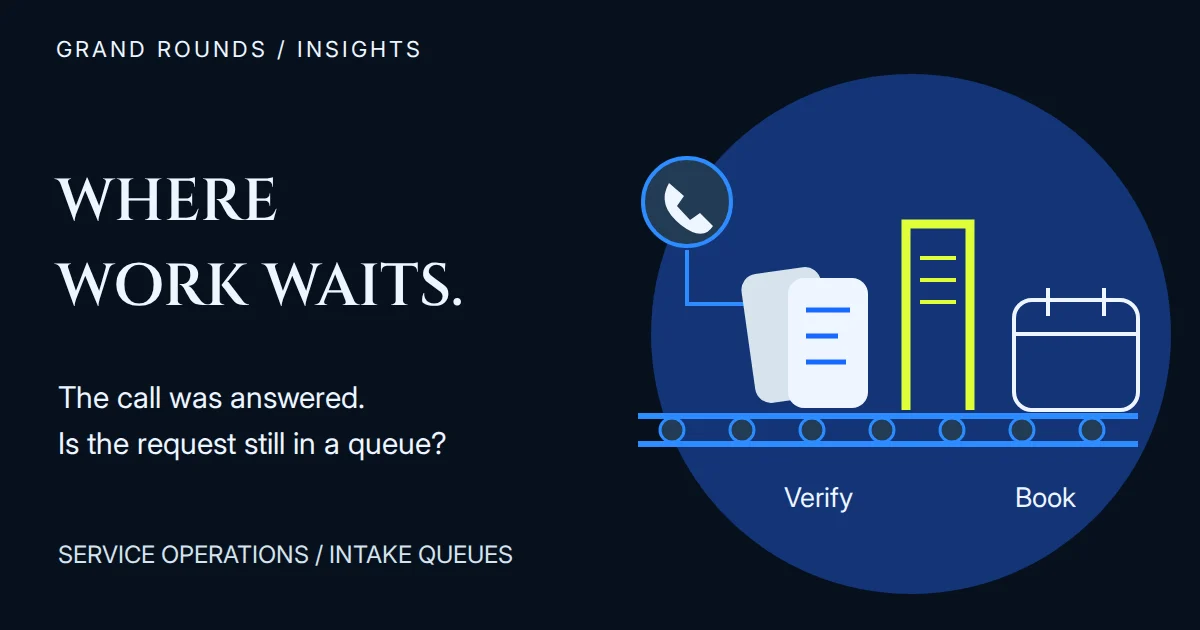
Define where this journey actually ends
Choose the journey’s start, the checks it requires and its accepted endpoint: a booking the customer has confirmed and the system record shows, or a human handoff that the receiving owner has acknowledged.
Where an intake queue forms
An intake queue contains arrived service requests still waiting for a confirmed booking or an accepted human handoff. From one bounded set of permitted records, count unique requests at a fixed cutoff and use four figures for a first read; the first snapshot is your baseline:
- Contacts per request. Count distinct journeys against total contacts. Check whether the gap is repeat attempts on the same request before treating it that way.
- State at the cutoff. List every request in exactly one of the eight states defined below. Keep "unknown" as its own line.
- Age of the oldest item in each waiting state (named below). This shows which queue is aging, whatever the call volume.
- Accepted handoffs. Of the requests sent to a person, how many has that person acknowledged and accepted?
Then locate the waits: in response, detail collection, verification, rekeying or exception ownership. Record repeat contacts against the same request and show unknown downstream states.
One simple loss estimate multiplies missed calls by a conversion rate and average job value, and each factor is hard to establish. A caller may try twice, then use the form; a missed call may be a wrong number. A request whose arrival time or current state cannot be established stays unknown. Map journeys before estimating loss.
Find the queue after the conversation
Report each request at the cutoff in exactly one of these eight states. The table gives what must be on record for each. Received, waiting for details, waiting for verification and waiting for booking are the waiting states. One rule separates received from unknown: a request with a timestamped arrival record and a known channel is "received" and is aged from that arrival, even if nothing later is found; "unknown" is for a request whose arrival time or current state cannot be established from permitted records.
| State at the cutoff | What must be on record | What could still be waiting |
|---|---|---|
| Received | Timestamped inbound contact or permitted request record, with a known channel | Response, callback, or identification of the service requested |
| Waiting for details | Request on record; a required field is missing | Location, contact detail, service type, or scheduling preference |
| Waiting for verification | Details collected, linked to the customer’s original input; required checks not yet complete | Service-rule question or an uncertain field needing human review |
| Waiting for booking | Details verified and corrections recorded; no confirmed booking yet | Slot, customer confirmation, or the write to the booking system |
| Booked | Customer confirmation plus a correct system record | No further intake work; later service delivery is a separate measure |
| Handoff accepted | Receiving owner acknowledges the request and next step | Resolution of the exception, not necessarily a booking |
| Closed | A confirmed closure reason on record | Nothing in intake |
| Unknown | Arrival time or current state cannot be established from permitted records | The record itself: find it first |
A request sent to a person but not yet acknowledged stays in its last waiting state, with the handoff noted under Ownership in the map below. Only the receiving owner’s acknowledgement moves it to "handoff accepted".
Create a request–verification–handoff map
Map each request ID through the channels and destination systems. Record the required verification, state, waiting age, accepting owner and next check. Use only permitted records.
| Map field | What to capture |
|---|---|
| Request identity | One journey ID; links to calls, forms, and CRM entries that concern that request |
| Arrival | First contact time, channel, service line, and repeat attempts |
| Required data | Fields needed for this journey; original input, checked value, and unknowns |
| Verification | Checks required, completion time, correction, and evidence reference |
| Current state | One of the eight states in the table above |
| Re-entry | Whether the same details were typed into a second system, and when each entry was made |
| Ownership | Current responsible person/queue, next action, and acknowledgement status |
| End state | Correct booking reference, accepted exception reference, unresolved status, or confirmed closure reason |
Worked example: eight contacts, six requests
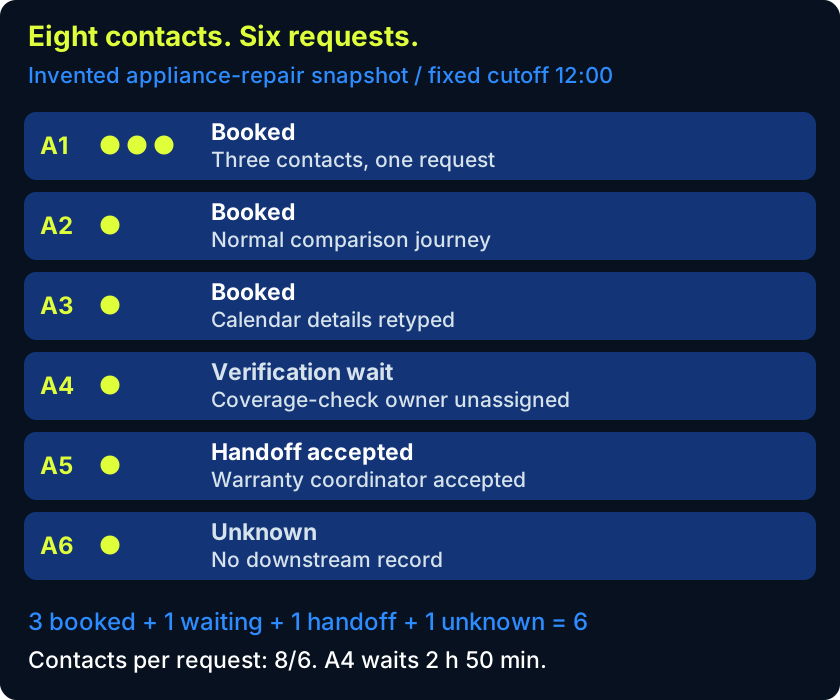
Invented example: a fictional company and fictional data. A small company repairs washing machines and dryers at customer homes. An operations manager reviews one morning's intake at the 12:00 cutoff. Eight contacts concern six requests.
| Request | Contacts | State at 12:00 | Evidence / waiting age |
|---|---|---|---|
| A1 | Two missed calls, then a form | Booked | Three contacts matched to one request |
| A2 | One call | Booked | Normal comparison journey |
| A3 | One form | Booked | Access details retyped into the calendar; re-entry recorded |
| A4 | One answered call | Waiting for verification | Coverage-check owner unassigned; received 09:10, waiting 2 h 50 min |
| A5 | One call | Handoff accepted | Named warranty coordinator accepted the request |
| A6 | One form | Unknown | Form submitted, but no arrival timestamp and no downstream record; waiting age unknown |
Three bookings (one with retyped details), one verification wait, one accepted handoff and one unknown account for all six requests. Contacts per request: 8/6, or 1.33. A4 is the oldest item with a known waiting age; A6's age is unknown. Accepted handoffs: 1 of 1. The next actions are to name the owner of A4's check and to find A6's record; lost revenue and customer motives need separate evidence.
Before comparing channels, write the protocol
Write down, before any channel is compared, the mandatory fields, the decisions automation may not make, who may authorize a booking, what is recorded and with whose permission, and the rule that sends a case to a person. If calls will be answered by voice, add speech to the list: how the service copes with accents and background noise in the languages your callers use, with interruptions, and with a customer correcting a detail already given.
With the protocol written, Voice AI, Forms or Human Intake? Choose by Completed Bookings compares a form, ordinary automation, voice AI and human intake on correct completed bookings.
Choose the smallest useful improvement
| Where the wait is | First fix to test |
|---|---|
| First response is late | Staffing or callback rule |
| Missing fields repeat | Form or intake questions |
| Verified details are retyped | Integration or supported configuration |
| Exception has no owner | Name an accepting owner before adding a channel |
Test supported configuration before adding another interface or custom system. These are investigation prompts, not proof of the cause.
What would change the answer
- How many channels feed the queue (phone, web form, email, chat).
- How many systems hold the request (CRM, calendar, booking tool, notes).
- Whether an existing intake product already covers the journey.
- Who accepts exceptions, and who can stop an automated action.
- Which data the privacy owner permits you to use.
Your next step: choose one repeatable service journey
Write one sentence that names its start, its required verification and its end state. Fill the map from a bounded set of permitted records and show unknowns as unknowns. Then pick the one gap to investigate first.
To talk through your map, contact the Grand Rounds curator.
Boundaries
The appliance-repair data are invented. Privacy and legal owners decide recording, reuse and retention; operational owners accept handoffs.
Grand Rounds is an initiative of Dinarys, and a conversation may lead to cooperation with Dinarys.