
Short answer: start with the simplest route that books correctly; give voice AI a place only if it improves the outcome on the same scenarios. Compare correct completed bookings over every eligible request. Exclude a route with a pre-agreed disqualifying failure, whatever its completion count. Owners retain the acceptance decision; this comparison is not automatic release approval.
A web form suits requests a customer can describe in a few fixed fields. Ordinary automation suits explicit rules and a schedule you can query. Human intake suits requests that need judgment. Voice AI is worth testing when customers phone rather than type, or when finishing the booking takes a back-and-forth that a form handles badly, and when a person can take over cleanly.
Count the outcome, not the conversation: unique, reviewed bookings that match what the customer confirmed, out of every booking-eligible request sent to that route. Count handoffs and critical failures separately.
This guide is for the COO or service-operations owner of a company with repeatable inbound requests; the person who holds the budget decides the next step with the evidence below.
Define a correct booking before comparing channels
Agree a correct completed booking: confirmed fields, an available accepted slot, one matching record and a customer message consistent with the receiving state. Define booking eligibility before assigning requests to a route.
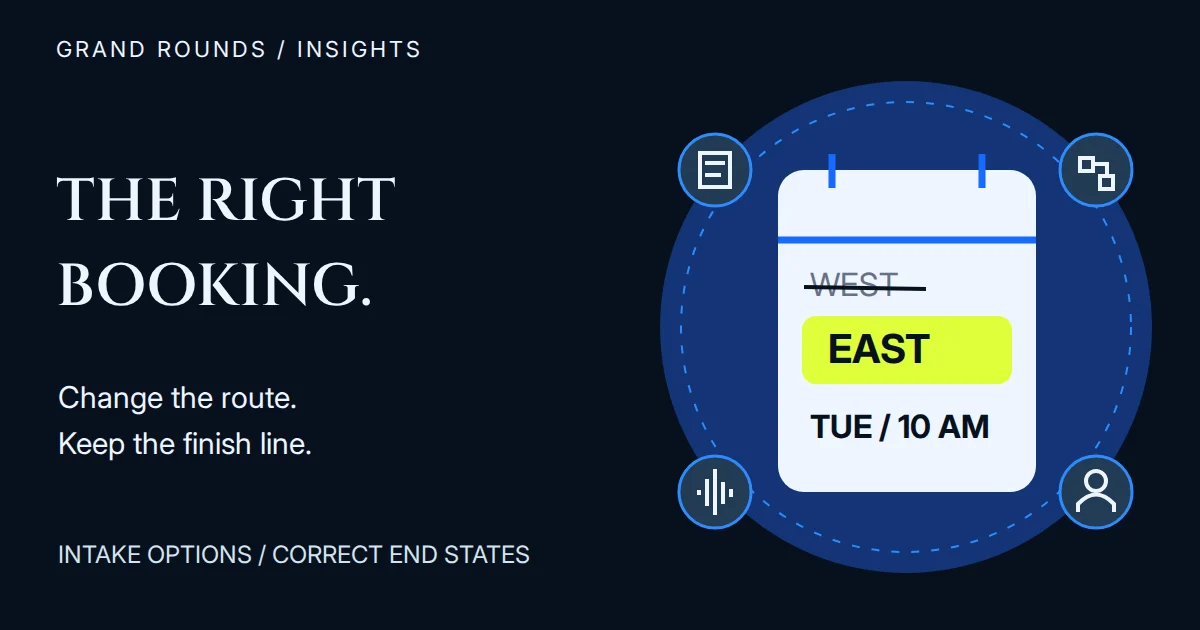
A booking record usually needs confirmed fields, a slot reference, source channel and handoff status; your system and owners determine the exact fields. Test that a correction, such as a customer changing West to East, creates one matching record rather than a duplicate. If you have not counted where requests wait, start with where an intake queue forms.
Forms, automation, voice AI or a person: when each fits
| Route | Start here when | Move away when | Count in the comparison |
|---|---|---|---|
| Form plus current staff workflow | The request fits a short structured form and customers can check it on screen | Submissions arrive incomplete, or staff re-key them | Abandoned forms, rework time, delay between submission and booking |
| Ordinary rules-based automation | Validation, routing and confirmations follow explicit rules and the schedule can be queried | Requests regularly fall outside the rules, or availability goes stale | Requests stuck in a waiting state, mapping errors, exceptions sent to people |
| Voice AI plus agreed fallback | Customers phone rather than type, or booking needs clarification | Interruptions, repeated corrections or unaccepted handoffs | Critical-field errors after corrections; accepted handoffs; response pauses measured on permitted test calls |
| Human intake | The request needs explanation or judgment, or the volume is low | Queue time grows or staff re-key records | Waiting time, rekeying errors, review effort |
These can be combined: a form with ordinary scheduling, voice that collects details but waits for human approval, or a person for exceptions while routine requests use the simplest route. Vendor pages may quote completion rates, caller preferences or monthly cost comparisons. Ask for the scenario set, denominator and definition of “completed” behind each claim.
Test every route on the same scenarios
Give every route the same facts, fields, service rules, availability and fallback. Use synthetic or permitted cases rather than live customer bookings.
| Scenario for every route | Expected behavior | Evidence to inspect |
|---|---|---|
| Customer asks for a person, or withdraws before submission | Hold the booking action. If a person was requested, offer the approved alternative and hand off; if the customer withdrew, record it and close the request | Choice recorded; booking action held; accepted handoff (person requested) or closed with a recorded reason (withdrawn) |
| Customer corrects a critical field | Use the confirmed correction | Source input, field history, final record |
| Request falls outside the service rules | Stop automated deciding; transfer the verified details | Reason, receiving owner, acknowledgement |
| Voice is interrupted or a detail is unclear | Clarify, preserve confirmed state, or hand off | Transcript or notes, correction, outcome |
| Caller asks whether this is AI, or declines recording | Use the disclosure wording and alternative path approved by the legal/privacy owner; follow that owner's recording choice | Disclosure turn, recorded choice and outcome; these examples are not approved legal notices |
Add the late or uncertain booking reply and unavailable receiver cases from the checks for the demo or build in Choosing a CTO for Safe Intake-to-Booking Automation. Test the supported language and noise conditions you actually have; a clean demo does not show how a route copes with another accent or a busy room.
Worked example: denominators and failure rules can change the comparison
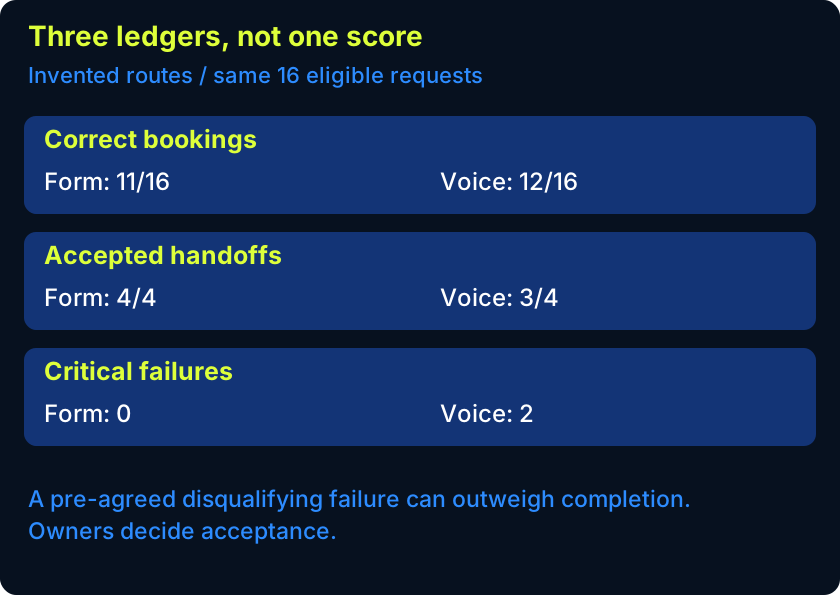
Invented example, fictional teaching material. A fictional office-cleaning company takes one-off deep-clean bookings. The same 20 requests are run through two routes on paper. For both routes, 16 requests are booking-eligible and 4 need a person (for example, a request outside the service area).
| Form plus staff | Voice AI plus fallback | |
|---|---|---|
| Booking-eligible requests | 16 | 16 |
| Correct completed bookings | 11 | 12 |
| Critical failures (wrong date, duplicate) | 0 | 2 |
| Abandoned or unresolved | 5 | 2 |
| Handoffs accepted by a person, out of 4 needed | 4 | 3 |
A vendor-style headline for the voice route could read "12 of 14 booked attempts were correct", where a booked attempt is any attempt that ended in a booking, right or wrong. The full count is 12 correct bookings out of 16 eligible requests, plus 2 critical failures and one handoff nobody accepted. The form route has 11 correct bookings out of 16 and no wrong ones.
The denominator changes the ranking: among booked attempts the form scores 11 of 11 and voice 12 of 14, while among all 16 eligible requests voice leads 12 to 11. The failure rule changes it again. If any wrong booking disqualifies a route, voice drops out in either view; if a wrong booking costs an operator a short correction, it may still earn a place. Agree both before the exercise, never after seeing which route wins. Divide the in-scope cost of each route by its own correct bookings to compare cost per correct completed booking.
Score completion and safety separately
Show correct bookings over every eligible request, critical failures, unresolved requests and accepted handoffs as separate lines. A merged score hides a failed condition. Report each unresolved request by its state at the cutoff, using the names in the queue guide: received, waiting for details, waiting for verification, waiting for booking, handoff accepted, closed or unknown. A wrong booking is a critical failure, not an unresolved request.
Where an experienced CTO fits
A CTO adds most when a specific gap remains in service rules, integration or acceptance evidence that your team cannot own, after a better form, ordinary automation or an existing product has been tested. Choosing a CTO for Safe Intake-to-Booking Automation sets out the questions to put to a candidate, the roles to name and the factors that set the scope.
Your next step: decide whether voice earns a place
Take one repeatable service journey and write the scenarios (the five in the table above plus the late-reply and unavailable-receiver cases from the checks in the CTO guide), the definition of a correct completed booking and the failures that would disqualify a route. Compare permitted or synthetic cases, then bring the reviewed counts and remaining limitations to the budget owner.
To talk through your counts, contact the Grand Rounds curator, who can tell you whether a Grand Rounds session fits.
Boundaries
This guide fits a service company with a repeatable inbound journey, booking destination and owner who can set the rules. It supports a bounded comparison, not automatic pilot acceptance. Thresholds, failure conditions and sample sizes stay with your owners; privacy, security and legal approvals stay with qualified reviewers. Evaluate permitted or synthetic data in an authorized environment. Implementation by your team or a selected provider is a separate decision.
Grand Rounds is an initiative of Dinarys, and a conversation may lead to cooperation with Dinarys.