
If you are on a venture fund's platform team, or a partner supporting a portfolio company, you may be holding a founder's request, a specific technical blocker and permission to explore help. The easy next move is to introduce the most impressive CTO you know. The more useful move is to ask which part of that person's experience is comparable to the decision this founder needs to make.
A platform partner is putting trust behind the connection, and a résumé forwarded alone carries little of it. The match should explain the relevant personal contribution, its limits, any conflicting interests and the scope of the first interaction. It should also leave room for the current lead or vendor to be the right answer.
The fund remains the referral route unless it separately commissions a program. Founder, client, payer and recipient of findings are separate roles.
What makes CTO experience comparable?
Write the blocker as a decision before comparing people: “Choose how to provision the first enterprise customer's users” is more useful than “find a SaaS CTO.” If the underlying need is still unclear, first build a founder-supported needs brief.
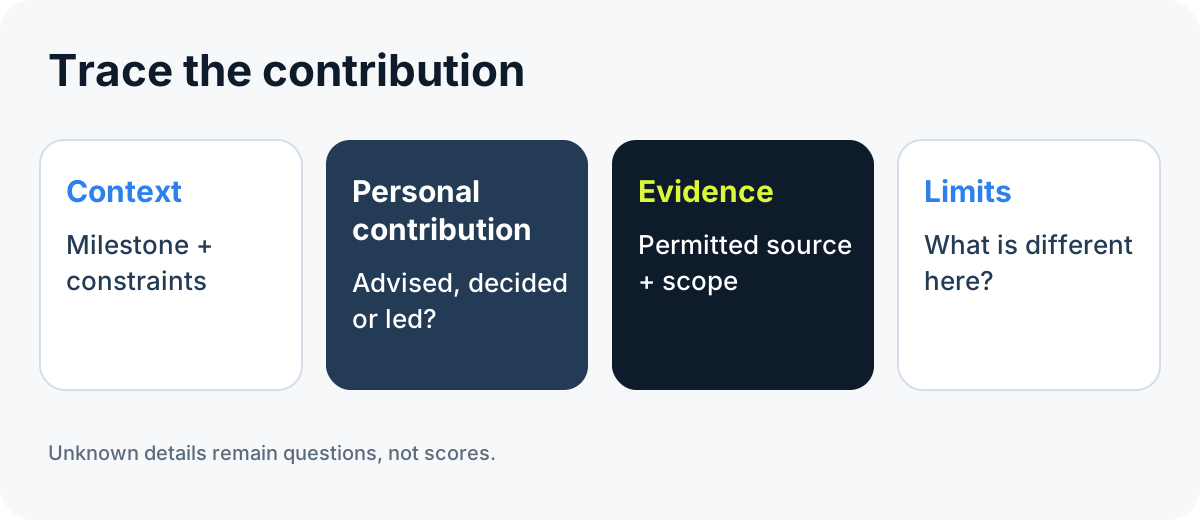
For each potential expert, ask for one relevant example they are permitted to discuss:
- Context: what business milestone, system and constraints made the decision difficult?
- Personal contribution: what did they recommend, decide or lead? What did other people implement?
- Evidence: which public account, permitted reference or shareable explanation supports that contribution?
- Boundary: where did their responsibility end, and what is materially different here?
Record the answer in plain language. An employer logo is a starting point for these questions. Advising on a plan is useful experience; responsibility for operating the resulting system is a separate question. A team outcome needs a further question to identify an individual's contribution.
Two profiles in the Grand Rounds CTO network show what concrete experience to examine looks like. As stated in the CTO's profile, Jerome MacGillivray delivered the Alpha Programme at NSPCC, a Microsoft Dynamics CRM/SharePoint case management system, and led the ChildLine Online Redevelopment Project. As stated in the CTO's profile, Neil Catton defined and delivered a five-year digital transformation roadmap for UK Government Home Affairs at Fujitsu, including leading the “Get to Green” recovery of multiple SLA failures for a major government client.
Statements like these give a partner better questions than “has this person worked at a large company?” Program delivery, redevelopment leadership and recovery responsibility are different kinds of contribution, so ask which one is comparable to this founder's decision and which parts differ. A profile statement opens the conversation; fit for this particular founder still has to be established. Treat the career examples as questions to ask, and keep promises about the proposed engagement out of the match.
Match the contribution to the kind of blocker
Use the comparison below as a discussion record. The founder's actual workflow and constraints determine relevance, so treat it as a prompt for questions rather than a scoring model.
| Founder situation | Contribution to examine | Boundary to clarify |
|---|---|---|
| Delivery accounts cannot be reconciled | Personally owning recovery choices, vendor challenge and review of working evidence | Diagnosis, recovery leadership and supplying developers are different scopes |
| AI or enterprise pilot cannot progress | Taking a comparable workflow through evaluation, integration and review | A prototype is different from production experience; domain or buyer review may need another owner |
| Technical questions need answering before investor conversations | Preparing traceable technical evidence and explaining uncertainties | Founder preparation is separate from investor-commissioned diligence, an investment opinion or a funding promise |
| Fund wants a repeatable referral route | Qualifying cases, surfacing conflicts and managing permitted handoffs | A contact network is a referral route, with a mandate for portfolio support still to be agreed |
For an AI pilot, ask which evaluation or deployment decisions the expert actually owned. For an enterprise pilot, ask how they handled the relevant integration, operating and buyer constraints. A precise permitted explanation can show what still needs checking, so ask for that in place of confidential client evidence.
Also compare the alternatives for the founder's problem: use an existing capability, change a working practice, buy a ready-made component or build something new. An adviser should be able to discuss why retaining the current route could be reasonable. This is technical-decision support rather than a default purchase of implementation services.
Check interests before describing advice as independent
“Independent” needs a concrete conversation. Ask about relationships that could matter to this case, including:
- Current or past work with the company, its fund, the vendor being assessed or a relevant competitor.
- Equity, board or advisory positions connected to the decision.
- Other financial interests in the vendor or option being assessed, if any.
- Whether the expert or an associated business would like to implement the recommendation.
Ask both the expert and the intermediary to disclose relevant interests and clarify the applicable arrangement. The Grand Rounds referral process describes how introductions through Grand Rounds work; confirm the arrangement for the actual inquiry rather than assuming it from an introduction.
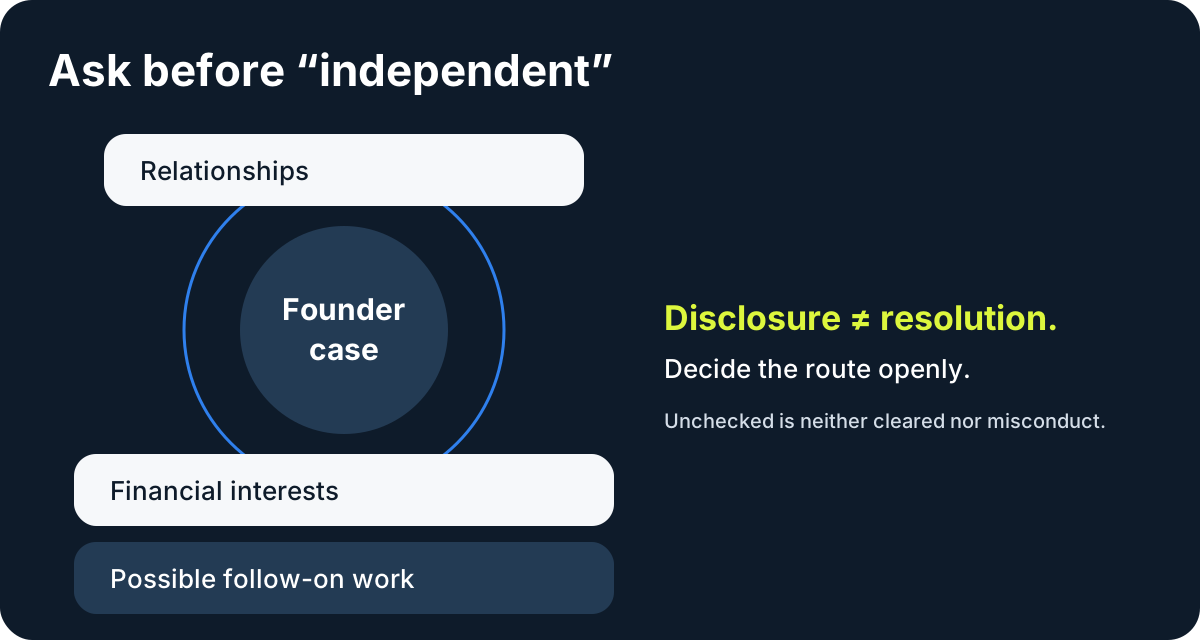
A disclosed relationship may still be workable. It may call for another reviewer, a narrower scope or a different expert, and the founder and the appropriate commissioning parties need to consider that openly. Some conflicts cannot be managed. Disclosure informs the decision; the decision itself comes afterwards, without a universal legal rule.
Agree what the first interaction is for
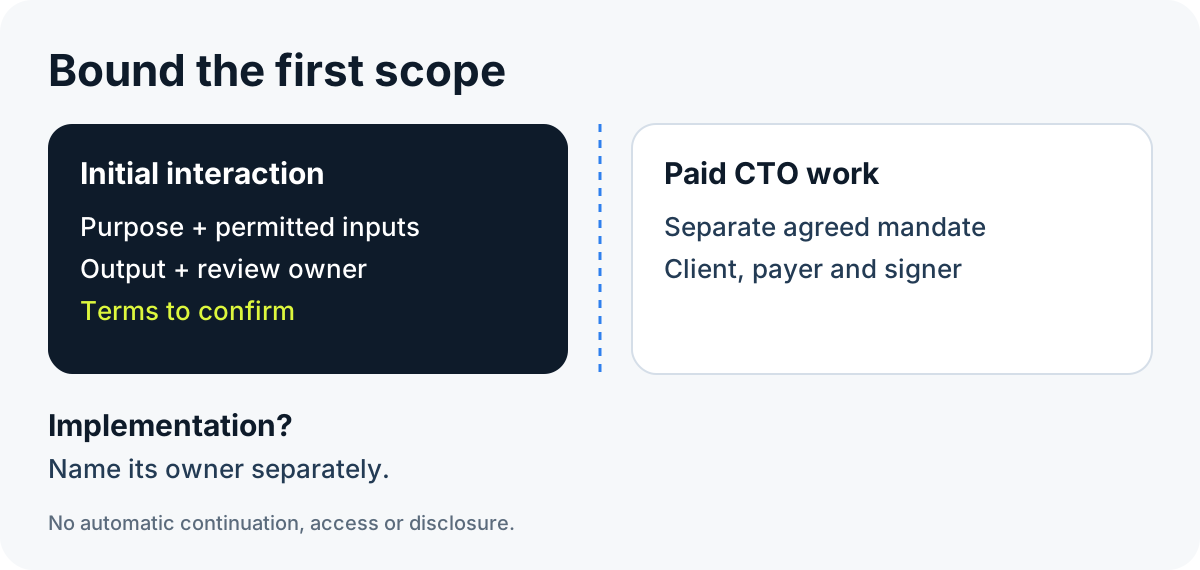
Distinguish a fit conversation, a prepared case discussion and commissioned CTO work. Ask what preparation each needs, what the founder should receive and what it can establish. A short discussion is a discussion; a code audit or a verdict on the architecture needs its own scope.
If a concrete paid decision-support task is already clear, discuss it directly and skip a ceremonial diagnostic. For a possible founder session, confirm in writing what the introduction covers.
Before the connection, clarify:
- The decision or question to address, permitted inputs and named participants.
- The proposed first output and who would review it; distinguish a proposal from agreed acceptance conditions.
- Whether this interaction or later work is paid, with client, payer and signer explicitly identified before commissioning.
- What the founder may share, who receives the technical output and what, if anything, returns to the partner.
- What would require a separate mandate, including ongoing leadership or any implementation by the company's team or chosen provider.
A short match brief you can use
For each proposed expert, complete the same fields. This makes the comparison inspectable, and fit stays a judgment.
Founder decision: ____
Workflow, constraints and current route: ____
Relevant personal contribution and source: ____
Comparable elements / important differences: ____
Unverified coverage and next question: ____
Declared interests / unresolved conflict check: ____
Proposed first scope, output and exclusions: ____
Founder agreement, recipients and permitted brief: ____
Client, payer, signer and paid boundary to confirm: ____
Worked comparison: enterprise provisioning
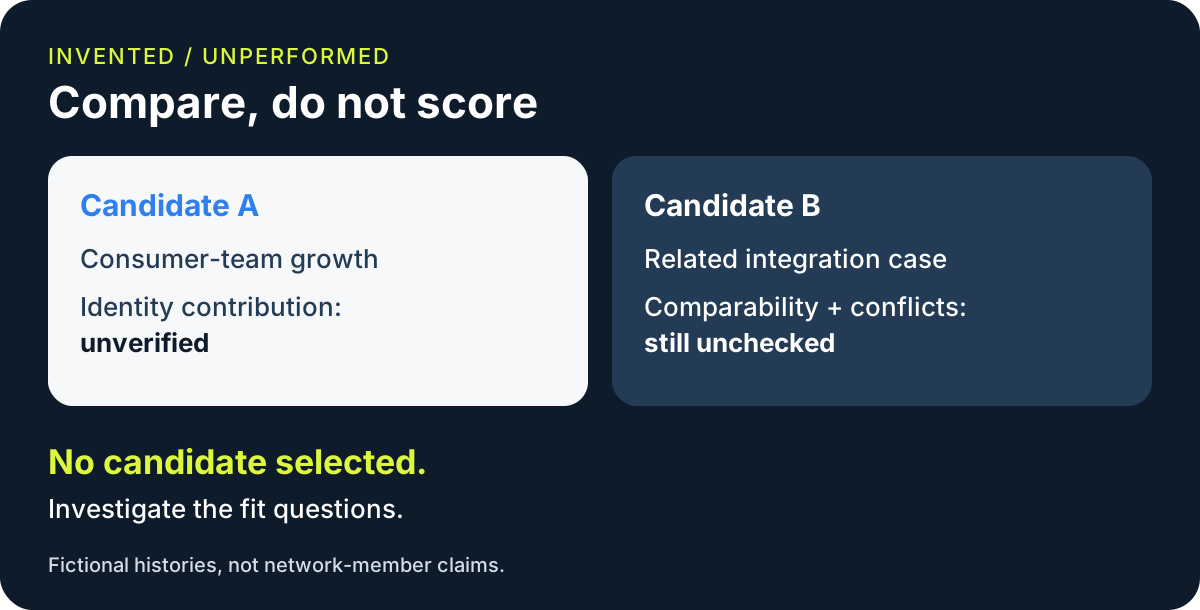
Invented and unperformed: these candidate histories, roles and records are fictional, not descriptions of network members or a completed match.
A software founder wants to decide between custom enterprise provisioning and an identity provider's existing capability. The platform partner proposes two possible advisers:
- Candidate A: a fictional public history describes growing a consumer-app engineering team. Personal ownership of enterprise identity decisions is unestablished. The follow-up question is whether they can explain a relevant integration trade-off they owned.
- Candidate B: a fictional shareable case note describes leading an enterprise identity integration. That is a closer topic to investigate and leaves the choice open. Customer-environment comparability, personal acceptance responsibility, conflicts and participation still need checking.
The proposed first scope is a review of the founder's requirements and the existing alternatives, producing a decision note with dependencies and remaining questions. Building the integration and certifying its security are outside it. The founder and technical lead would need to agree what makes that note useful and who reviews it. No review, permission, engagement or candidate selection has actually occurred.
Agree the route before sending the introduction
Review the match brief with the founder. Resolve the questions that could change whether to proceed: relevant contribution, conflicts, first purpose, sharing boundary and any paid route. If the founder prefers the existing team, another expert or no introduction, keep that option open.
Once those boundaries are agreed, use the referral process. A contact accepting the introduction is one step; useful advice is judged afterwards.
For a possible Grand Rounds session or partnership route, talk with the curator using only the permitted summary. Confirm fit, participation and any later commercial scope separately; the practical next step remains agreeing a transparent route with the founder.
Boundaries
Grand Rounds is an initiative of Dinarys, and a conversation may lead to cooperation with Dinarys.