
Prefer evidence of a personal contribution to comparable buyer acceptance over a senior title alone. This is editorial selection advice, not a validated test. If an enterprise deal is waiting on IT or security approval, ask: who can lead this product through this buyer's gate, with evidence your team can maintain afterward?
Compare each candidate on six points:
- Personal contribution: what they decided, who authorized it, and who implemented it.
- Comparable starting conditions: product stage, team capacity, buyer type, data sensitivity.
- Evidence discipline: how they connect a buyer requirement to a check and a reviewer's decision.
- Mandate: which decisions they will own and which stay with the sponsor, engineering lead and the buyer's reviewers.
- Scope: whether assessment, leadership and implementation are agreed as separate deliverables.
- Handover: who owns the decisions, evidence and recurring work when the engagement ends.
First, check you need an external CTO
An internal lead with enough authority may own the milestone, a narrow security question may need a specialist, and a clear change can go directly to implementation. External leadership is worth considering when an unresolved technical decision or cross-team responsibility exceeds your current team's authority or capacity.
This guide is for a founder or CEO, product lead and engineering lead preparing a signature, pilot, production activation or wider rollout.
Define the mandate before comparing candidates
Choose one buyer gate: signature, pilot, production activation or wider rollout. Identify the technical decision the internal lead can own, the specialist question requiring separate expertise and the cross-team responsibility that might justify an external CTO.
Compare candidates once you can name the gate, the requirements the buyer confirmed for it and the decisions your lead cannot cover. If the blocker itself is unclear, start with your product works but the enterprise buyer still cannot sign.
Verify personal contribution, not proximity to an enterprise project
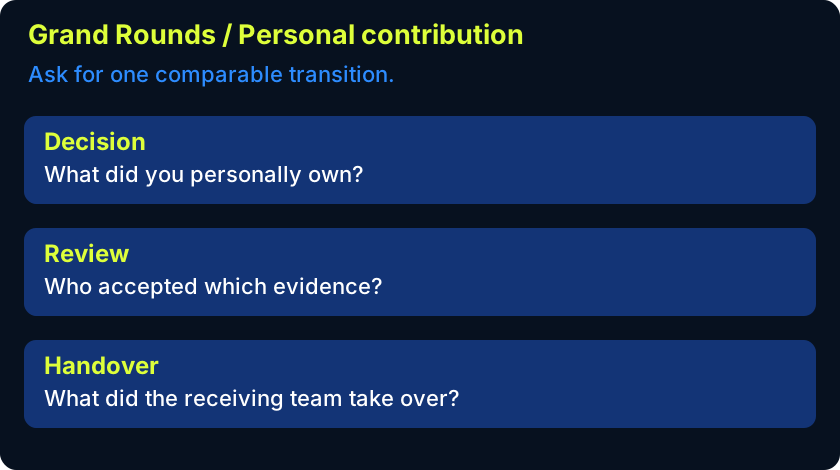
Ask for one comparable transition with a permitted artifact or reference. Separate the candidate's decision, the employer's program and others' work. Use the same questions for each shortlisted person.
| What you need to establish | Evidence to request |
|---|---|
| Comparable starting conditions | The product’s starting state, buyer milestone, team capacity, and constraints. Ask what differs from your situation. |
| Personal decision and mandate | A specific decision the candidate owned, the alternatives considered, who authorized it, and which work belonged to others. |
| What was tested and who reviewed it | A permitted example of requirement-to-evidence traceability: what was checked, in which scope, with what limitations. |
| Actual acceptance | A permitted record or authorized reference explaining which reviewer accepted which requirement for which milestone—with that milestone’s explicit review outcome. |
| Handover to your team | How engineering and operations took over, which issues remained open, and what caused the plan to be revisited. |
What public CTO profiles show, and what to ask next
| Profile | Attributed experience | Evidence to request |
|---|---|---|
| Amer Murad | As stated in his profile, enterprise modernization, security and compliance in regulated industries, including building a compliance and governance function from scratch. | Which buyer requirement did he personally own? Who accepted the evidence and who took over operations? |
| Marton Csernai | As stated in his profile, auditable, verifiable AI for regulated industries and high-compliance B2B SaaS. | Which reviewer accepted which requirement, in what scope, and with what operational handover? |
These profiles illustrate how to read attributed experience; neither establishes acceptance for your buyer's gate. Use the right-hand column and six-point list to ask candidates for the same evidence. Large-program scale and senior titles establish context rather than personal responsibility for a comparable acceptance.
A fictional comparison: similar titles, different evidence
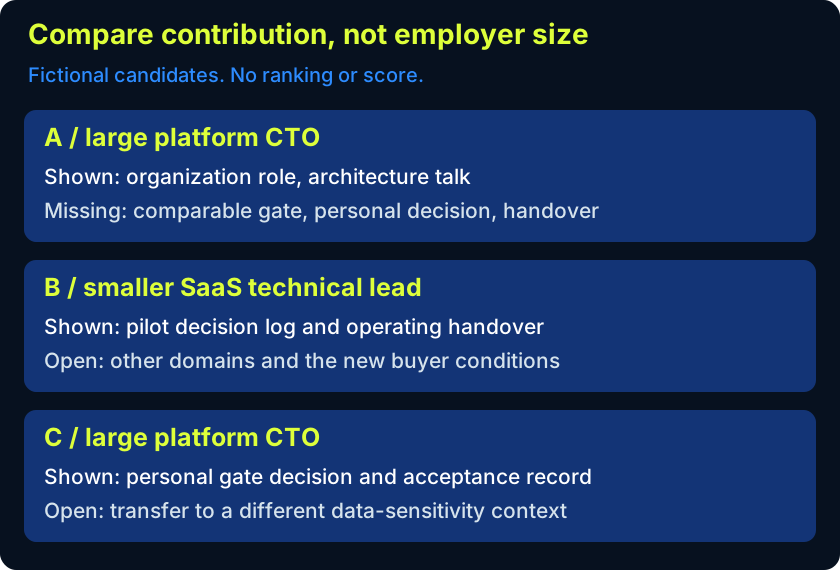
Candidates A, B and C below are invented. Compare demonstrated responsibility for buyer evidence and handover, and record differences in starting conditions and corroboration still needed.
| Candidate | What the fictional selection record establishes | Evidence still required |
|---|---|---|
| A: former CTO at a large platform company | Explains responsibility for a large engineering organization and shows a public platform architecture presentation. | Ask for a comparable buyer gate, personal acceptance decisions and operating handover. Ask for that evidence before concluding fit. |
| B: former technical leader at a smaller SaaS company | A fictional, permission-cleared decision log records B retaining an identity integration after distinguishing sign-in from missing application permissions. Engineers implemented the access change; B agreed evidence criteria with the buyer’s reviewers and led the technical reviews. A fictional reviewer decision accepted only that pilot scope, followed by handover to a named operating owner. | Verify other security domains, broader-rollout scope and fit to the new buyer separately. |
| C: former CTO at a large platform company | A fictional permitted decision record shows personal responsibility and acceptance for one buyer gate, but at a different data sensitivity. | Establish what differs and whether the experience transfers; organization size alone neither qualifies nor disqualifies C. |
What a CTO mandate should produce
A mandate should name one buyer gate, a requirement-to-evidence record and accepting internal owners for decisions, evidence and follow-up. The enterprise-readiness evidence guide covers the record; this page selects who leads it.
Keep assessment, leadership, and delivery separately scoped
Write separate deliverables for assessment, leadership and implementation. Agree the reviewer for each. An assessment may accurately identify open gaps while buyer acceptance remains pending; implementation and recurring operations have their own completion evidence.
| Scope | Concrete output to agree | Boundary |
|---|---|---|
| Assessment | Evidence-backed gaps, options, roadmap, and ownership model for the uncertain area. | Implementation, executed load tests and release need separate evidence. |
| Milestone leadership | Technical decisions, agreed criteria, dependency coordination, reviews, and handover. | Agree engineering capacity and reserved functional authority separately. |
| Implementation | Specifically agreed changes, authorized testing, release work, and operating transition. | Belongs to the client’s team or a separately selected provider under its agreed delivery scope. |
Your next step: make the fit decision explicit
Write the milestone, selected contribution and accepting internal owner in one paragraph. If the remaining gap needs cross-team leadership, discuss the milestone, current team and unresolved decision with the Grand Rounds curator. Use the six-point list to ask any proposed candidate for evidence. Availability and any later working arrangement require separate confirmation.
Boundaries
The candidate comparison is invented. Public-profile facts are attributed career statements. The CTO leads agreed technical decisions; buyer reviewers, procurement, legal and the signatory retain their decisions. This article is not an audit, legal advice or a compliance certificate. Testing requires the relevant authorization.
Grand Rounds is an initiative of Dinarys, and a conversation may lead to cooperation with Dinarys.