
Choosing a CTO adviser for a field service pilot comes down to one question: who will connect dispatch, the field team and your ERP, and hand control back to operations?
You have three options: your current team, your existing FSM provider, or an external technical leader for one bounded mandate. Start with one job type, one region and one dispatch team, and let the COO sponsor the change. An adviser can establish the decisions, evidence, acceptance criteria and handover for that scope; your team or an agreed supplier builds it.
Use your current team or FSM provider when mapped handoffs meet the agreed conditions on your sample orders. Consider outside technical leadership when an unresolved boundary crosses operations, field delivery, IT and finance and needs accepted ownership.
This guide shows what to verify in a candidate's own contribution, how to write acceptance up to ERP invoice readiness into the mandate, and what to ask for at handover.
Verify the contribution your workflow needs
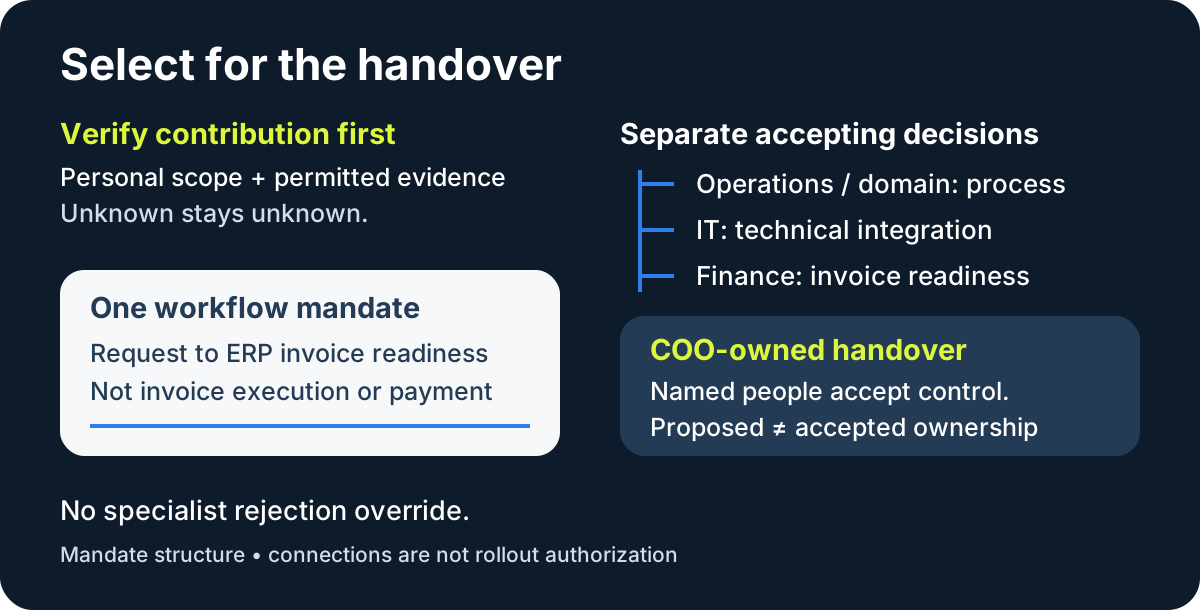
Ask for personal decisions at the interfaces your pilot crosses: work-pack identity, FSM/mobile/ERP state, offline returns and finance acceptance. Request permitted records or an authorized reference and mark remaining corroboration openly.
| Relevant dependency | Ask about personal contribution | Useful permitted evidence |
|---|---|---|
| Operating redesign | Which handoff did you change, what did operations retain, and what alternative did you reject? | Redacted process/decision record or an authorized reference |
| FSM and API integration | Which interfaces, identifiers, retries and exception paths did you personally decide or lead? | Allowed architecture walkthrough, test example or reference |
| Field adoption and completion | How did crews and reviewers accept the work-pack and proof process? | Permitted acceptance or handover account, including unresolved limits |
| ERP boundary | How did you distinguish accepted work, invoice readiness and actual invoicing? | Allowed state-transition or reconciliation example |
A title or contribution in one area does not establish contribution in another. Ask which decisions the person owned at each boundary, then verify permitted corroboration.
Adjacent experience in the network
As stated in Jerome MacGillivray’s profile, he grew a Customer Experience engineering unit at Techwave's European delivery centre to nearly 50 people across SAP Commerce Cloud, S/4HANA integration and AI-enabled customer engagement features; directed Ratio Software Engineering, an ecommerce agency delivering SAP Hybris, Magento and SAP ECC projects; and delivered the NSPCC Alpha Programme, a Microsoft Dynamics CRM/SharePoint case management system rolled out across 40+ sites to 1,000 users. These describe the scope of a unit, an agency and a programme; the profile does not say which interface decisions were his own, so treat them as adjacent integration and multi-site examples to explore, not as evidence of personal integration work. Field-service dispatch, skills scheduling and safety acceptance need separate evidence from a comparable mandate; the curator helps check that fit.
Put request-to-invoice acceptance in the mandate
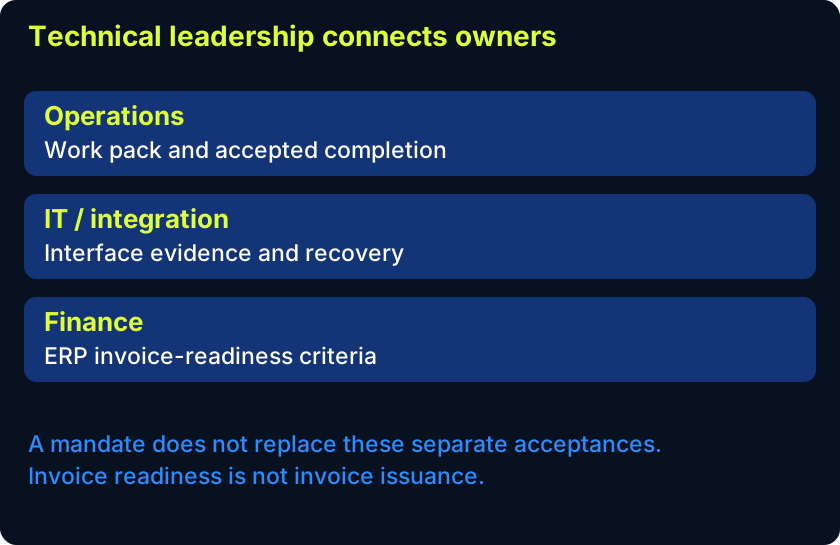
Agree one job type, region and dispatch team. End the sample remit at ERP invoice readiness. In the proposed split, operations accepts the work pack, the authorized completion reviewer accepts completion and finance accepts invoice readiness. Define fallback, reconciliation and receiving owners before implementation.
The boundary-by-boundary tests and the proposed accepting role at each of the five boundaries (for example field operations with IT for proof receipt, an authorized completion reviewer for completion, finance/ERP with IT for invoice readiness) are in field-service automation; write the roles you confirm into the mandate, and no title bypasses them. The table below adds what this guide owns: the evidence each boundary must present and the ongoing owner to name. The one addition is the last row, where the COO is the proposed decider on whether the pilot continues, after the required domain, technical and finance acceptances.
| Boundary | Evidence the pilot must present | Ongoing owner to name |
|---|---|---|
| Request → work pack | Job/source/version identity, missing information | Intake/dispatch lead |
| Work pack → schedule | Approved constraint inputs, visible conflicts | Scheduling operations owner |
| Work → proof receipt | Pending/received status, repeated upload behavior | Mobile workflow owner |
| Proof → accepted completion | Recorded reviewer decision and reasons | Completion-review owner |
| Accepted completion → ERP readiness | Accepted job reference, validation/rejection record, duplicate handling | ERP support and finance process owners |
| Pilot → continuing operation | Baseline, evaluation results, open limits, fallback/reconciliation | Named operating owner and technical support owner; COO as proposed decider |
An invented walkthrough: challenge the endpoint before the architecture
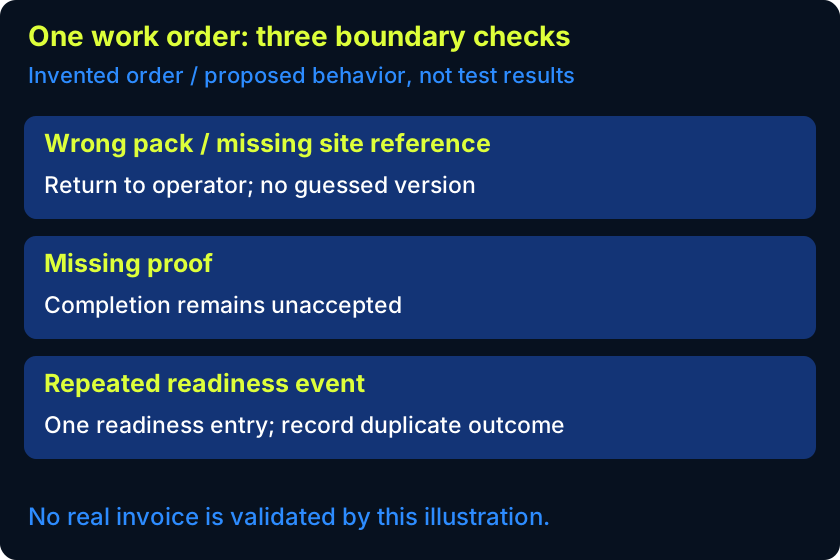
For this invented work order, ask the candidate to explain each receiving state and accepting owner:
- Wrong work-pack version or missing site reference: return it to the authorized operator; do not schedule from a guessed version. Identify how the corrected, approved pack replaces it.
- Missing proof: keep completion unaccepted until the authorized reviewer has the required evidence.
- Repeated readiness event: show one ERP readiness entry, the stable event identity and the recorded duplicate outcome. This walkthrough does not validate a real invoice.
Ask for a handover, not continuing dependence
The receiving operations/IT team should repeat the agreed checks, find decision records, inspect open issues, stop the pilot and restore the supported route. Assign ongoing monitoring, exception handling and change ownership.
What shapes the scope of an adviser mandate
These factors change what the mandate needs to say:
| Factor | Why it matters |
|---|---|
| Pilot boundary: job type, region, crews, dispatch team | Sets which acceptance roles are needed |
| Systems touched: FSM, mobile app, ERP, existing connector | Defines the interfaces and identifiers the adviser must decide on |
| Who implements: your team, your FSM provider or another supplier | Determines what the adviser reviews versus builds |
| Endpoint: ERP invoice readiness, invoice creation or other | Fixes the finance acceptance criteria |
| Fallback and reconciliation | Decides who restores state if the pilot is stopped |
| Handover package: decision records, tests, runbook, monitoring | Shapes what operations can run independently after handover |
Bring the mandate to the curator
Name the pilot boundary, the accepting people, the evidence and the receiving operational owner. Test supported FSM configuration first. To discuss whether anyone in the network is relevant to that scope, talk with the curator.
Boundaries
The mandate ends at agreed ERP invoice readiness. Finance owns readiness criteria and later invoicing; in the proposed split, operations owns the work pack and the authorized completion reviewer decides completion; operations/domain owners retain skills, SLAs, safety and instructions. The sample work order is invented. Leadership, implementation and operating acceptance are separate scopes. A network profile is a public statement, not an offer of availability or a confirmed fit.
Grand Rounds is an initiative of Dinarys, and a conversation may lead to cooperation with Dinarys.