
Configure what your field service management (FSM) system supports; integrate where data must cross a boundary intact; test reviewed AI extraction for repeated work on unstructured inputs. Consider custom work only for a named gap the configured FSM and bounded integration fail to cover on the same orders. This is comparison advice, not a validated selection algorithm. For repeat work, several crews and contractual SLAs, compare one job type, region and dispatch team. Skills, SLA and safety constraints remain with the configured rules and authorized operations/domain reviewers.
Written for the operations or service owner of a distributed field-service operation, working with IT and finance, who is weighing FSM configuration, integration and custom work.
Your next step: complete the scheduling, mobile-proof and ERP matrix with operations, IT and finance; decide whether to propose one pilot or retain the existing configuration.
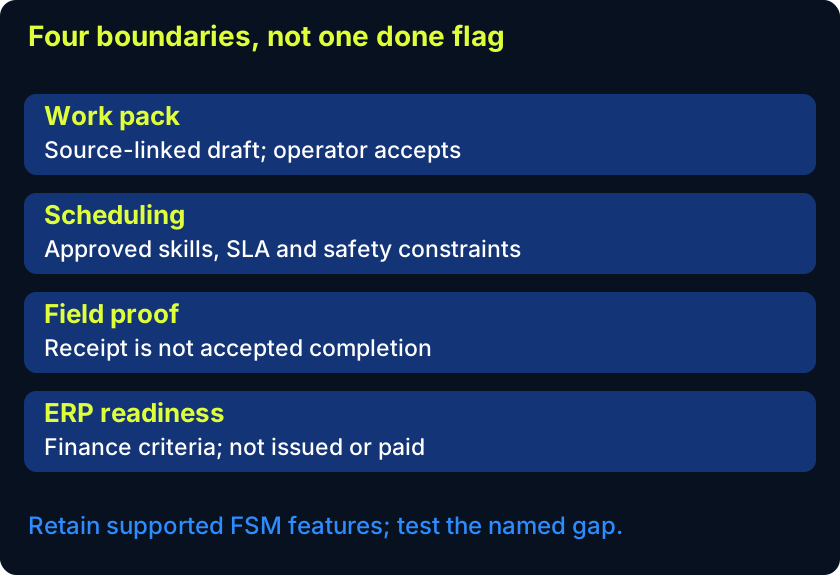
Compare coverage across the whole workflow
Use one job type, region and dispatch team. Compare the current FSM, supported configuration and a bounded integration on the same authorized work orders. Follow job identity and accepted states through scheduling, mobile evidence and ERP readiness.
| Boundary | Native FSM/configuration test | Integration gap to verify | Proposed accepting role |
|---|---|---|---|
| Intake → work pack | Can required fields, source references, versions, and unresolved items be represented? | Does incoming data reach the correct job without re-entry or silent substitution? | Operations accepts the work pack; IT accepts technical delivery |
| Work pack → scheduling | Can the configured scheduler apply the approved skills, availability, SLA and other applicable constraints? | Are the approved constraint values transferred intact and exceptions returned visibly? | Operations/domain reviewer accepts the constraints; IT accepts the transfer |
| Field work → proof receipt | Can staff submit the required evidence and see pending, received and returned states? | What happens when connectivity fails, an upload is repeated, or a work-pack version changes? | Field operations owner, with IT |
| Proof → accepted completion | Can the reviewer see the received evidence, record an accept or return decision with reasons, and list outstanding work? | Does the decision reach the job record, and what happens if evidence changes after acceptance? | Reviewer authorized under operating and contract requirements |
| Accepted completion → ERP readiness | Can the required job and commercial references be checked before handoff? | Are accepted records transferred without duplicate readiness entries, and are rejections visible? | Finance/ERP owner, with IT |
The table separates accepted completion from proof receipt, so it lists five boundaries. These roles are proposals to confirm with your own organization; the adviser guide uses the same role names where it names them.
Where AI helps: a reviewed draft work pack, not scheduling
AI may prepare a source-linked draft from unstructured material for review. Operations and qualified domain owners retain skills, SLA, safety, approved instructions and dispatch authority. Structured intake may make extraction unnecessary.
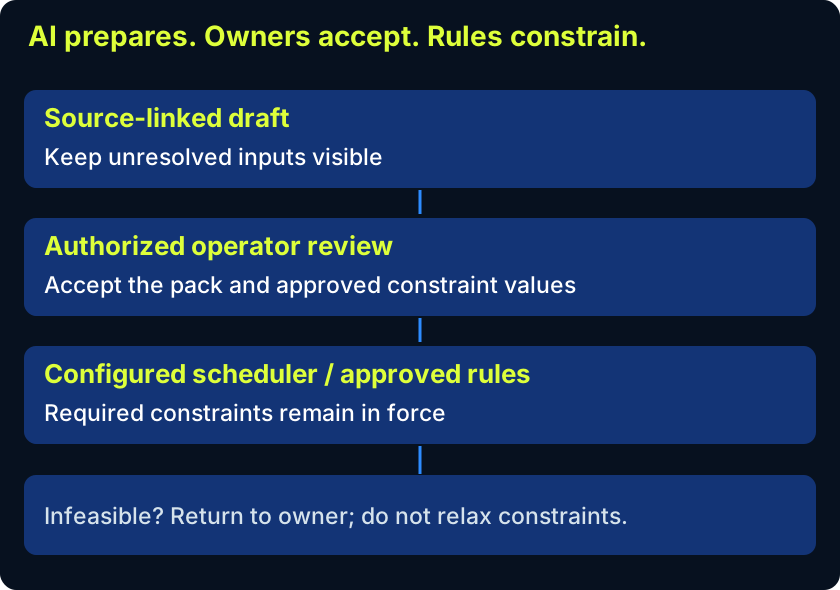
An invented fit-gap walkthrough
J1–J3 are three invented sample work orders. The table describes how each option would be compared on the same authorized basis; no test has been run. Compare native behavior, reviewed preparation and approved skill-tag mapping before proposing a platform change.
| Sample work order | Existing configured path in the illustration | Proposed change to test |
|---|---|---|
| J1: complete request and accepted constraints | Existing work-pack and scheduler functions cover the path | Retain native configuration; no new AI step |
| J2: site reference appears only in an incoming document | Dispatcher retypes the reference | Compare a proposed extractor (an ambiguous reference stays unresolved and the draft is not dispatched) with a better intake form |
| J3: required skill appears only in free text | Scheduler supports skill tags, but the work pack does not map to them | Map the approved skill to the scheduler tag; return unresolved mappings to the operator |
Test failure states, not just the happy path
Exercise offline submission, stale work-pack versions, rejected evidence, ERP rejection and stop/recovery. In the proposed split, the authorized completion reviewer accepts completion; finance/ERP, with IT, accepts invoice readiness. Assign an owner for every returned item and unresolved mapping.
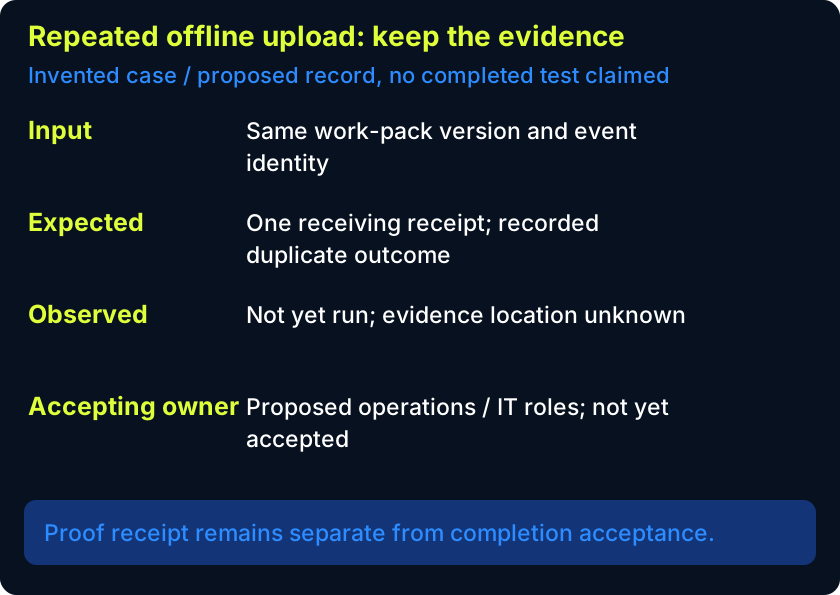
Choose one pilot workflow
Use three planning questions: is one economically meaningful job type in scope, is an accepting owner named at each boundary, and has the gap been demonstrated on the same sample orders? These are prompts, not a validated test. Retain supported FSM features and agree implementation separately; an accepted pilot leads to a separate scope, not an automatic extension.
Gather permitted sample orders and exceptions, staff skills, SLAs, locations, approved manuals and authorized FSM/ERP read access before the comparison. For how an adviser mandate is scoped, what to ask a candidate and what a handover should contain, see the field-service CTO adviser guide.
To discuss relevant integration or multi-site experience, bring the matrix to the Grand Rounds curator, who can say whether any CTO profile in the network is relevant; adjacent experience shown in a profile is not dispatch-delivery proof. If still locating effort, start with the dispatch-work diagnosis.
Boundaries
This comparison concerns one bounded operation, not universal FSM capabilities. A small service or a supported configuration may need a smaller step. Operations/domain owners retain skills, SLAs, safety and instructions; finance retains invoice-readiness and invoicing decisions. Proof receipt, accepted completion and invoice readiness are separate states. The examples are invented and are not authorization to deploy.
Grand Rounds is an initiative of Dinarys, and a conversation may lead to cooperation with Dinarys.