
Choose the CTO who can show how the correct record reaches your booking system and how a difficult request reaches a person. How well a conversation sounds is the lesser test.
“Safe” here names inspectable conditions, not a safety certification: unknown details are held rather than guessed, corrections survive, one request produces one booking, and an exception reaches an acknowledging owner. Your responsible reviewers approve the actual conditions and use.
This is a decision for a service business with a repeatable inbound journey, a CRM or booking destination and a Service Operations owner. It follows the queue count in missed calls and intake queues and the route comparison in Voice AI, Forms or Human Intake?. Here the question is what to ask a CTO candidate, and what a useful answer looks like.
Confirm that the task needs CTO leadership
Decide first whether a CTO is the right resource. A better form, standard scheduling automation, an existing intake platform or a revised operator process can close many gaps. A CTO mandate fits when a specific gap remains: service rules that vary, several systems that must agree, difficult state handling, or acceptance requirements outside the current team’s coverage.
What the CTO owns, and what your team or supplier owns. The CTO recommends technical decisions, defines controls and evaluation, and takes accountability for the technical handover. Building and maintaining the workflow is a separate scope for your team or a chosen provider. State it in the mandate.
Factors that set the scope: number of service lines; languages and channels; booking destination and its API; systems that must stay consistent; escalation owners and hours; privacy, security and legal reviewers involved; how much evidence your reviewers need.
Start narrow: one service line, one language and channel, one booking destination, one receiving team.
Name the business owner, reviewer, and action authority
Name the Service Operations owner, evidence reviewer, action authority, implementation owner and receiving human team. Agree who may change a booking and who can stop automated action; acceptance follows each person’s remit.
| Role | Responsibility to acknowledge |
|---|---|
| Service Operations owner/COO | Define the service journey, mandatory fields, booking rules, exceptions, baseline, and operational acceptance |
| Budget sponsor | Approve spend, scope, operational trade-offs and continuation |
| CTO adviser/technical evaluator | Define architecture, integration boundaries, evaluation, action controls, and technical handover |
| Implementation and maintenance owner | Build/configure assigned work, maintain it, and resolve failures within the agreed remit |
| Service-quality reviewer | Inspect source-to-field accuracy, corrections, correct bookings, and accepted handoffs |
| Privacy/security/legal reviewers as applicable | Approve their respective data, access, notice/consent, retention, and operational requirements |
| Receiving escalation owner | Accept difficult cases and own the next step, including when the normal receiver is unavailable |
Questions to put to a CTO candidate
These questions test the person’s own decisions, not a product. Put them to each candidate in a first conversation, however that conversation is arranged (for Grand Rounds profiles, requests go through the curator), and compare the answers across candidates.
| Question for the candidate | A useful answer shows |
|---|---|
| 1. When would you advise an existing intake platform, a better form or a revised operator process instead of custom work? | Custom work is kept for a gap that remains after configuration and an existing product have been tested, such as your own protocol, integrations, evaluation or privacy needs |
| 2. Which decisions did you own in a comparable system, and which did a team or vendor own? | Named responsibility, the kind of system and what changed, kept apart from what a company or team delivered; adjacent experience described as adjacent |
| 3. What would you ask us to write down before any channel is compared? | The protocol described in the queue guide, including consent and recording rules that your privacy reviewer owns |
| 4. How do you keep the right state when a customer corrects a detail or the booking system replies late? | A confirmed value that survives the correction, a stable action reference so a retry does not create a second booking, and a customer message that matches the real state |
| 5. What happens to a request the automation cannot finish? | A named receiving owner; the request stays visible in its last waiting state, with the handoff noted, until that owner acknowledges (states as in the queue guide); and a fallback when the usual receiver is unavailable |
| 6. What would you accept as evidence, and who judges it? | Criteria set on an agreed sample: critical fields correct, interruptions and fallbacks exercised, no unagreed booking or CRM action, minimal personal data in logs; your reviewers record the disposition |
| 7. Where does your remit end? | A written split between recommending and controlling (the CTO) and building and maintaining (the team), plus a technical handover the receiving team can run |
| 8. What do you need before estimating scope? | A review of data, access and boundaries first; scope, time and price are not set before that review |
Reading a profile against the questions
As stated in Carlos Blanco’s profile, he “built an AI-powered interviewer from scratch including voice, analytics and payments”. That is adjacent dialogue and product experience. For a profile like this, use questions 2 to 5 and ask for separate evidence of booking identity, corrected fields, delayed replies and accepted operational handoffs.
Invented example: two CTO candidates
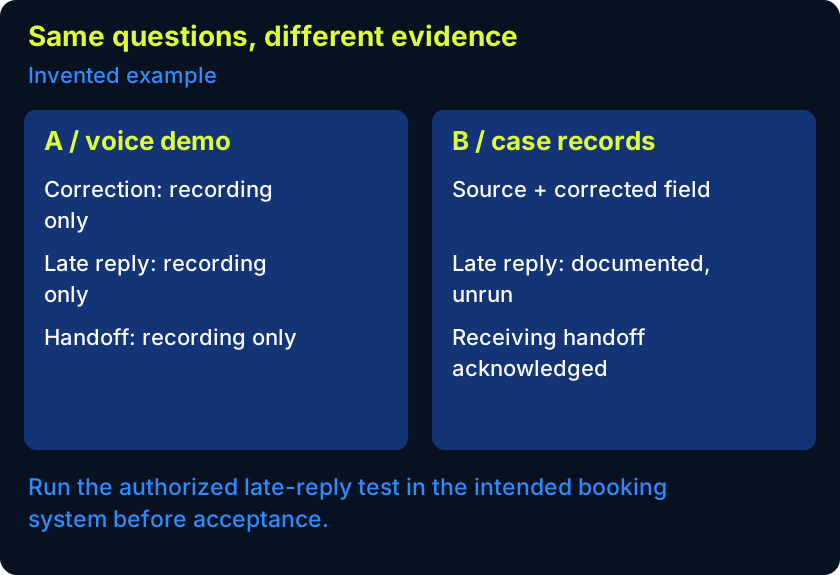
Invented example, fictional teaching material. A regional home-services business wants automated intake for service appointments and speaks to two invented CTO candidates, A and B, who are not any real person or profile. It puts the candidate questions to both and asks each to show, on the business's own sample, where a customer's correction is stored, what happens when the booking system replies late, and who accepted an escalated request.
Candidate A plays a recorded demonstration of a voice product built earlier. The conversation is polished. Asked which decisions A owned, the answer covers the speech provider and the tone of the dialogue, not where a correction is stored or what happens when a booking reply is late.
Candidate B brings permitted, anonymized case-level records from a comparable engagement: for one request, the source passage, the corrected field, the reference of the single booking created, and the handoff packet for an out-of-scope request. B says which decisions were B’s and which belonged to the client team. B’s late-reply handling is documented but was never run against the business's booking system, so the business asks for an authorized test before treating that question as answered.
Neither candidate is appointed on this evidence. A has shown a conversation; B has shown case records and a design, with its late-reply behavior still untested. B’s answers are easier to check against the business's own journey.
Checks for the demo or build your CTO will review
Once a CTO is advising, apply the same discipline to whatever your team or a supplier shows. Give each demonstration or build the same permitted journey and expected state changes, and keep observed records beside the reviewer’s disposition. The correction, unclear-input, decline and out-of-scope cases are set out in Voice AI, Forms or Human Intake? and are reused here. This walkthrough adds the cases that test the booking destination and the receiving side.
| Walkthrough case | Required behavior to agree | Evidence the reviewer needs |
|---|---|---|
| Normal in-scope request | Verified fields, customer confirmation, one authorized matching booking | Source/form input, validated record, confirmation state, destination reference |
| Booking reply is delayed or uncertain | Reconcile the original action; retry preserves the original action identity | Stable request/action reference, destination state, duplicate check, accurate customer status |
| Receiving person or system is unavailable | Keep the request in its last waiting state with the unacknowledged handoff noted, and follow the approved fallback | Waiting state and handoff note, fallback owner, queue visibility, and customer-facing status |
Require the evidence and handover, not just the demo
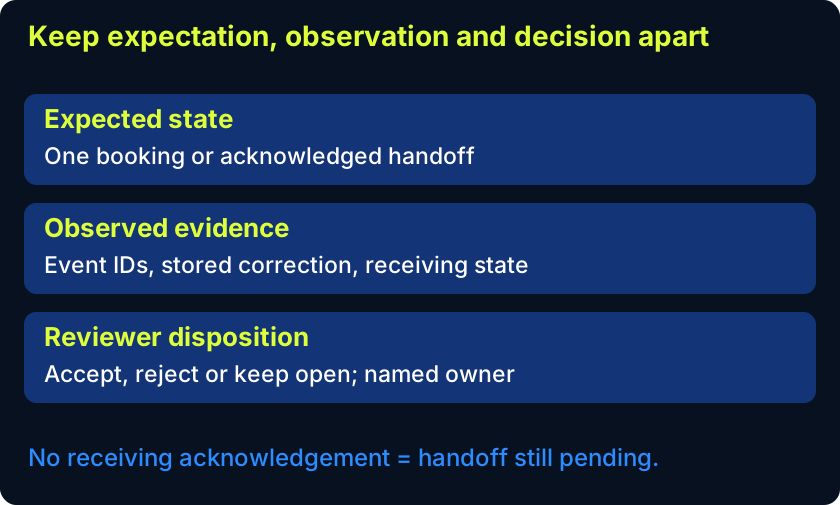
Require a runbook, versioned configuration, case evidence, monitoring, fallback and an accepting operational owner, together with a control sample (a sample of cases run from intake to escalation) and a cost-and-quality report (critical failures and cost per correct completed booking, counted as in the route comparison). The mandate should say who prepares each. Have the receiving team run an exception and recovery path independently before ending the mandate. In the figure below, “pending” means the request stays in its last waiting state with the handoff noted.
Your next step: agree the reviewer and mandate
Agree the proposed mandate with the business owner and reviewer, and mark the candidate questions that matter most for your journey. Then bring the journey, booking destination and open integration question to the Grand Rounds curator. Confirm expert fit, implementation scope and terms separately.
Boundaries
Roles, questions and cases are proposals awaiting local acceptance and execution. Qualified privacy, security and legal owners approve notice, consent, retention and access requirements. Profile summaries are attributed public statements, not availability or fit evidence. Any subsequent scope needs agreement through the curator.
Grand Rounds is an initiative of Dinarys, and a conversation may lead to cooperation with Dinarys.