
When every new crew brings more dispatch calls, chat threads and manual reports, repeated handoffs may be the cause rather than a shortage of dispatch capacity. Separate necessary coordination, such as a changed site condition or skill/SLA conflict, from reconstruction of information already held, such as retyping a reference or re-sending a pack version. This is a working split to investigate. Process changes may reduce repeated information handling; they do not remove legitimate coordination or staffing needs.
To tell coordination from reconstruction, follow one job type, region and dispatch team from request to invoice handoff, and record every repeated touch with its reason and receiving owner. If the touches are genuine and there are simply too few qualified crews for the contracted workload, the evidence points to staffing or contract scope rather than workflow.
Written for the COO or service director of a field-service operation with several crews.
Is dispatch deciding, or rebuilding the job?
Record why each dispatch touch occurs. Changed site conditions and skill/SLA conflicts need coordination; retyping known references and chasing current evidence are reconstruction. Separate capacity shortage from information handling.
Map intake to the invoice handoff
Follow the same job ID and current work-pack version from intake to field evidence, completion acceptance and ERP readiness. Record returned work, waiting states and the receiving owner at each step.
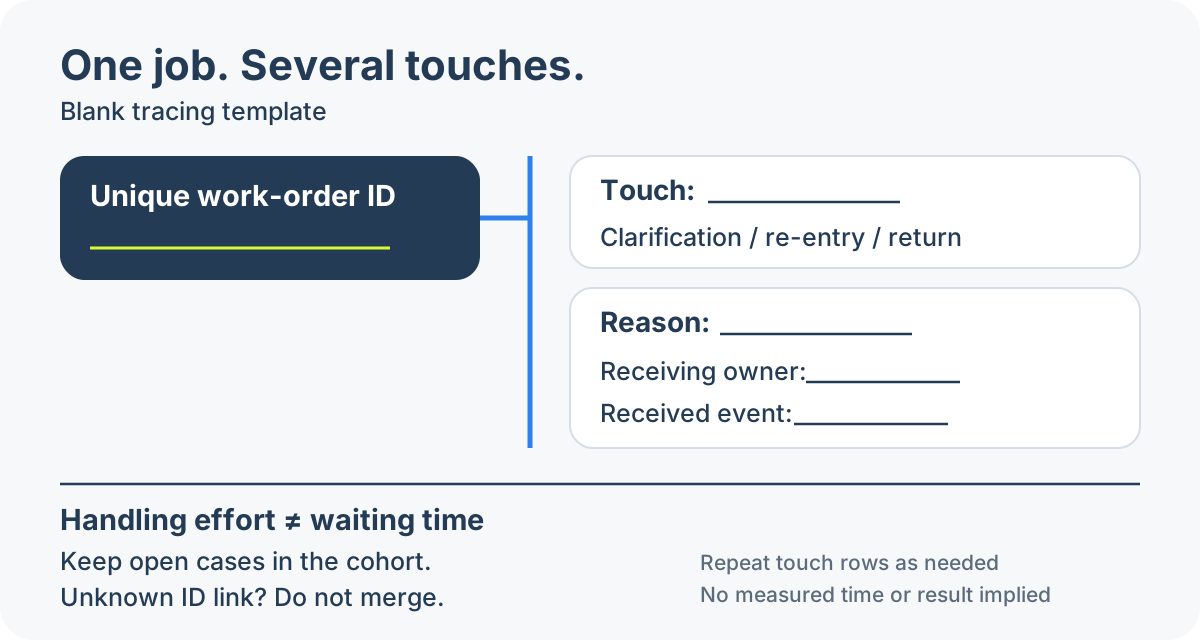
In the template, the cohort is the set of orders you trace (one job type, region and dispatch team), each followed by its own job ID. Handling effort and waiting time are recorded separately, and open cases stay in the cohort. If the link between two records' IDs is unknown, do not merge them.
| Stage | Evidence to collect | Question that exposes repeat work |
|---|---|---|
| Request/intake | Original request, job/customer/site IDs, approved scope reference, missing fields, changes | What must dispatch ask for again before a job can be planned? |
| Planning/work pack | Version received by crew, required fields, owner-approved constraints and instruction references | Does everyone work from the same accepted version? |
| Work execution | Acknowledgment, recorded changes, exceptions, responsible supervisor | Which updates require re-entry or another phone call? |
| Proof submission | Required report/evidence references, upload and receipt events, missing items | Has evidence arrived, or merely been sent? |
| Completion acceptance | Authorized reviewer, decision, returned reason, outstanding work | Which authorized reviewer decides that the work meets the agreed completion requirements? |
| ERP/invoice handoff | Accepted completion reference, required commercial fields, ERP validation result, finance owner | What is still missing before finance can treat the record as invoice-ready? |
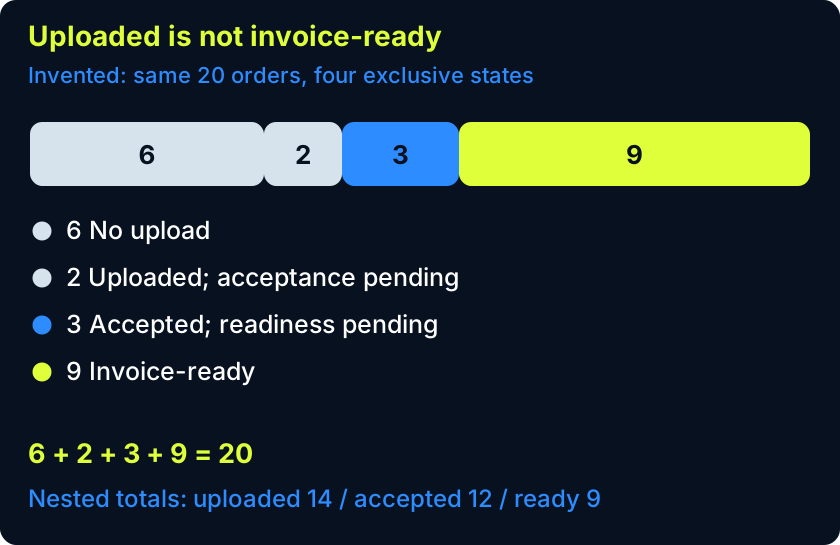
An invented example: the “done” count overstates the flow
Invented 20-order snapshot: 14 have uploaded evidence, 12 have accepted completion and 9 are invoice-ready. A board calling uploaded “done” would show 14/20 while only 9 are ready for finance. The mutually exclusive states are 6 without upload, 2 uploaded awaiting acceptance, 3 accepted awaiting readiness and 9 ready: 6 + 2 + 3 + 9 = 20. Nested totals, 14 = 2 + 3 + 9 and 12 = 3 + 9, answer different questions. These counts illustrate the method and are not a benchmark.
Diagnose the existing setup before proposing a new platform
Ask the operations owner and existing FSM provider to reproduce the mapped gap on permitted orders. Compare supported configuration, missing identifiers and interface behavior before considering a new platform.
The first check depends on job types, regions, systems and whether the same job ID survives the handoffs. A small service or a supported FSM configuration may need configuration help rather than an adviser mandate.
Choose the next bounded check
Follow one job ID through the state map and inspect returned or waiting work before buying capacity. Use the field-service fit-gap comparison for the next-stage options and the proposed accepting role at each boundary, and the CTO adviser mandate if technical ownership remains open. The curator is the route to discuss relevant experience.
Boundaries
Operations and domain owners retain dispatch rules, skills, SLA, safety and authorization constraints; finance owns the invoice endpoint. The 20-order snapshot is invented.
Grand Rounds is an initiative of Dinarys, and a conversation may lead to cooperation with Dinarys.