
Adding clinical advice to a health app looks like an integration task. It is first a decision about what the product claims to do. If the new feature turns general information into a recommendation based on one person's symptoms, the benefit you are weighing may no longer sit inside the purpose and evidence you have documented.
Short answer. As a working rule, the proposed benefit is still inside the documented purpose only when the written purpose, the evidence you hold and the app's own wording already cover the new user, setting, input, output and resulting action. If any of those changes, treat it as a claim change. Complete the before/after intended-purpose and claim-to-evidence sheet below, and route what you cannot settle, above all the classification question, to a qualified regulatory specialist before you commit build time or promise the feature to a partner.
This page is for a HealthTech founder extending an existing app and covers Great Britain only. It is not a classification guide and does not say whether any product is a medical device. The sheet is a planning aid, not an official form.
What is the health product now claiming it is for?
Start from what the product says, not from what the team meant. The MHRA guidance on crafting an intended purpose (published 22 March 2023, read on 18 November 2026) defines intended purpose as "the use for which the device is intended according to the data supplied by the manufacturer", read objectively from labeling, instructions and promotional materials. It is written for manufacturers of software as a medical device. Whether it applies to your app is one of the questions to refer, so this page borrows only its way of describing a purpose.
Table 1. The sheet: ask each question twice, for today's product and the proposed one
| Field | Question |
|---|---|
| Claim wording | What do our materials say the product does? |
| Intended user | Who uses it, and in what role? |
| Population | For whom, and who is excluded? |
| Setting | Where: home, clinic, with or without a clinician? |
| Input | What data about the person goes in? |
| Output | What comes back, and how specific is it to one person? |
| Resulting action | What might the person do next because of it? |
| Foreseeable harm | What goes wrong if the output is wrong or misread? |
| Evidence held | What shows the claim holds for this user and setting? |
| Gap, owner, next step | What is not covered, who owns it, what happens next? |
Before filling it in, collect these. Where a record does not exist, write "unknown", not an assumption.
- Every surface that makes a claim: store listing, website, onboarding, in-app text, partner one-pagers.
- The evidence behind today's claim: content review records, user testing, validation, incident logs.
- The spec for the new feature: inputs, rules or model, outputs, what the user is told to do.
- Any hazard or risk log. If none exists, write "none".
- The named product owner and clinical reviewer. If nobody is named, that is your first gap.
Check wellness information against a changed medical intended purpose
Table 2 is a completed example for an invented app, Calm Notes. It is illustrative: it is not a client case and has no results. Today the app offers sleep and stress articles reviewed by a clinician editor, and a mood diary. The proposed feature asks the user to type in symptoms and returns a suggestion about what to do next.
Table 2. Illustrative completed sheet (invented app)
| Field | Before: information | After: proposed advice | Existing evidence covers it? |
|---|---|---|---|
| Claim wording | "General sleep and stress information" | "Tells you what to do about your symptoms" | Before: for article accuracy. After: not shown |
| Intended user | Any adult reader | Adult entering their own symptoms; a carer may enter someone else's | Carer use not assessed |
| Setting | Home, self-directed | Home, no clinician at the moment of use | Not tested at point of use |
| Input | A mood score | Free-text symptoms, duration, diary | Not applicable |
| Output | The same article for everyone | A suggestion specific to the individual | Not tested |
| Resulting action | User reads | User waits, self-treats or books an appointment | Not tested |
| Foreseeable harm | Reading general content | Missed warning sign; false reassurance; delayed care | No hazard entry |
| Open classification question | Not raised | Does the new purpose need assessment, and by what route? | Referred; no answer here |
| Owner, next step | Content lead | Product owner sends the sheet to a regulatory specialist before build | Open |
What a documented career adds at this step
The profile of Berkan Sesen is career evidence for two mechanisms in this sheet. One is pairing a builder with a clinical owner on the same product: from 2024, co-founding Recallify, a memory and learning app built with an NHS neuropsychologist as clinical co-founder. The other is evaluating clinical AI output: an Oxford DPhil in AI and Medical Informatics and recent publishing on evaluating retrieval-augmented language models in clinical use. For your sheet, that suggests asking who reviewed the clinical content of each output, and whether that person sat inside the product team.
This is career work, not a Grand Rounds engagement. It does not show that any product is or is not a device, and it establishes no approval, certification or regulatory result. It is not evidence about your app.
Map advice, users, inputs and product claims
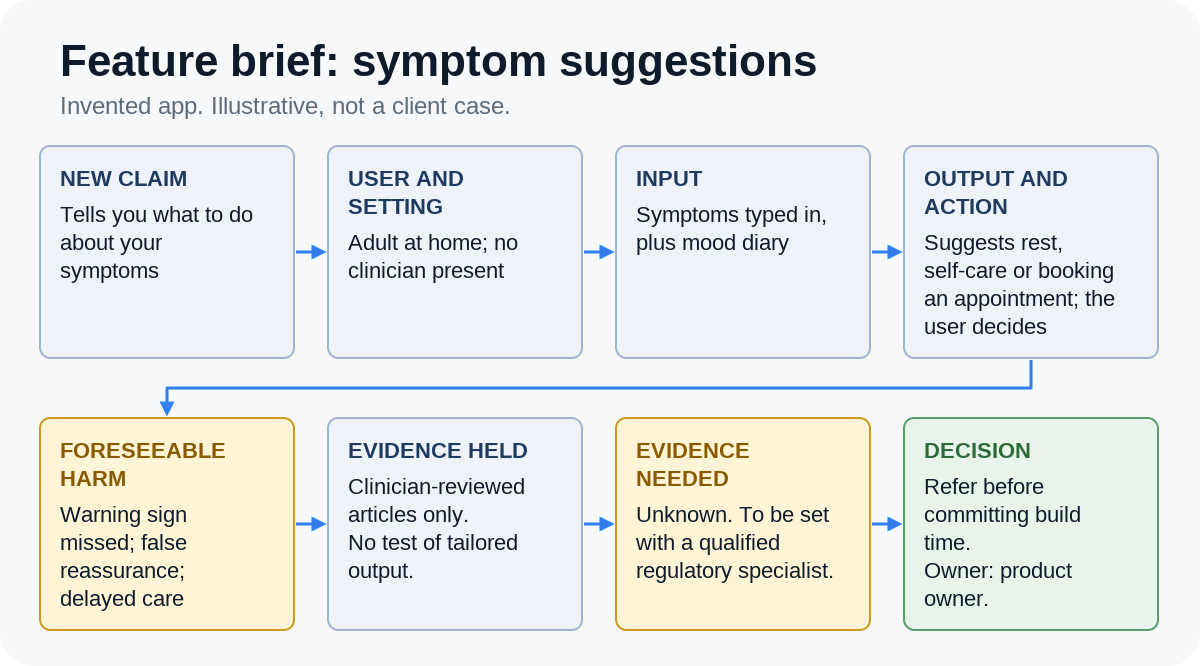
Reading Table 2. The review of articles shows the content was checked. It does not show that tailored suggestions are safe for people who type in symptoms, so the earlier evidence does not automatically cover the new claim. Two items stay open: whether carers are in scope, and the classification question. Nothing in Table 2 says the new feature is, or is not, a medical device.
Read the diagram from top to bottom. Each box should trace to a claim line and an evidence line. Three checks:
- Same words everywhere. If the store listing says "wellbeing information" while a new screen says "what to do about your symptoms", an objective reader of your materials is likely to take the second as the claim.
- The user is not always the patient. The MHRA page notes that the patient population may differ from the user population. Record a carer, parent or clinician as a separate user, with their own setting.
- Can the claimed performance be tested? The MHRA page treats this as a key test: if clinical evidence or a trial could not demonstrate the claim, the purpose is likely inappropriate. "Tells you what to do about your symptoms" is broad. A narrower claim, such as suggesting whether an adult with a named condition should book an appointment, may be easier to test. The page says vague wording may be read as needing a larger evidence base, and that greater specificity is "generally a simpler and safer approach".
The unresolved exception in this example is the softest output, "consider booking an appointment". It still changes what a person does next. Whether a gentler suggestion is treated differently is not for the product team to assume. It goes on the referral list.
Use the current MHRA boundary and accountable review
The MHRA intended-purpose page lists four elements of a purpose: structure and function of the device, intended population, intended user and intended use environment. Table 1 follows those, adding claim wording, harm and evidence. The page also describes "function creep": updates that add functions which drift from the original purpose while the evidence does not keep pace, so that added functionality needs further evidence and risk assessment.
It also states that extending the intended purpose and change management are outside its scope. Do not treat it as the process for extending a purpose. It describes how to write one.
The wider MHRA page, Medical devices: software applications (published 8 August 2014, last updated 1 July 2023, read on 18 November 2026), links the main guidance on stand-alone software and apps, with appendices that include symptom checkers. We could not read that PDF, so nothing here relies on it. Ask your specialist to work from the current version.
Accountability in this example:
- Product owner: claim wording on every surface; the decision to proceed, narrow or stop.
- Clinical reviewer: foreseeable harm and the clinical content of outputs.
- Engineering lead: what the system actually does with which inputs, and change control.
- Qualified regulatory specialist: the classification question and the evidence route.
The Grand Rounds page CTO for Healthtech & MedTech states that clinical acceptance stays with its owners and gives no clinical validation or regulatory approval. Choosing a CTO for a Clinical AI Pilot Without Vague Compliance Claims makes the same separation for a CTO's technical work.
Record the claim change and the expert's limited role
Keep one versioned record for each claim change, so a later reader can see what was decided and on what evidence:
- Date and version, and the person who approved the wording.
- The old and new claim text, and every surface where it changed.
- The evidence references behind each field of the sheet.
- Open questions, the specialist they were sent to and the date.
- The decision: proceed, narrow, gather evidence or stop.
The technical side of this is where an adviser's input would sit: what the feature does, how to test whether a claimed performance figure is real, and how to evaluate outputs with clinicians. The Sesen profile lists questions such as "We're moving from research into a regulated or high-stakes environment. How do we validate it properly?" as typical decisions. That is the limit of the role. An adviser is not a regulatory authority. Their background is no proof that your app is a device or is exempt, and no Grand Rounds medical-device certification result is established.
Decide the next evidence step before expanding clinical claims
Table 3. What the sheet shows, and the next step
| What the sheet shows | Next evidence step | Owner |
|---|---|---|
| Every "After" field matches "Before", and evidence is on file | Record the check; continue normal release review | Product owner |
| "After" differs; evidence covers only the old claim | Do not commit build or partner promises; refer the sheet; decide with the specialist whether to narrow the claim or gather new evidence | Product owner, regulatory specialist |
| "After" fields are unknown | Finish discovery first: inputs, user, setting, action | Product and engineering leads |
Narrowing is a real option, but it has to be real. The purpose is read from labeling and promotion, so every surface must change, not only the model prompt. Whether a narrowed version still leaves a classification question is also for the specialist.
When the claim is settled and you move to integration, How Should a Clinical AI Documentation Product Connect to the EHR? covers the EHR boundary for a documentation product. If your product also has hardware or firmware, Repair, Replace or Change? The Next Test Iteration After a MedTech Field Failure covers what to change after a field failure. If clinicians reject the output after release, Is It the Model or the Handoff? Trace Where a Clinical AI Documentation Tool Stops Fitting shows how to trace one action before changing the model.
Next step
This week, fill in the "Before" column of Table 1 from your current store listing, spec and evidence files, and write "unknown" wherever a record does not exist. Then fill in "After" for the proposed feature and mark each field where the earlier evidence does not cover it. Send the sheet to your accountable owner and, for the open classification question, to a qualified regulatory specialist. Hold build commitments and partner promises until that referral has an answer.
Grand Rounds is an initiative of Dinarys, and a conversation may lead to cooperation with Dinarys. If you want a technical second view on one decision about the feature, the page AI Readiness Assessment & Strategy describes an assessment of one AI workflow. It lists no price, and it says domain, legal, security and data approvals stay with their responsible owners. It does not replace the regulatory referral.
Limits of this page
- The MHRA pages were read on 18 November 2026; check the current versions. The intended-purpose page refers to the UK Medical Device Regulations 2002 (as amended) and states no geographic scope. This page is written for Great Britain only and does not cover Northern Ireland rules.
- The stand-alone software PDF could not be read, so no detail from it is used.
- Calm Notes and the entries in Table 2 are invented for illustration.
- Nobody at MHRA or any specialist was contacted. This is not regulatory or legal advice.
- Berkan Sesen's profile is career evidence only.