
A bank, payments firm or other regulated customer has asked what happens if your service fails, and wants your answer in writing. The decision is which recovery, dependency, data-access and exit promises you can actually support, and what has to change before you agree.
The short answer: promise only what you can show evidence for. Sort every request into one of three groups before signing: support now, support after specific work, or narrow or decline. To do that sorting, build one pack of three documents: a service and dependency map, a recovery-evidence index and an exit and export acceptance test. Give every line an owner and a status.
This page uses published regulator guidance to explain why the customer is asking. It does not tell you your own legal obligations: the customer's regulatory duty and your contractual promise are different things, and contract wording belongs with appropriate counsel.
The pack at a glance
| Document | What it answers | Evidence needed before you use it |
|---|---|---|
| Service and dependency map | Which customer process relies on which part of your product, and what that part relies on | Architecture and hosting records, third-party and sub-processor list, the actual customer workflow |
| Recovery-evidence index | For each recovery or continuity promise, which record shows you can keep it | Dated restore-test results, backup configuration, incident runbook, on-call arrangements, past incident reviews |
| Exit and export acceptance test | Whether the customer can get its data out, in a usable form, through an agreed process | A real export run on realistic test data, with the checks the customer will apply |
Every line carries four fields: an owner (a named role, usually in engineering), a status (evidenced, partly evidenced, unsubstantiated, not offered), an exclusion (what the promise does not cover) and a commercial assumption (what the customer must accept or pay for so the promise holds). If you cannot fill a field, the line is not ready to promise.
Which customer service depends on your SaaS?
Start with the customer's process, not your architecture. Your software sits inside a service people depend on, such as onboarding, payment instructions, case handling or reporting. Ask the customer's sponsor or risk contact:
- Which customer service does your product support? Name the workflow, not the department.
- How important is that service to them? A regulated customer classifies the arrangement itself, so you need its classification, not your guess.
- What do they do when your service is unavailable? A manual workaround, a delay, or nothing.
- What data of theirs do you hold?
Then draw the map, one row per component of your product that the workflow uses:
| Component | Customer function | Depends on | If it fails | Owner | Exclusions |
|---|---|---|---|---|---|
| Case database | Case history and audit trail | Managed database service, one cloud region | Customer cannot open or update cases | Head of engineering | Data entered after the last verified backup |
| Notification service | Alerts to the customer's staff | Third-party email provider | Alerts delayed; case database unaffected | Platform lead | Provider-side delivery delays |
Illustrative template. The two rows are not drawn from a customer.
Include the unglamorous dependencies: the login identity provider, the email or SMS gateway, the status page host, any third party feeding data into the workflow, and the people who must be reachable. The row that matters most is often the one your team forgets, such as an export job running on the database it is meant to rescue you from.
Separate the customer's regulatory duty from your supplier commitment
A questionnaire can read as if it were regulating you. Usually it is the customer's own diligence: the customer is regulated, and it remains accountable to its own supervisor for how it depends on you.
The UK Financial Conduct Authority's page on outsourcing and operational resilience (first published 9 January 2020, last updated 14 July 2026, read 17 November 2026) shows how a UK-authorized firm is expected to think. The points that matter to a supplier:
- The page expects a firm to understand and map the people, processes, technology, facilities, information and third parties behind each important business service.
- The page states: "Firms cannot delegate any part of this responsibility to a third party." The customer stays accountable, which is why its questions are detailed.
- Outsourcing generally means a provider performs something the firm would otherwise do itself. The page says buying standard off-the-shelf software should not be considered outsourcing, and that third-party arrangements outside the definition can still fall under the firm's governance and risk-management rules. It treats cloud services used for important business functions as potentially material outsourcing. Which category your product falls into is the customer's call.
- New incident and third-party reporting requirements (PS26/2) were published on 18 March 2026 and take effect on 18 March 2027, according to the page. A customer preparing for them may ask you for more structured incident information.
- A separate regime covers critical third parties whose failure could threaten UK financial stability. Do not assume your company is in that category.
The FCA's FG16/5 guidance on outsourcing to the cloud and other third-party IT (first published 6 July 2016, last updated 18 March 2026) remains relevant, the page says, to firms the FCA authorizes that are not covered by the EBA outsourcing guidelines. Its summary of consultation feedback lists themes including effective access to data, expectations around exit plans, supply chain and sub-contracting, concentration risk, and choice and control over where data is processed and stored. They are plausible diligence questions, not a checklist.
Three consequences for your pack:
- Ask which rules the customer works to. A UK-authorized firm, an EU financial entity (which may cite DORA) and a firm elsewhere ask for different things. Do not volunteer that you are "compliant" with a regime nobody has told you applies.
- Do not call your company FCA-regulated or DORA-certified unless it is, with a source you can show. Serving a regulated customer does not by itself make the supplier regulated.
- Answer the actual question. "Can you restore our data after a database failure, and how do we know?" has an evidence answer. If a clause says you will "comply with" the customer's regulatory obligations, send it to counsel. Supporting the customer's evidence needs is something engineering can reason about; guaranteeing its compliance is not.
Map dependencies, incident ownership and exit arrangements
Extend the map along the timeline of an interruption. The diagram shows five responsibilities, with the question a customer will ask at each and the evidence to attach.
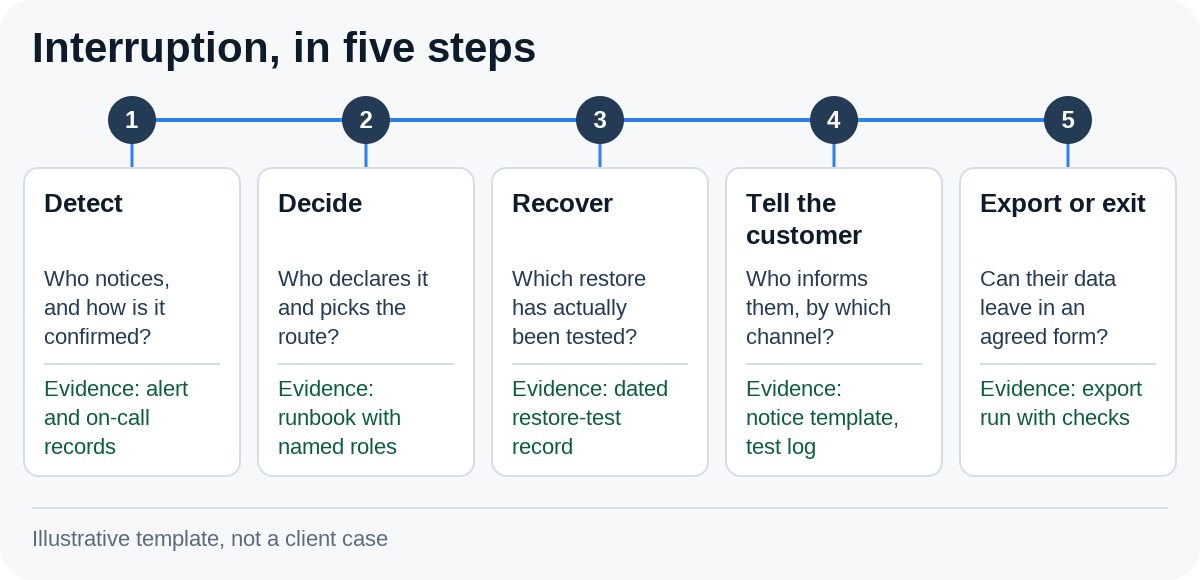
For each step, record the owner and the systems it depends on.
- Detect. Who sees the failure first: your monitoring, the customer, or the customer's customer? Name the on-call person and the alerting tool.
- Decide. Who declares an incident, chooses between failing over and restoring, and approves what the customer is told? In a small company that is often one person, so name a deputy. GR network expert Neil Catton's profile lists leading the "Get to Green" recovery of multiple SLA failures for a major government client while at Fujitsu. That is self-reported career information, not a Grand Rounds engagement, with no figures or outcomes. It suggests asking any candidate who decided, who held the incident record and what the client accepted.
- Recover. Which route applies to which failure: restore from backup, regional failover, release rollback? Each needs its own evidence.
- Tell the customer. Who informs them, through which channel, and does that channel depend on the system that failed? A status page on the same infrastructure is a common weak point.
- Export or exit. If the customer has to leave, mid-incident or at contract end, what happens to its data and who does the work?
A step with no owner today is the finding.
Test recovery and continuity against the stated commitment
A recovery plan is a document. A restore test is an event with a result. A customer's risk team can rely only on the second.
Build the recovery-evidence index with one row per promise:
| Promise the customer wants | Evidence that would support it | Evidence held today | Status | Owner |
|---|---|---|---|---|
| Restore the case database after a failure | Dated restore test on realistic data, with time taken and what was checked afterwards | None yet | Unsubstantiated | Head of engineering |
| Tell the customer promptly about a significant incident | Notification procedure, contact list, a test of the channel | Draft procedure, no test | Partly evidenced | Platform lead |
| Return customer data on exit | Export run reviewed by the customer | Not yet run | Unsubstantiated | Product lead |
Three rules keep the index honest:
- A backup is not a restore. Backups running is not evidence you can recover from them within any particular time.
- Date and scope matter. A test on a different architecture two years ago supports very little. Record when, what it covered and what has changed since.
- Measure before you quote. Do not write a recovery time or recovery point figure into a contract or questionnaire unless a test or other measured record supports it. Otherwise say you will measure it by a stated date.
Worked example (illustrative)
It is not a customer case, and no results are implied.
A supplier questionnaire says the supplier will restore the case service after a database outage "within the period agreed in the contract". The customer's case handling stops if the database is unavailable. The period in the draft contract is blank, and the supplier has never run a restore test.
- Map. The case database is the dependency. The export job and the status page rely on the same database or hosting, so if it fails, so do the means of getting data out and of telling the customer.
- Evidence index. The restore promise is marked unsubstantiated, with the head of engineering as owner. The next action is a restore test on realistic non-production data, recording date, scope, time taken and what was checked afterwards.
- Notification and exit. Both are marked unsubstantiated until shown to work while the database is down. The fixes are to move the notification path off it and to run the export once.
- Negotiation. The supplier proposes no figure. It tells the customer the commitment will be agreed once the restore-test result exists, and asks whether the customer wants to witness the test. Only the figure the test supports then enters the contract, with its exclusions and commercial assumptions.
A vague "yes" has become a dated action with an owner.
Explain the actual evidence without a blanket DORA or FCA claim
When a customer asks "are you DORA compliant?" or "are you FCA compliant?", the useful answer is rarely yes or no. It is a short statement of what you can show.
- State what exists. "The latest restore test on our primary database was on [date], covered [scope] and took [measured time]. The record is attached."
- State what does not. "We have not tested regional failover. It is planned for [month] and owned by [role]."
- State what is outside your scope. "Whether our service counts as outsourcing under your policy is for you and your advisers. We can supply evidence for the questions you ask."
- Avoid collective labels. "Meets FCA standards", "DORA ready" and "bank-grade resilience" promise a standard neither side has defined.
Keep a confirmed / not confirmed list at the front of the evidence index: unknowns with owners and dates give a risk team something to check, which blanket assurance does not.
The exit and export acceptance test
Exit is where vague promises show up fastest, and FG16/5's feedback themes include both data access and exit plans. Define the test before signing:
- Scope. What can be exported (records, files, audit logs, configuration) and what cannot.
- Format. Structured and documented, readable by the customer or another provider.
- Run. Who runs the export and how long it takes at realistic volumes.
- Checks. Record counts, relationships, attachments and audit history compared with the source, agreed in advance.
- Service during exit. How long service continues after notice, and what support is included.
- Deletion. What happens to the data afterwards, and how deletion is confirmed.
- Exclusions and costs. What is not included, and what the customer pays for.
Run the test once on realistic non-production data before you sign and record the result in the evidence index.
Scope the service commitment and ongoing operating cost
Every promise has a running cost, and keeping evidence current is the part most easily missed. Before agreeing, list what each commitment requires: repeated restore tests (at an agreed interval and after major architecture changes), on-call cover, incident communication and reviews, monitoring your own providers and updating the map, audit and questionnaire time, and export and exit support when a customer leaves.
Then sort each requested promise:
| Group | Test | Action |
|---|---|---|
| Commit | Evidence exists, is dated and covers the scope; an owner is named; the cost is understood | Put it in the contract with its exclusions |
| Commit after work | Evidence does not exist yet, but a specific, owned, scheduled action will produce it | Agree the action and date; make the commitment conditional on the result |
| Narrow or decline | No evidence is available, or the cost does not fit the commercial terms | Offer a smaller promise or a different service tier, or say no |
The commercial assumptions column carries the rest: what the customer must provide (realistic test data, a named contact), which service tier the promise covers, how many exports or audits are included, and how extra work is handled. Do not put prices in a draft before a real costing. If the customer's demands outrun what the deal will fund, say so early. Enterprise SaaS Readiness: Turn a Security Questionnaire Into Evidence shows how to sort buyer requirements before you commit.
Boundaries and next step
This page is not legal advice, regulatory interpretation or a compliance opinion. It does not say any customer's rules apply to you, or that following this process satisfies a regulator. The FCA pages were read on 17 November 2026; check the current text and your customer's actual rules before relying on them.
The practical next step: fill in one service map and one evidence index for the single customer workflow in question, marking every line unsubstantiated until a record supports it. Then take the unresolved lines to the customer and counsel as a list, not as promises.
For an independent view of what your engineering evidence supports, Grand Rounds describes a separately scoped technology assessment and architecture review. It starts with a bounded written request and a conversation with the curator, and the proposed output is a decision memo separating inspected evidence, assertions and unknowns. It does not provide security, legal or regulatory clearance, and leading any fix needs a separate mandate. If your product sits in a lending workflow, Fintech CTO Consulting for Lending Workflows explains how the curator checks fit first. If you need hands-on leadership rather than a review, Fractional CTO Services: What a Part-Time CTO Covers and When It Fits is the route to discuss a role. Those pages state no price or availability, so assume none.
Related decisions
- Enterprise SaaS readiness: turn a security questionnaire into evidence: the wider questionnaire.
- Your product works but the enterprise buyer still cannot sign: why a deal stalls.
- How to choose a CTO for an enterprise readiness milestone: scoping the person who owns the work.
Grand Rounds is an initiative of Dinarys, and a conversation may lead to cooperation with Dinarys.